 Ferry network
Philippines ferry schedules — every island route & operator
Philippines has 79 ferry routes operated by 15 companies across 74 ferry ports. The average crossing takes about 5h 49m, with the longest running roughly 61h. Major operators include 2GO Travel, Camotes Ferry Services, Cebu Ferries Corporation, Cokaliong Shipping Lines Inc., Evaristo and Sons - Sea Transport Corporation and FastCat. Below you'll find crossing times, operators and timetables for each route.
- 79
- Ferry routes
- 15
- Operators
- 74
- Ports
- 5h 49m
- Avg crossing
About
About ferries in Philippines
Four boats, 7,600 islands, one lifeline
Spread a map of the Philippines on a table and you are really looking at water with land in it — more than 7,600 islands scattered from the Batanes in the north to the Sulu Sea in the south. There is no bridge long enough to stitch that together, so the boat does the stitching. But there is no single kind of Philippine ferry. There are four, and knowing which one you actually need is half the battle. Giant overnight inter-island ships haul you across whole seas while you sleep. Roll-on/roll-off RORO ferries turn the ocean into a driveable highway. Fast craft and catamarans dart between neighbouring islands in an hour or two. And the little wooden outrigger bangka pump-boats putter across the short hops nothing bigger bothers with. Browse every Philippine ferry route to see how the whole web fits together.
Sleeping your way across the sea: 2GO and the overnight ships
2GO Travel is the name most Filipinos say when they mean "the big ferry" — the long-haul overnight ships that link Manila's North Harbor with Cebu, Cagayan de Oro, Iloilo, Bacolod, Zamboanga and beyond. The classic run, Manila to Cebu, is roughly a 22-hour voyage: you board in the evening, eat dinner on deck, wake up somewhere in the Visayas, and dock the next day. These vessels sell berths by the bunk across a whole ladder of comfort — from open fan-cooled economy decks with double-deck bunks, up through air-conditioned tourist and business tiers, to fully enclosed private cabins and staterooms with en-suite showers. Meals are typically bundled into the fare on these longer sailings. Other lines fill out the network: Cokaliong Shipping and Lite Ferries run the Visayas and Mindanao overnight circuits out of Cebu, often at friendlier prices, if with plainer accommodation.
The nautical highway, where buses cross the water
The single cleverest thing about Philippine ferry travel is the RORO system — officially the Nautical Highway, launched in 2003 to let vehicles simply drive on and off across a ramp instead of being craned aboard. It knits Luzon, the Visayas and Mindanao into continuous driveable corridors, and hundreds of RORO vessels now work the connections it spawned. In practice this means a long-distance bus — Ceres, Philtranco, ALPS, Bachelor Express — can board a ferry with you still in your seat, cross a strait, roll off the far ramp and keep driving. Backpackers exploit exactly the same trick with a motorbike or a rented car. Montenegro Shipping Lines and FastCat (the country's catamaran-hulled RORO operator) are the workhorses here, running the short vehicle straits like Batangas–Calapan, Matnog–Allen and Dumangas–Bacolod.
Fast craft country: the one- and two-hour hops
On the busiest short crossings, speed wins, and this is where the sleek catamaran fast craft take over. Cebu is the undisputed capital of them — from its piers, OceanJet, SuperCat and Weesam Express fire off frequent daily departures to Tagbilaran on Bohol (roughly two hours, though the fastest services trim it well under that), plus runs to Ormoc, Dumaguete, Siquijor and Tagbilaran's smaller neighbours. Over in the Western Visayas, the Iloilo–Bacolod dash across the Guimaras Strait is a fast-craft duel between OceanJet, Weesam and Montenegro, with the quickest boats crossing in about an hour. Fast craft usually offer just two or three seating classes — an open-air deck and an air-conditioned cabin — and no vehicle deck. They are the everyday commuter option, not the scenic cruise.
| Ferry type | Best for | Feel of it |
|---|---|---|
| Overnight inter-island (2GO, Cokaliong, Lite) | Long hauls like Manila–Cebu | Bunks to cabins, meals aboard, sleep through it |
| RORO / nautical highway (Montenegro, FastCat) | Crossing with a car, bike or bus | Drive on, drive off; road trips that don't stop at the coast |
| Fast craft / catamaran (OceanJet, SuperCat, Weesam) | Busy short routes, Cebu–Bohol, Iloilo–Bacolod | Quick, frequent, air-con or open deck |
| Bangka pump-boat | Island-hopping, remote short hops | Wooden outrigger, open air, salt spray |
The little wooden boats that go where ships can't
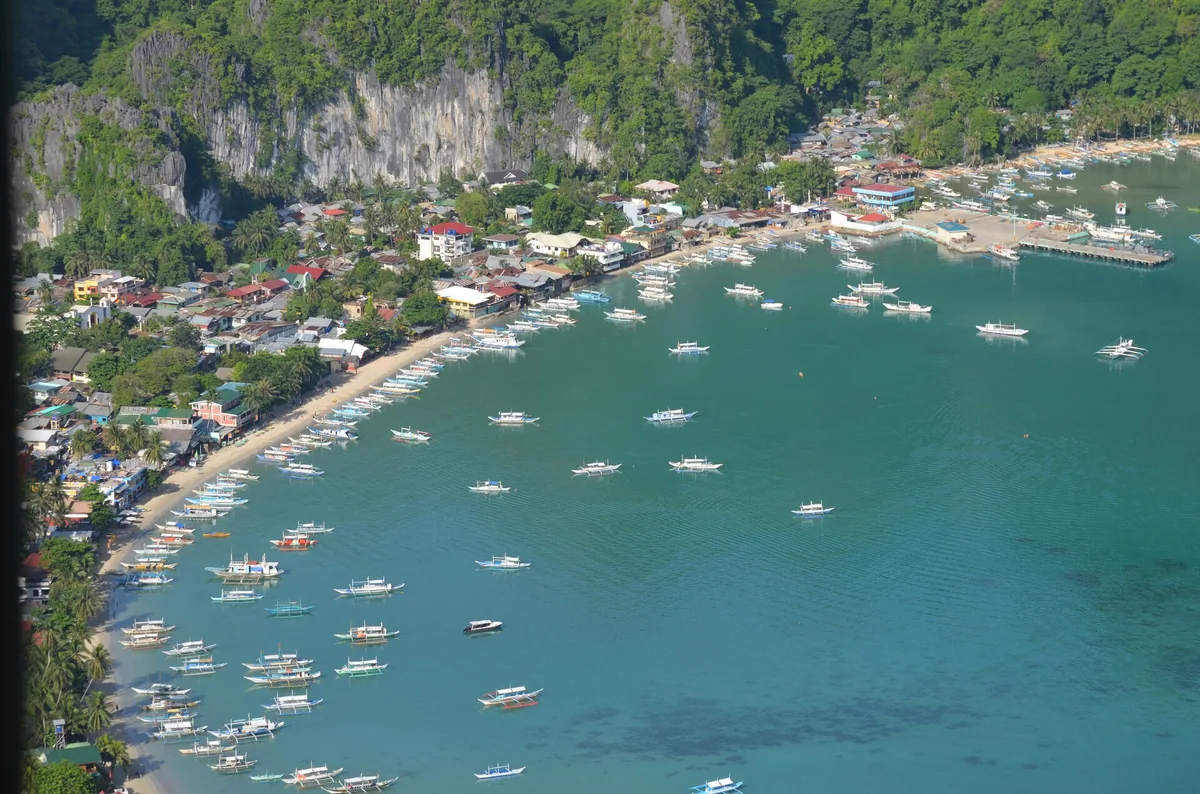
For the last mile — the beach with no pier, the sandbar, the island too small for a schedule — you take a bangka. These narrow wooden hulls braced by bamboo outriggers are the country's true workhorse, doubling as fishing boat, cargo hauler and island-hopping taxi. In El Nido, Coron and Honda Bay a chartered bangka is how you reach the lagoons; on countless local runs it is simply the ferry, boarded off the sand with your shoes in your hand. There are no cabins and rarely a printed timetable — you turn up, you pay the boatman, you go.
Typhoons, tickets and turning up
One thing shapes every Philippine sailing between roughly June and November: the weather. When a storm approaches, PAGASA issues gale warnings and the Philippine Coast Guard suspends departures — smaller vessels and bangkas first, then the bigger ships if conditions worsen — and boats do not move until it is declared safe again. Suspensions can strand hundreds of passengers at short notice, so in storm season build slack into your plans and check with your operator before heading to the pier. Tickets are sold three ways: at the terminal window, through travel agents, and increasingly online — 2GO, OceanJet, FastCat and aggregators all sell digital tickets now. For popular fast-craft slots and holiday sailings it pays to secure a seat ahead; for a bangka hop you simply walk down to the water. You can compare every Philippine ferry route to plan the chain of boats your trip needs.
What Philippine ferry tickets cost
Philippine ferry fares split cleanly into two worlds. The short island crossings that stitch the Visayas together are astonishingly cheap — Cebu City out to Lapu-Lapu is around ₱35, and the Dumaguete–Oslob and Sibulan–Liloan hops across to Cebu about ₱130 — and you simply pay at the pier. At the other end sit the long inter-island voyages, like 2GO’s multi-day Manila–Cebu sailings, where an economy “tourist” berth costs far more and a private cabin more again. Between the two, the fast craft (air-conditioned, reserved seats) always cost more than the RORO on the same water, buying you an hour or two rather than sea breeze on an open deck.
Two things shape the final figure. Craft: an open-deck RORO economy seat is the floor, a fast-craft aircon seat costs more, and a 2GO cabin on the long hauls costs the most. Vehicles: only RORO ferries take cars and motorbikes, and they are ticketed on top of your own fare — a motorbike is modest, a car a real line item. Terminal fees are usually small and paid separately at the port.
| Crossing | From (one-way) | Typical time |
|---|---|---|
| Cebu City → Lapu-Lapu | ₱35 | 30m |
| Dumaguete → Oslob | ₱130 | ~1h |
| Sibulan → Liloan | ₱130 | 25m |
| Ormoc → Camotes Island | ₱150 | 2h |
| Zamboanga → Isabela | ₱198 | ~1h 30m |
| Iligan → Ozamiz | ₱230 | 2h |
Operators
Which companies run ferries in Philippines?
- 2GO Travel
- Camotes Ferry Services
- Cebu Ferries Corporation
- Cokaliong Shipping Lines Inc.
- Evaristo and Sons - Sea Transport Corporation
- FastCat
- Lapulapu Shipping Lines
- Lite Ferries
- Maayo Shipping Inc
- Metro Ferry
- Montenegro Shipping Lines
- OceanJet
- Roble Shipping, Inc.
- Starhorse Shipping Lines
- SuperCat Fast Ferry Corporation
Regions
Ferry regions in Philippines
Coastal travel is local — jump to a region for its routes, quays and timetables.
Ports
Ferry ports in Philippines
74 ports with published ferry connections. Open a port for every route that departs or arrives there.
- Cebu21
- Dumaguete11
- Batangas9
- Manila9
- Caticlan6
- Siquijor6
- Tagbilaran6
- Cagayan de Oro5
- Iloilo5
- Davao City3
- Dipolog3
- General Santos3
- Jagna3
- Masbate3
- Nasipit3
- Ormoc3
- Allen (Dapdap)2
- Banago (Bacolod)2
- Bato2
- Bulalacao2
- Calapan2
- Dapitan2
- Dumangas2
- Getafe2
- Liloan2
- Matnog2
- Odiongan2
- Palompon2
- Pilar2
- Romblon2
- Roxas (Oriental Mindoro)2
- Sibulan2
- Surigao2
- Talibon2
- Tampi2
- Tubigon2
- Zamboanga2
- Abra de Ilog1
- Bacolod (BREDCO)1
- Balanacan1
- Calbayog1
- Camotes Island1
- Camotes Island via Pilar, Kawit, Puertobello, Tudela1
- Cebu city1
- Isabela1
- Lapu Lapu City1
- Larena1
- Lucena1
- Maasin1
- Ormoc via Tudela, Pilar1
- Oslob1
- San Carlos1
- Siargao Island/Dapa1
- Toledo1
- Argao
- Balingoan
- Bogo
- Cabalian
- Castilla
- Coron
At a glance
Which Philippines ferry crossings run most often?
The busiest published crossings, ranked by number of listed sailings.
| Route | Crossing | Sailings | Operators |
|---|---|---|---|
| Cebu city → Lapu Lapu City | 30m | 31 / wk | 1 |
| Cebu → Tagbilaran | 2h | 14 / wk | 4 |
| Tagbilaran → Cebu | 2h | 14 / wk | 3 |
| Sibulan → Liloan | 25m | 13 / wk | 1 |
| Liloan → Sibulan | 30m | 13 / wk | 1 |
| Batangas → Calapan | 2h | 13 / wk | 4 |
| Calapan → Batangas | 2h | 13 / wk | 4 |
| Lucena → Balanacan | 2h | 13 / wk | 2 |
| Cebu → Ormoc | 3h | 8 / wk | 5 |
| Ormoc → Cebu | 3h | 8 / wk | 3 |
| Bato → Tampi | 30m | 7 / wk | 1 |
| Tampi → Bato | 30m | 7 / wk | 1 |
Timetables
What ferry routes run in Philippines?
79 routes across the network.
79 routes
FAQ
Frequently asked questions
How long is the ferry from Manila to Cebu?
The 2GO Travel overnight ship between Manila's North Harbor and Cebu City takes roughly 22 hours. You board in the evening, sleep aboard and dock the following day. Meals are usually included on this long sailing, and accommodation ranges from fan-cooled economy bunks to private air-conditioned cabins.
What is a RORO ferry in the Philippines?
RORO stands for roll-on/roll-off. Instead of cranes lifting cargo, buses, cars, motorbikes and trucks drive straight onto the ship over a ramp, park on the vehicle deck, and drive off the other side. It is the backbone of the Nautical Highway, launched in 2003 to let roads effectively continue across the sea between Luzon, the Visayas and Mindanao.
Can I bring my car or motorbike on a Philippine ferry?
Yes, on RORO ferries. Operators like Montenegro Shipping Lines and FastCat run vehicle decks on straits such as Batangas–Calapan, Matnog–Allen and Dumangas–Bacolod. You drive on, ride across and drive off, which makes self-drive island-hopping by car or motorbike entirely possible. Fast craft catamarans, by contrast, carry passengers only.
What are 2GO's cabin classes like?
2GO Travel sells berths by the bunk across a ladder of tiers. The cheapest are open economy decks with double-deck bunks and fans; mid-range tourist and business classes add air-conditioning and more comfortable berths; and at the top are enclosed private cabins and staterooms with lockable doors and en-suite showers. On longer sailings the fare typically includes meals.
How do I get from Cebu to Bohol by fast ferry?
Fast craft operators OceanJet, SuperCat and Weesam Express run frequent daily departures from Cebu's piers to Tagbilaran on Bohol. The crossing is roughly two hours, though the quickest services are faster. OceanJet offers the most departures through the day, giving you flexibility if you miss one.
Are Philippine ferries cancelled during typhoons?
Yes. Between roughly June and November, when PAGASA issues gale warnings, the Philippine Coast Guard suspends sailings — small boats and bangkas first, then larger ships if the storm intensifies. Departures resume only when authorities declare it safe. Always check with your operator before heading to the port in storm season.
Is ferry travel in the Philippines safe?
Major operators run modern vessels and the Coast Guard actively suspends sailings in bad weather, which is the single biggest safety factor. Travel with reputable lines, avoid boarding overloaded boats, heed suspension notices, and know where the life jackets are. Overnight ships and licensed fast craft are the safest tiers; be more cautious with informal small-boat hops in rough seas.
What is the cheapest way to travel between Philippine islands by boat?
For long hauls, the open economy or 'super value' bunk decks on overnight ships from 2GO, Cokaliong or Lite Ferries are the most economical. For short crossings, the open-air deck class on a fast craft is cheaper than the air-conditioned cabin. Local bangka hops are often the cheapest of all for very short distances.
What is a bangka and when would I use one?
A bangka is a narrow wooden boat braced with bamboo outriggers — the traditional Filipino pump-boat. You use one for island-hopping tours and short hops to places too small or remote for scheduled ferries, such as the lagoons of El Nido and Coron or beaches with no pier. There are no cabins; you board off the sand and pay the boatman.
Can I take a bus across the sea in the Philippines?
Yes, thanks to the RORO Nautical Highway. Long-distance bus companies like Ceres, Philtranco, ALPS and Bachelor Express drive their coaches onto RORO ferries with passengers still aboard, cross the strait, and continue on the far side. It lets a single bus ticket carry you across islands without changing vehicles at the coast.
How long is the Iloilo to Bacolod ferry?
The fast-craft crossing over the Guimaras Strait between Iloilo City and Bacolod takes about an hour on the quickest boats. OceanJet, Weesam Express and Montenegro Lines all run daily departures on this busy route, one of the shortest and most frequent inter-city ferry hops in the country.
Can I book Philippine ferry tickets online?
Increasingly, yes. 2GO Travel, OceanJet, FastCat and various booking aggregators sell digital tickets, so you no longer have to queue at a terminal window. Tickets are still also sold at the pier and through travel agents. For popular fast-craft slots and holiday sailings, booking ahead is wise; for a bangka hop, you simply turn up.
Do I need to book ferries in advance in the Philippines?
For busy fast-craft routes like Cebu–Bohol, overnight cabins on 2GO, and any travel around holidays or long weekends, booking ahead secures your seat and class. On quieter routes and everyday RORO crossings you can usually buy at the terminal. Bangka island-hopping needs no advance booking at all.
What's the difference between a fast craft and a RORO ferry?
A fast craft is a passenger-only catamaran built for speed on short, busy routes — think Cebu–Bohol or Iloilo–Bacolod in an hour or two, with just open-air and air-conditioned seating. A RORO carries vehicles and buses on a drive-on vehicle deck and is slower, prioritising cargo and cars over speed.
Which ports are the main ferry hubs in the Philippines?
Manila's North Harbor is the hub for long-haul overnight ships. Cebu is the great fast-craft capital, fanning out to Bohol, Dumaguete, Siquijor and beyond. Batangas is the gateway to Mindoro and the western islands, while Iloilo and Bacolod anchor the busy Western Visayas crossings. Matnog in southern Luzon is the key RORO gateway to Samar and Mindanao.
How much do ferries cost in the Philippines?
Short island crossings are very cheap — Cebu City to Lapu-Lapu is around ₱35, and Visayas hops like Dumaguete–Oslob or Sibulan–Liloan about ₱130. Longer routes cost more, and the multi-day 2GO sailings from Manila to Cebu run into the thousands of pesos once you add a cabin. Fast craft always cost more than the open-deck RORO on the same crossing.
Is it cheaper to take a RORO or a fast craft in the Philippines?
The RORO is almost always cheaper. It is slower and more exposed, but on short Visayas hops it can cost a fraction of the air-conditioned fast craft for only an extra half-hour or so at sea. Fast craft earn their premium on longer legs and when the weather turns rough.
Do I pay extra to bring a vehicle on a Philippine ferry?
Yes. Only RORO ferries carry vehicles, and the car or motorbike is ticketed separately from your passenger fare. A motorbike is a modest add-on, but a car is a real line item — so island-hopping on foot and using jeepneys or tricycles at the other end is usually cheaper.
Explore
Ferries in other countries


























Reviewed by Serhat Özçelik, Founder & Editor of Ferry Schedule Hub · Last updated August 2, 2026.