 Ferry network
Denmark ferry routes & schedules — island & Øresund crossings
Denmark has 29 ferry routes operated by 5 companies across 34 ferry ports. The average crossing takes about 10m, with the longest running roughly 3h 45m. Major operators include Color Line, Movia, NT, Svendborg Havn, Færge- og Sundfart and Ærøfærgerne. Below you'll find crossing times, operators and timetables for each route.
- 29
- Ferry routes
- 5
- Operators
- 34
- Ports
- 10m
- Avg crossing
About
About ferries in Denmark
Denmark is really an archipelago wearing the clothes of a mainland country: over four hundred islands, a long Jutland peninsula and a capital that sits on an island itself. Even after an ambitious bridge-building era — the Great Belt and Øresund crossings among them — ferries remain woven into everyday Danish travel, from two-minute harbour shuttles to full-scale international crossings, and Danes treat them less like an event and more like a bus that floats.
Domestic lifelines and fast catamarans
The marquee domestic corridor is the Kattegat, where Molslinjen's fast catamarans sprint between Aarhus and Sjællands Odde in about an hour and twenty minutes, tying Jutland to Zealand and competing directly with the road route over the Great Belt Bridge. It is one of the busiest car-ferry runs in the country, with dozens of daily departures in summer aboard some of the world's largest high-speed catamarans. A seasonal sister route links Ebeltoft with Odden. Because these are car-carrying express boats that can sell out, advance online booking is the norm rather than the exception.
Crossing to Germany: Scandlines
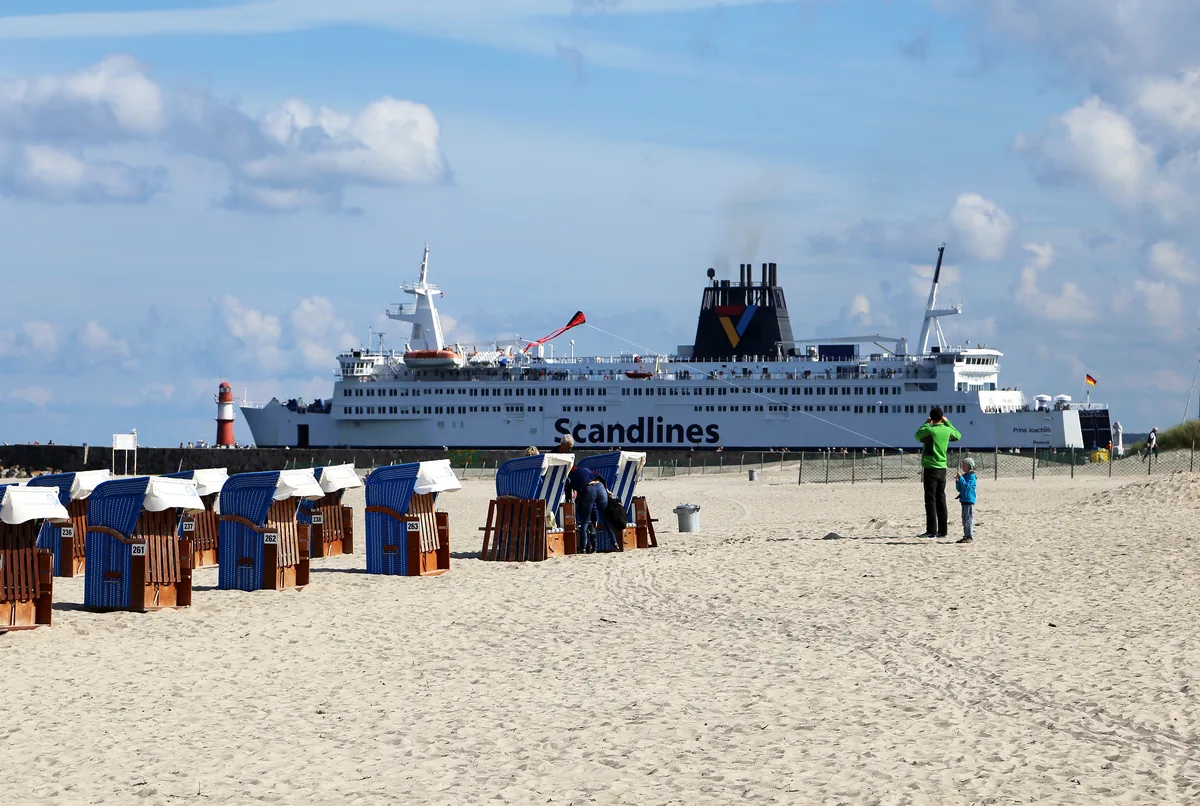
Denmark has long been the hinge between Scandinavia and the Continent, and the shortest hop south is Rødby–Puttgarden, a 45-minute Scandlines crossing that runs every half-hour by day and hourly through the night, 365 days a year. Its modern hybrid ferries even carry EV fast-charging lanes so electric cars can top up during the sailing. Further east, Gedser–Rostock takes just under two hours on the large hybrid ships Berlin and Copenhagen. On both routes you can simply turn up and buy at the terminal, though booking online is cheaper and wiser at peak times.
The Øresund shuttle to Sweden
Between Helsingør and Helsingborg, the narrowest point of the Øresund, a ferry crosses to Sweden in about 20 minutes, every 15 minutes by day and around the clock. The route (now branded Øresundslinjen, formerly ForSea and HH Ferries) runs the battery-electric ships Tycho Brahe and Aurora af Helsingborg, among the largest all-electric ferries in the world. There is no need to book — you drive up and pay at the gate — and it carries a heavy flow of Øresund commuters who use frequent-traveller cards.
Getting to Bornholm
The Baltic island of Bornholm sits closer to Sweden than to the rest of Denmark, so the fastest way there is Bornholmslinjen's fast ferry from Rønne to Ystad in Sweden, about an hour and twenty minutes, timed to connect with buses and trains from Copenhagen. A longer, slower crossing runs Rønne–Køge on Zealand in roughly five and a half hours. Bornholmslinjen (a Molslinjen brand) runs the route under a state tender, and summer car slots should be booked well ahead — the island fills up in July.
The small-island ferries and the "road principle"
Around Denmark's coasts, some twenty-seven small inhabited islands are served by mostly municipally run ferries, and their fares are shaped by a distinctive Danish policy called the landevejsprincippet, or "road principle": the idea that sailing a kilometre by ferry should cost about the same as driving a kilometre by road. In practice, subsidised discount periods flatten fares so that everyone pays the same regardless of age or island residency, with children under three travelling free and those aged four to fifteen at half price. In recent years the state has funded moves to extend this pricing across the whole year, and past summers have seen campaigns making the small-island ferries free for foot passengers and cyclists — worth checking the current season's offer before you travel.
Reaching Samsø, Ærø, Fanø, Læsø and Anholt
Each holiday island has its own crossing. Samsø is reached from Kalundborg to Ballen (about 1h20, Molslinjen) or Hou to Sælvig (about an hour, run by the municipal Samsø Rederi). Ærø is served by the municipal Ærøfærgerne from Svendborg to Ærøskøbing in around an hour, and the island also runs Ellen, one of the world's largest all-electric ferries. Fanø is a 12-minute shuttle from Esbjerg to Nordby, frequent enough that you just turn up. Læsø is a 90-minute sailing from Frederikshavn, and Anholt, far out in the Kattegat, is about three hours from Grenaa. The busier island routes, especially Ærø and Samsø in summer, take car reservations that are worth making in advance.
International overnight and long-haul routes
Beyond the short hops, Denmark anchors several longer international lines. DFDS sails an overnight cruise ferry between Copenhagen and Oslo in about 17 hours aboard Pearl Seaways and Crown Seaways, with a departure each evening from both cities. From Hirtshals in northern Jutland, ferries fan out towards Norway, and the Smyril Line links onward to the Faroe Islands and Iceland. Frederikshavn and Grenaa add further Kattegat connections across to Sweden.
How to pay and book
Payment is overwhelmingly digital. On the big car-ferry corridors — the Kattegat catamarans, Bornholm, Copenhagen–Oslo and peak Rødby–Puttgarden — booking online in advance is the sensible default, and Kattegat and Bornholm sailings genuinely sell out in summer. The high-frequency crossings to Germany and Sweden are turn-up-and-go. Denmark's national Rejsekort travel card is accepted on some ferry routes, but many island ferries use their own booking systems, so check the specific route. Bicycles are welcomed almost everywhere, reflecting a country where a bike-and-ferry holiday is a perfectly ordinary way to spend a week.
When to travel
The peak is the July industriferie, when much of the country holidays at once and car slots to Bornholm and Ærø should be reserved weeks ahead. Foot passengers can almost always travel spontaneously. Winter services keep running with Scandinavian punctuality, though the fast catamarans are the first to be cancelled in heavy weather, with conventional tonnage or a road detour as the fallback.
The Fehmarn Belt tunnel
The biggest change on the horizon is the Fehmarn Belt fixed link, an 18-kilometre immersed road-and-rail tunnel under construction beneath the Rødby–Puttgarden crossing. Once open — currently targeted for the end of the decade — it will put Denmark and Germany roughly ten minutes apart by car, and the historic Scandlines ferry is expected to scale back. Until then, the ferry remains the way across.
Where to check timetables
Open the route you are travelling on for its crossing time and operator, then confirm with the operator's own app or website, since departures shift between the summer and winter timetables and fast boats can be weather-dependent. The ferry schedules on this page are reviewed and updated regularly.
Operators
Which companies run ferries in Denmark?
Regions
Ferry regions in Denmark
Coastal travel is local — jump to a region for its routes, quays and timetables.
Ports
Ferry ports in Denmark
34 ports with published ferry connections. Open a port for every route that departs or arrives there.
- Bryggebroen (Islands Brygge)4
- Det Kongelige Bibliotek (Københavns Havn)4
- Enghave Brygge4
- Islands Brygge Syd (Islands Brygge)4
- Knippelsbro (Københavns Havn)4
- Nordre Toldbod (Københavns Havn)4
- Nyhavn (Københavns Havn)4
- Operaen (Københavns Havn)4
- Refshaleøen (Refshalevej)4
- Svendborg Færgehavn3
- Havnepladsen (Frederikshavn Færgeleje)2
- Hirtshals2
- Orientkaj St. (Orientkaj)2
- Skarø Havn (færge)2
- Teglholmen (Teglholmens Sydkaj)2
- Vesterø Færgehavn (Læsø Kommune)2
- Ærøskøbing Havn (færge)2
- Drejø Havn (færge)1
- Fynshav Havn (færge)1
- Søby Havn (Ærø Kommune)1
- Aarhus Havn, Dokk1 (færge)
- Faaborg Havn (færge)
- Frederikshavn
- Gedser
- Havneby (Rømø)
- Helsingør
- Hjortø Havn (færge)
- Hou Havn (færge)
- Marstal Havn (færge)
- Rudkøbing Havn (færge)
- Rødby (Lolland)
- Rønne (Bornholm)
- Rønne Havn (færge)
- Sælvig Havn (færge)
At a glance
Which Denmark ferry crossings run most often?
The busiest published crossings, ranked by number of listed sailings.
| Route | Crossing | Sailings | Operators |
|---|---|---|---|
| Operaen (Københavns Havn) → Nyhavn (Københavns Havn) | 4m | 177 / wk | 1 |
| Nyhavn (Københavns Havn) → Operaen (Københavns Havn) | 4m | 159 / wk | 1 |
| Nordre Toldbod (Københavns Havn) → Refshaleøen (Refshalevej) | 4m | 79 / wk | 1 |
| Operaen (Københavns Havn) → Nordre Toldbod (Københavns Havn) | 6m | 79 / wk | 1 |
| Nordre Toldbod (Københavns Havn) → Operaen (Københavns Havn) | 6m | 78 / wk | 1 |
| Refshaleøen (Refshalevej) → Orientkaj St. (Orientkaj) | 17m | 77 / wk | 1 |
| Enghave → Islands Brygge Syd (Islands Brygge) | 3m | 72 / wk | 1 |
| Det Kongelige Bibliotek (Københavns Havn) → Knippelsbro (Københavns Havn) | 4m | 72 / wk | 1 |
| Islands Brygge Syd (Islands Brygge) → Bryggebroen (Islands Brygge) | 7m | 72 / wk | 1 |
| Knippelsbro (Københavns Havn) → Nyhavn (Københavns Havn) | 7m | 72 / wk | 1 |
| Teglholmen (Teglholmens Sydkaj) → Enghave | 8m | 72 / wk | 1 |
| Bryggebroen (Islands Brygge) → Det Kongelige Bibliotek (Københavns Havn) | 11m | 72 / wk | 1 |
Timetables
What ferry routes run in Denmark?
29 routes across the network.
Bryggebroen (Islands Brygge)2 routes
Det Kongelige Bibliotek (Københavns Havn)2 routes
Enghave Brygge2 routes
Hirtshals2 routes
Islands Brygge Syd (Islands Brygge)2 routes
Knippelsbro (Københavns Havn)2 routes
Nordre Toldbod (Københavns Havn)2 routes
Nyhavn (Københavns Havn)2 routes
Operaen (Københavns Havn)2 routes
Refshaleøen (Refshalevej)2 routes
Svendborg Færgehavn2 routes
Ærøskøbing Havn (færge)1 route
Drejø Havn (færge)1 route
Havnepladsen (Frederikshavn Færgeleje)1 route
Orientkaj St. (Orientkaj)1 route
Søby Havn (Ærø Kommune)1 route
Teglholmen (Teglholmens Sydkaj)1 route
Vesterø Færgehavn (Læsø Kommune)1 route
FAQ
Frequently asked questions
Do I need to book Danish ferries in advance?
For the big car-ferry corridors — Molslinjen's Kattegat catamarans, Bornholm, Copenhagen–Oslo and peak Rødby–Puttgarden — advance online booking is the sensible default and genuinely necessary in summer, when Kattegat and Bornholm sailings sell out. The high-frequency crossings to Germany and Sweden are turn-up-and-go, and foot passengers can almost always travel spontaneously.
How do you get to Bornholm by ferry?
The fastest way is Bornholmslinjen's fast ferry from Rønne to Ystad in Sweden, about 1 hour 20 minutes, timed to connect with buses and trains from Copenhagen. A slower crossing runs Rønne–Køge on Zealand in roughly five and a half hours. Book summer car slots well ahead.
Can you take a car on ferries in Denmark?
Yes on the main corridors — the Kattegat catamarans, the German and Swedish crossings, Bornholm, Copenhagen–Oslo and the larger island routes all carry cars, though vehicle space is booked and charged separately. Some short harbour shuttles are foot-passenger focused, so check the specific route.
Are Danish ferries reliable in winter?
Yes. Winter services keep running with Scandinavian punctuality, but the fast catamarans are the first to be cancelled in heavy weather, with conventional ships or a road detour as the fallback. Check the operator before travelling on a stormy day.
How do I get from Denmark to Germany by ferry?
The short hop is Scandlines' Rødby–Puttgarden, a 45-minute crossing running every half-hour by day and hourly at night, 365 days a year, with EV charging on board. Further east, Gedser–Rostock takes just under two hours on the hybrid ships Berlin and Copenhagen.
How long is the Helsingør–Helsingborg ferry to Sweden?
About 20 minutes across the narrowest point of the Øresund, departing every 15 minutes by day and around the clock. The route (Øresundslinjen, formerly ForSea) runs the battery-electric ferries Tycho Brahe and Aurora af Helsingborg — no booking needed, just drive up and pay at the gate.
Are ferries to the small Danish islands free?
Fares to the small inhabited islands are heavily subsidised under the landevejsprincippet ("road principle"), and past summers have seen campaigns making them free for foot passengers and cyclists. Whether a free-ferry offer applies in a given year varies, so check the current season; children under three always travel free and ages four to fifteen at half price during discount periods.
What is the landevejsprincippet?
It is Denmark's "road principle" for ferry pricing — the idea that sailing one kilometre by ferry should cost about the same as driving one kilometre by road. Subsidised discount periods flatten the fares on small-island routes so everyone pays the same regardless of age or island residency.
How do I get to Samsø?
Two routes serve Samsø: Kalundborg–Ballen takes about 1 hour 20 minutes (Molslinjen), while Hou–Sælvig takes about an hour and is run by the municipal Samsø Rederi. In summer, book a car space in advance.
How do I get to Ærø?
The municipal Ærøfærgerne sails Svendborg–Ærøskøbing in around an hour. Ærø also operates Ellen, one of the world's largest all-electric ferries. Reserve a car slot ahead in the summer season.
How do I get to Fanø?
Fanø is a 12-minute shuttle from Esbjerg to Nordby, frequent enough that you simply turn up rather than book. It is one of the shortest scheduled car-ferry crossings in the country.
Which companies operate ferries in Denmark?
The main operators are Scandlines (Germany crossings), Molslinjen and its brands Bornholmslinjen, Fanølinjen, Samsølinjen and Øresundslinjen, and DFDS (Copenhagen–Oslo and freight). Many small-island routes are run by municipalities, such as Ærøfærgerne, Samsø Rederi and the Læsø and Anholt ferries.
Can I use Rejsekort on Danish ferries?
Rejsekort is Denmark's national travel card and is accepted on some ferry routes as part of the public-transport network, but many island ferries use their own booking systems and fares. Acceptance is route-specific, so check before relying on it.
How do I get from Copenhagen to Oslo by ferry?
DFDS runs an overnight cruise ferry between Copenhagen and Oslo in about 17 hours aboard Pearl Seaways and Crown Seaways, with a sailing leaving each city every evening. Cabins are booked in advance.
How do I find Danish ferry timetables?
Open the route you are travelling on for its crossing time and operator, then confirm with the operator's own app or website, since departures change between the summer and winter timetables and fast boats can be weather-dependent. The schedules on this page are reviewed and updated regularly.
Explore
Ferries in other countries










Reviewed by Serhat Özçelik, Founder & Editor of Ferry Schedule Hub · Last updated October 11, 2026.