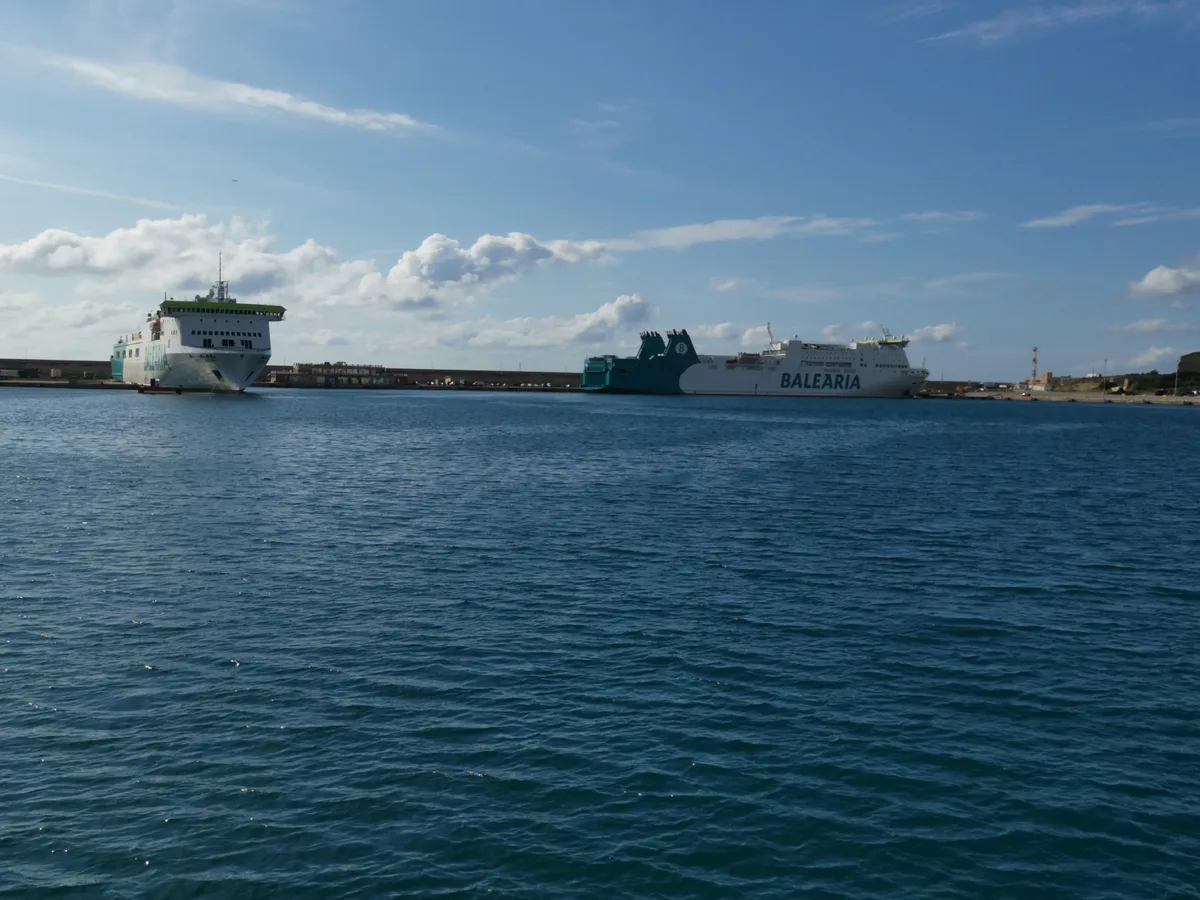
 Ferry network
Spain ferry routes & schedules — Balearic & Canary islands
Spain has 16 ferry routes operated by 8 companies across 38 ferry ports. The average crossing takes about 2h 51m, with the longest running roughly 28h 30m. Major operators include Africa Morocco Link, Baleària, Brittany Ferries, DFDS, Fred. Olsen Express and Grandi Navi Veloci. Below you'll find crossing times, operators and timetables for each route.
- 16
- Ferry routes
- 8
- Operators
- 38
- Ports
- 2h 51m
- Avg crossing
About
About ferries in Spain
Un país, tres mares
Spaniards will tell you their country has one coastline, but that is a cartographer's lie. Spain reaches the islands across three completely different seas, and each one has its own temperament, its own smell, its own idea of what a boat is for. There is the short, glittering Mediterranean that flicks you out to the Balearics before your café con leche goes cold. There is the wide grey-blue Atlantic that swallows a ship for a night and a day on the way to the Canaries. And there is the Estrecho — the Strait of Gibraltar — a sliver of water barely wide enough to see across, yet in August the most emotionally loaded stretch of sea in Europe. Learn to read all three and you understand every Spanish ferry route at a glance.
El mar corto: sun-drunk hops to the Balearics
The Mediterranean run is the flirtatious one. From Dénia, a modest Valencian port with a castle and a fish market, a Baleària fast catamaran throws itself across to Ibiza in roughly two and a quarter hours — the shortest hop from the peninsula, and the one locals use like a bus. Barcelona and Valencia play the longer game: their sailings to Mallorca, Menorca and Ibiza often go overnight, so you sleep your way over and wake to limestone cliffs. Baleària is the dominant name here, though it rarely has the sea entirely to itself.
Then there is Formentera, the flat white island with no airport, which is why the little boats matter so much. You reach it almost exclusively as a foot passenger, hopping from Ibiza on the frequent Trasmapi and Aquabus shuttles — a half-hour skip across turquoise shallows, dozens of departures a day in season. Bring a bike, not a car; the island prefers it that way.
Un día y medio de Atlántico
Now forget the postcard. To reach the Canary Islands you leave the Mediterranean entirely and commit to the open Atlantic from Cádiz or Huelva, down in Andalusia. This is not a hop; it is a voyage — somewhere between 36 and 40 hours of blue horizon, which is why the ships carry proper cabins, restaurants and deck chairs where regulars settle in with a book as if they had booked a small hotel that happens to move. The names to know are Naviera Armas Trasmediterránea and Baleària. Book an interior cabin if you want to actually sleep; book an exterior one if you want to watch the Andalusian coast dissolve behind you.
Once you arrive, the tempo flips completely. Between the islands, speed is everything, and Fred Olsen Express and Baleària run gleaming catamarans that treat the archipelago like a single city. The signature dash is Agaete (Gran Canaria) to Santa Cruz de Tenerife in about 80 minutes, several times a day — locals commute on it. The contrast tells you everything about this sea: a day and a half to get there, then eighty minutes to island-hop once you have.
| Sea | Signature crossing | Feel of it |
|---|---|---|
| Mediterranean | Dénia → Ibiza, ~2 h 15 m | A sun-drunk afternoon hop |
| Atlantic | Cádiz/Huelva → Canaries, ~36–40 h | An overnight voyage with cabins |
| Strait of Gibraltar | Tarifa → Tánger Ville, ~1 h | Two continents, one short hop |
El Estrecho, or the summer two continents share
The third sea is the narrowest and the loudest. Across the Strait of Gibraltar the crossings are brief — Tarifa to Tánger Ville in about an hour, Algeciras to Tánger Med in roughly ninety minutes (the fast boats trimming it to one), and the short run over to Ceuta — served by a busy cast of FRS, Baleària, AML and Naviera Armas, with departures all day long.
And then summer arrives and turns it into something else. From mid-June to mid-September the Operación Paso del Estrecho — the OPE — sees millions of travellers, many of them Moroccan families living in Europe, pour south through Algeciras, Tarifa, Almería and Motril, cars roof-racked with gifts, on their way home for the holidays. Around 3.5 million passengers and hundreds of thousands of vehicles move across in a single season. It is a migration, a reunion and a logistical marvel all at once, and if you cross in those weeks you are joining one of Europe's great annual human tides. Reserve a specific sailing; do not just turn up.
The quiet economics that shape a ticket
Two practical truths run underneath all three seas. First, if you live on the islands, the state carries most of the cost: residents of the Balearics, Canaries, Ceuta and Melilla get a 75% discount on the passenger fare — rising to a remarkable 89% for Formentera residents on the Ibiza run. It applies to the passenger, not usually the car, and you must prove residency, so keep your paperwork ready.
Second, seats are not infinite. On the popular Mediterranean and Strait crossings you can often improvise outside peak dates, but for August, for Semana Santa, and for any sailing where a car goes with you, book ahead — early. The Atlantic run to the Canaries has limited weekly departures and cabins that genuinely sell out. Prices shift with season and demand, so compare directly on each operator's own site, decide whether you want the fast boat or the slow one, and let the sea set the pace.
Operators
Which companies run ferries in Spain?
Regions
Ferry regions in Spain
Coastal travel is local — jump to a region for its routes, quays and timetables.
Ports
Ferry ports in Spain
35 ports with published ferry connections. Open a port for every route that departs or arrives there.
- Los Cristianos4
- Santander4
- Barcelona3
- Bilbao3
- Almería2
- Corralejo2
- Melilla2
- Playa Blanca2
- Valencia2
- Valverde2
- Agaete1
- Algeciras1
- Ibiza1
- Las Palmas1
- Mahón1
- Morro Jable1
- San Sebastián de La Gomera1
- Santa Cruz de La Palma1
- Santa Cruz de Tenerife1
- Alcúdia
- Alicante
- Arrecife
- Ceuta
- Ciutadella
- Cádiz
- Dénia
- Formentera
- Huelva
- Motril
- Málaga
- Palma
- Pedreña
- Puerto del Rosario
- Somo
- Tarifa
At a glance
Which Spain ferry crossings run most often?
The busiest published crossings, ranked by number of listed sailings.
| Route | Crossing | Sailings | Operators |
|---|---|---|---|
| Corralejo → Playa Blanca | 25m | 14 / wk | 2 |
| Playa Blanca → Corralejo | 25m | 14 / wk | 2 |
| Agaete → Santa Cruz de Tenerife | 1h 20m | 8 / wk | 1 |
| Algeciras → Tánger Med | 1h 30m | 7 / wk | 3 |
| Las Palmas → Morro Jable | 2h | 5 / wk | 3 |
| Almería → Melilla | 6h | 4 / wk | 3 |
| Los Cristianos → San Sebastián de La Gomera | 50m | 3 / wk | 2 |
| Los Cristianos → Valverde | 2h 20m | 2 / wk | 2 |
| Valverde → Los Cristianos | 2h 20m | 2 / wk | 2 |
| Los Cristianos → Santa Cruz de La Palma | 2h 30m | 2 / wk | 2 |
| Melilla → Almería | 6h | 2 / wk | 2 |
| Ibiza → Valencia | — | 2 / wk | 3 |
Timetables
What ferry routes run in Spain?
16 routes across the network.
Los Cristianos3 routes
Santander2 routes
Agaete1 route
Algeciras1 route
Almería1 route
Bilbao1 route
Corralejo1 route
Ibiza1 route
Las Palmas1 route
Melilla1 route
Playa Blanca1 route
Valencia1 route
Valverde1 route
FAQ
Frequently asked questions
What is the shortest ferry crossing from mainland Spain to the Balearic Islands?
Dénia to Ibiza is the shortest, taking roughly 2 hours and 15 minutes on a Baleària fast catamaran. Sailings from Barcelona and Valencia are longer and often run overnight.
How long does the ferry to the Canary Islands take?
The Atlantic crossing from Cádiz or Huelva to the Canary Islands takes about 36 to 40 hours. It is an overnight voyage, so ships offer cabins, restaurants and lounges. Naviera Armas Trasmediterránea and Baleària operate the route.
Can you take a car on the ferry to the Canary Islands?
Yes. The long-haul ships from Cádiz and Huelva carry vehicles as well as passengers, which is why many residents use them to bring a car to the islands rather than renting one.
What is the fastest ferry between the Canary Islands?
Fred Olsen Express runs the quickest inter-island hop, Agaete (Gran Canaria) to Santa Cruz de Tenerife, in about 80 minutes, with several departures a day. Baleària also operates fast ferries within the archipelago.
How do you get to Formentera by ferry?
Formentera has no airport, so you reach it by sea, almost always as a foot passenger from Ibiza. Trasmapi and Aquabus run frequent fast ferries that cross in around half an hour, with dozens of departures daily in summer.
How long is the ferry across the Strait of Gibraltar?
Tarifa to Tánger Ville takes about an hour, and Algeciras to Tánger Med around 90 minutes (fast ferries trim it to roughly one hour). The short crossing to Ceuta is quicker still. FRS, Baleària, AML and Naviera Armas operate these routes.
Which is better, Tarifa–Tánger Ville or Algeciras–Tánger Med?
Tarifa–Tánger Ville drops you directly in Tangier's city centre and is slightly faster. Algeciras–Tánger Med has far more daily departures and takes vehicles, but the port sits about 50 km outside the city.
What is the Operación Paso del Estrecho (OPE)?
The OPE is Spain's summer operation, from mid-June to mid-September, managing the huge flow of travellers crossing the Strait of Gibraltar to and from North Africa. Around 3.5 million passengers move through ports such as Algeciras, Tarifa, Almería and Motril each season.
Do I need to book Strait of Gibraltar ferries in advance during summer?
Yes. During the OPE period the ports are extremely busy, so reserve a specific sailing rather than turning up hoping for space, especially if you are travelling with a vehicle.
How does the Spanish island resident ferry discount work?
Residents of the Balearic Islands, Canary Islands, Ceuta and Melilla receive a 75% discount on the passenger fare. It applies to the person, not usually the vehicle, and you must prove residency when booking and boarding.
Why do Formentera residents get an 89% discount?
Because Formentera has no airport and depends entirely on the ferry to Ibiza, residents receive an enhanced 89% discount on the passenger fare for that specific crossing, rather than the standard 75%.
Does the resident discount cover my car and pets?
Generally no. The subsidy applies to the passenger fare only. The vehicle portion, pet transport and extras such as onboard meals or Wi-Fi are usually charged in full unless you hold a specific authorised parking (TEA) card.
When should I book Spanish ferries to avoid selling out?
Book well ahead for August and for Semana Santa (Easter week), and for any sailing where you are bringing a car. The Canary Islands route has limited weekly departures and cabins that sell out early.
Who are the main ferry operators in Spain?
Baleària is dominant in the Balearics and active on the Strait and Canaries; Naviera Armas Trasmediterránea runs the Atlantic Canary route and Strait crossings; Fred Olsen Express and Baleària handle inter-island Canary hops; FRS and AML serve the Strait; and Trasmapi and Aquabus link Ibiza with Formentera.
Should I choose a fast ferry or a conventional one?
Fast ferries and catamarans save time on shorter routes like Dénia–Ibiza or the Strait crossings, while conventional ships are steadier, cheaper and better suited to overnight voyages such as the Canary Islands run. Compare both directly on each operator's own website, as prices vary by season and demand.
Explore
Ferries in other countries


























Reviewed by Serhat Özçelik, Founder & Editor of Ferry Schedule Hub · Last updated August 6, 2026.