 Ferry network
Japan ferry routes & schedules — island crossings
Ferry routes in Japan will be listed here as schedules are published.
About
About ferries in Japan
Japan has one of the world's densest domestic ferry networks, with hundreds of routes linking its four main islands — Honshu, Hokkaido, Kyushu and Shikoku — and thousands of smaller islands that no bridge or train can reach. Ferries here range from 20-minute island hops to 34-hour overnight voyages on cruise-grade liners with private cabins, open-air baths and restaurants. For travellers, the ferry is often both the cheapest way to move a car between regions and one of the most memorable journeys in the country.
The long-distance overnight network
Japan's flagship ferries are the long-haul "long course" liners that sail through the night between major cities. The busiest corridor runs between the Kansai region and Kyushu: Osaka to Beppu (about 12 hours), Kobe to Oita (11 hours) and Osaka to Kitakyushu (13 hours) are all operated as evening departures that arrive the next morning. On the Pacific side, Tokyo (Yokosuka) to Kitakyushu takes around 21 hours, while the epic Tokyo to Tokushima to Kitakyushu service runs up to 34 hours. Up the Sea of Japan coast, ferries connect Maizuru and Tsuruga to Otaru and Tomakomai in Hokkaido in 17–21 hours, and the Nagoya–Sendai–Tomakomai run stitches central Japan to the far north.
Island and strait crossings
Shorter ferries handle the crossings that trains cannot. The Tsugaru Strait between Aomori and Hakodate (3.5–4 hours) links Honshu to Hokkaido by sea, while the northern islands of Rishiri and Rebun are reached from Wakkanai. In the south, ferries thread the Kagoshima–Amami–Okinawa chain over 11–25 hours, and popular day trips include Kagoshima to Sakurajima (15 minutes across the bay) and the Izu Islands from Tokyo. The Seto Inland Sea — one of the most scenic stretches of water in Japan — is crossed by frequent services such as Hiroshima–Matsuyama, Kobe–Takamatsu and Wakayama–Tokushima.
Cabin classes and what to expect on board
Most long-distance ferries offer a tier of accommodation. The cheapest second class without a bed is an open carpeted or tatami-matted room where passengers rest side by side; second class with a bed adds bunk-style berths for a 20–40% premium. First class and special class / suites provide private rooms, and many ships have female-only sections. Onboard facilities on the larger liners rival a small cruise ship: public baths (some with ocean-view onsen), restaurants and cafés, observation decks, and on some vessels karaoke rooms, cinemas and vending areas. Bringing cash is wise, as not every onboard facility accepts cards.
Fares, vehicles and the Japan Ferry Pass
Second-class fares are excellent value — an overnight Osaka–Beppu berth starts around ¥10,000, and Tokyo–Kitakyushu from roughly ¥15,000 — with higher classes costing two to three times more. Cars, motorcycles and bicycles can be carried for an additional fee based on length. Budget travellers should look at the Japan Ferry Pass 21, which allows 6 journeys on 14 long-distance routes over 21 days for a flat ¥21,000, an outstanding deal for anyone planning to island-hop.
Booking and practical tips
Reservations typically open two to three months before departure and are strongly recommended for overnight sailings, especially around Golden Week, Obon and summer weekends, when private cabins sell out first. Many operators run English-language booking pages, and third-party sites cover the major routes. Check-in usually begins about 60 minutes before departure at the ferry terminal. International routes also connect Japan to its neighbours — Busan to Hakata (Fukuoka) by high-speed or overnight ferry, and a weekly Shanghai to Osaka/Kobe crossing of about three days.
Regions
Ferry regions in Japan
Coastal travel is local — jump to a region for its routes, quays and timetables.
Ports
Ferry ports in Japan
38 ports with published ferry connections. Open a port for every route that departs or arrives there.
- Akita
- Aomori
- Beppu
- Hakodate
- Hiroshima
- Kagoshima
- Kobe
- Kumamoto
- Kumejima
- Kure
- Maizuru
- Matsuyama
- Miyajima
- Miyazaki
- Motobu
- Muroran
- Nagoya
- Naha (Okinawa)
- Naze (Amami Oshima)
- Niigata
- Oarai
- Oita
- Oma
- Osaka (Nanko)
- Otaru
- Sendai
- Shibushi
- Shimabara
- Shinmoji (Kitakyushu)
- Takamatsu
- Tokushima
- Tokyo (Ariake)
- Tomakomai
- Tomakomai-Higashi
- Tsuruga
- Wakayama
- Yokosuka
- 兼城港旅客ターミナル
Timetables
What ferry routes run in Japan?
No routes listed yet.
FAQ
Frequently asked questions
How long is the ferry from Osaka to Beppu?
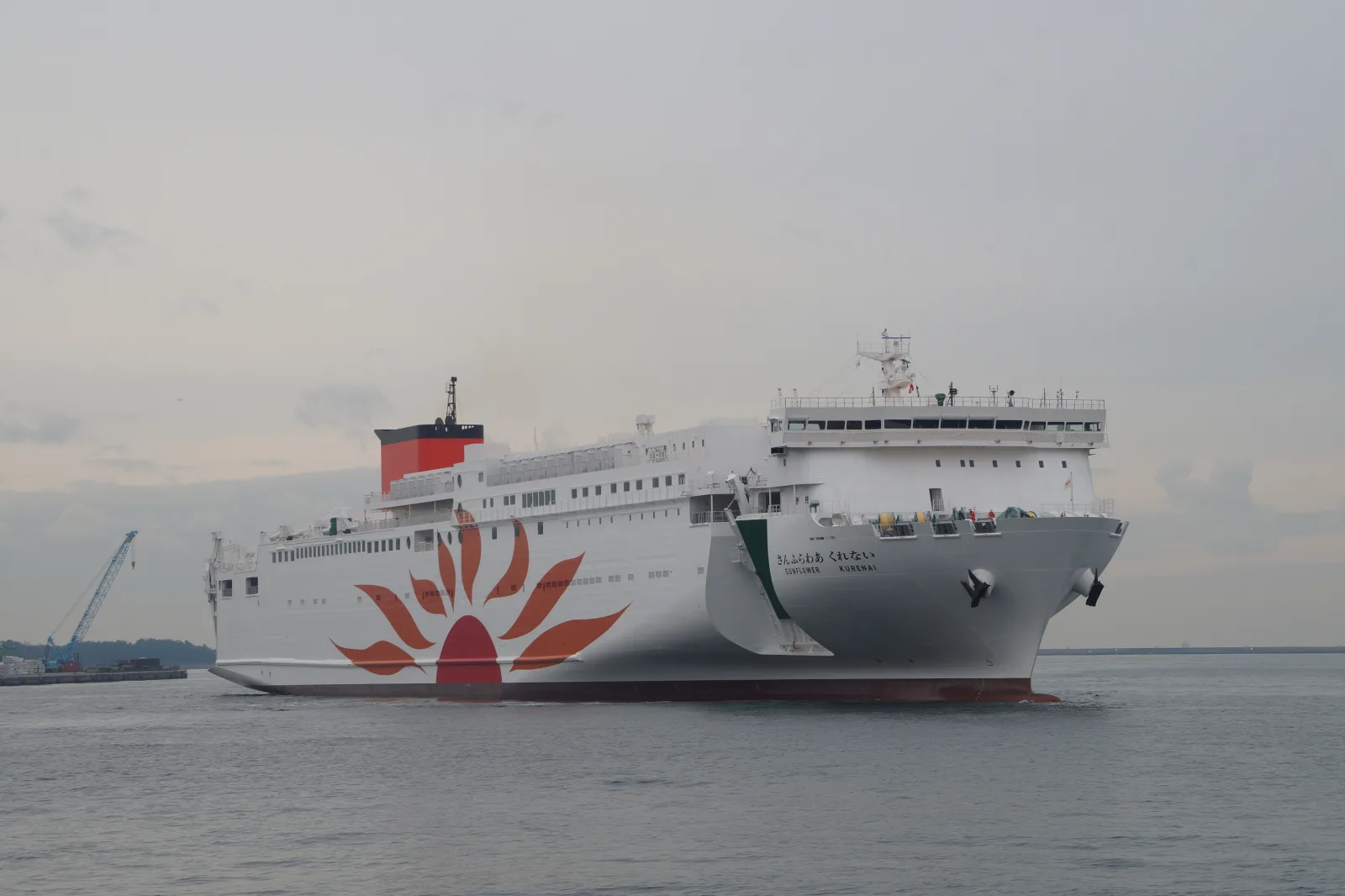
The Osaka to Beppu ferry, operated by MOL Sunflower, takes about 12 hours. It is an overnight service that typically departs Osaka in the evening (around 19:00) and arrives in Beppu the next morning.
What is the longest ferry route in Japan?
The Tokyo to Kitakyushu service via Tokushima is among the longest, running up to about 34 hours. The direct Tokyo (Yokosuka) to Kitakyushu route takes around 21 hours.
Can you take a car on a ferry in Japan?
Yes. Almost all long-distance and many short-distance Japanese ferries carry vehicles. Cars, motorcycles and bicycles are charged an additional fee based on their length, on top of the passenger fare.
What is the cheapest way to travel on a Japanese ferry?
Second class without a bed — an open carpeted or tatami room shared with other passengers — is the cheapest option. Overnight fares in this class start from roughly 5,000 to 12,000 yen depending on the route.
How far in advance should I book a ferry in Japan?
Reservations usually open two to three months before departure. Booking early is recommended for overnight ferries, particularly during Golden Week, Obon and summer weekends when private cabins sell out fast.
Do Japanese ferries have beds and private rooms?
Yes. Beyond open second-class rooms, most long-distance ferries offer second class with beds, first-class private rooms, and special-class suites. Facilities often include public baths, restaurants and female-only sections.
What is the Japan Ferry Pass 21?
The Japan Ferry Pass 21 is a discount pass that allows 6 journeys on 14 long-distance ferry routes over 21 days for a flat 21,000 yen, offered through the Japan Long Course Ferry Service Association.
How do I get from Honshu to Hokkaido by ferry?
The shortest crossing is Aomori to Hakodate across the Tsugaru Strait (3.5 to 4 hours). Longer overnight routes run from Maizuru, Tsuruga, Niigata, Oarai and Sendai to Otaru or Tomakomai.
Are there overnight ferries in Japan?
Yes. Japan's long course ferries are overnight liners with cabins, public baths and restaurants. Major overnight routes include Osaka–Beppu, Tokyo–Kitakyushu, Nagoya–Tomakomai and Maizuru–Otaru.
Which company operates the Osaka to Beppu ferry?
MOL Sunflower operates the Osaka–Beppu route, as well as Kobe–Oita and Osaka–Shibushi services, using its Sunflower-class ferries.
Can foreigners book Japanese ferries in English?
Many major operators such as MOL Sunflower, Shin Nihonkai Ferry and Tokyo Kyushu Ferry provide English-language booking pages, and several third-party sites cover the busiest routes.
How do I get to Okinawa by ferry?
Ferries run from Kagoshima to Naha (about 25 hours), often calling at Amami-Oshima on the way. There is no direct ferry from mainland Honshu to Okinawa; travellers connect via Kagoshima in Kyushu.
Is there a ferry between Japan and South Korea?
Yes. Ferries connect Fukuoka (Hakata) with Busan in South Korea by both high-speed hydrofoil (about 3 hours) and overnight ferry. There are also longer routes to Shanghai in China.
What should I bring on an overnight ferry in Japan?
Bring cash (not all onboard facilities accept cards), any food or drinks you prefer (onboard prices are higher), and essentials in an accessible bag, as vehicle decks are closed during the voyage.
How much does a ferry cost in Japan?
Fares vary widely by distance and class. Short island crossings can cost a few hundred yen, while an overnight second-class berth runs 5,000 to 21,000 yen; first-class and suites cost two to three times more.
Explore