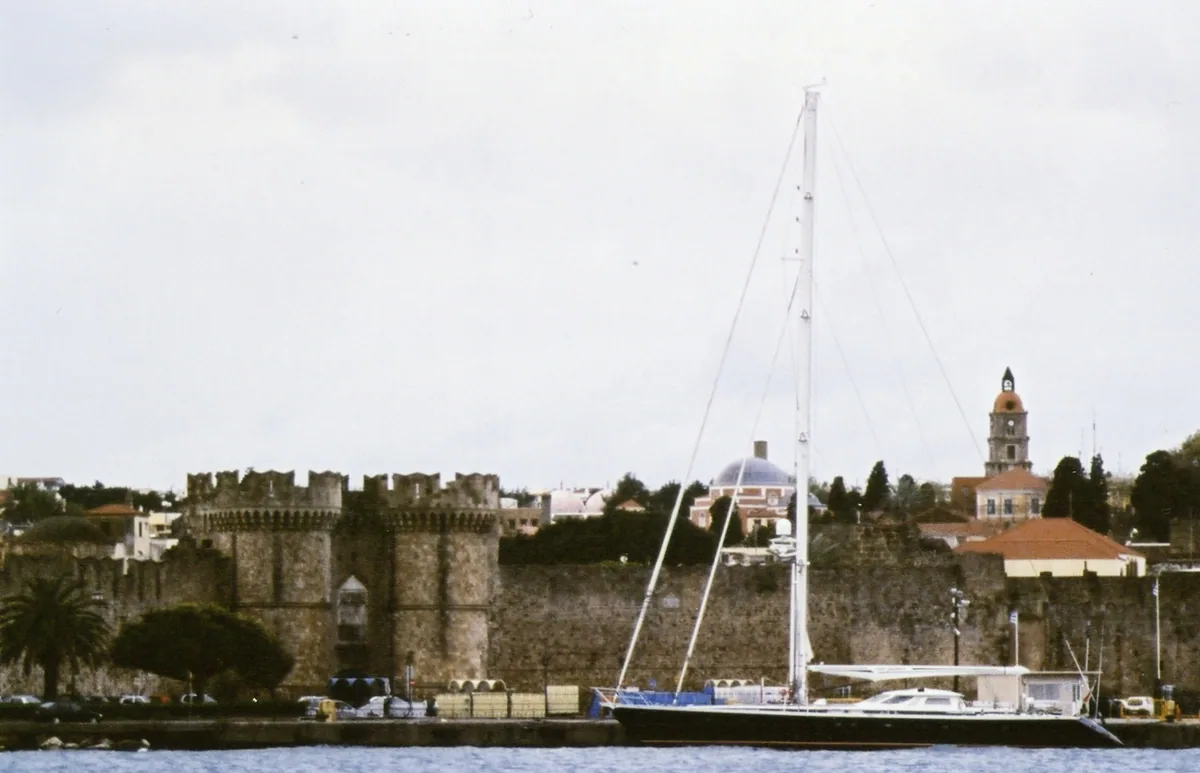
Dodecanese · Greece
Rhodes
Rhodes Town has three working ferry harbours within about a kilometre of each other, and which one your boat uses is decided by the boat, not by where you are going. Get that wrong and you are dragging a suitcase between two of them in August heat. The rest is straightforward: the big ships to Athens sail overnight, the small ones fan out across the Dodecanese, and — rarely for a Greek island — two of them cross to Turkey.
Getting to Rhodes by ferry
Direct crossings serving Rhodes — open one for its full timetable.
Rhodes to Fethiye
- Fastest crossing
- 1h 25m
- Operators
- 1 operator
See schedule
Rhodes to Kalymnos
- Fastest crossing
- 3h
- Operators
- 2 operators
See schedule
Rhodes to Marmaris
- Fastest crossing
- 50m
- Operators
- 1 operator
See schedule
Rhodes to Piraeus
- Fastest crossing
- 12h 15m
- Operators
- 1 operator
See schedule
Rhodes to Symi
- Fastest crossing
- 50m
- Operators
- 2 operators
See schedule
Rhodes ferry crossings at a glance
| Route | Crossing | Sailings | Operators | Country |
|---|---|---|---|---|
| Rhodes → Piraeus | 12h 15m | 6 / wk | 1 | Greece |
| Rhodes → Symi | 50m | 5 / wk | 2 | Greece |
| Rhodes → Marmaris | 50m | 2 / wk | 1 | Greece |
| Rhodes → Fethiye | 1h 25m | 2 / wk | 1 | Greece |
| Rhodes → Kalymnos | 3h | 1 / wk | 2 | Greece |
Three harbours, and the vessel picks one
Everything on Rhodes starts here, so it is worth learning before you book:
- Akandia — the commercial harbour. Big domestic car ferries, all Blue Star sailings, freight, and some cruise arrivals from other Greek ports.
- Kolona — the small fast boats. Dodekanisos Seaways catamarans and the local craft working the Dodecanese.
- The international quay, on Kolona's eastern side — the crossings to Turkey.
A rough rule: if your ticket has a car deck and an overnight, it is Akandia. If it is a catamaran doing island hops, it is Kolona.
⚠ Akandia has nothing on it
This is the practical warning nobody puts on a booking page. Akandia is a working cargo quay: no waiting area, no shade, no toilets, no food. There is a Blue Star ticket kiosk and that is close to the extent of it. On a July afternoon with a delayed departure, that matters.
It is roughly a 20-minute walk to the Old Town and about 30 minutes to the New Town and the main bus station. Parking is free with a shuttle bus running every half hour, on a reduced timetable on Saturdays and not at all on Sundays — check the day before you rely on it.
Kolona is the easy one
Kolona sits right by the entrance to the Old Town, so arriving on a Dodekanisos Seaways catamaran means walking off the boat and into the medieval walls within a few minutes. If you are choosing between two routings to the same island and one lands at Kolona, that is a real convenience worth a small premium.
Turkey, on a scheduled boat
Very few Greek islands have a regular international ferry. Rhodes has two:
- Marmaris — about 50 minutes, with three or four sailings in our current timetable, operated by Yeşil Marmaris.
- Fethiye — about 85 minutes, a longer run down the Turkish coast.
These are proper border crossings: passports, not identity cards, and the crossing leaves the Schengen area. Build in time on both sides and do not plan a tight onward connection the same day.
Where else the ferries go
From our timetable, the busiest links out of Rhodes:
- Kos — 15 sailings, about 2 h 40 m, on both Blue Star and Dodekanisos Seaways. This is the strongest connection the island has.
- Symi — 6 sailings, around 50 minutes, the classic day trip.
- Piraeus — 6 sailings, and see the next section.
- Kalymnos, Tilos, Chalki and Kastellorizo — the smaller Dodecanese runs, one to three sailings each.
- Santorini — 3 sailings, but a genuinely long crossing at around 13 hours.
Athens is 12 to 13 hours away
People underestimate this one badly. Rhodes sits at the far southeastern corner of the Greek ferry network: Piraeus to Rhodes runs about 12 h 50 m, and the return is a little quicker at roughly 12 h 15 m. It is an overnight ship, and it is the right way to do it — a cabin turns the crossing into the night you would have spent in a hotel anyway.
What it is not is a day trip or a casual add-on to an Athens holiday. If your time is short, fly one leg and sail the other.
Rhodes or Kos as a Dodecanese base?
These two are the obvious island-hopping bases and they behave differently. Kos is further north and closer to the middle of the chain. Rhodes is the terminus — more connections in absolute terms, but many of them radiate outward rather than passing through.
The 15 sailings on the Kos–Rhodes link mean you do not have to choose exclusively. A common pattern is to fly into one, work along the chain, and fly out of the other.
When to come
The full picture — Turkey crossings, the small-island catamarans, the daily Symi boats — belongs to roughly May through September. Outside that the international sailings thin out first, then the smaller Dodecanese runs, leaving the Blue Star ships to Piraeus and Kos as the year-round spine.
Late September is the sweet spot: the sea is still warm, the catamarans are still running, and Akandia's lack of shade stops being a problem.
Rhodes ferry & travel FAQ
Which port do ferries use in Rhodes?
It depends on the vessel. Big car ferries including all Blue Star sailings use Akandia, the commercial harbour. Dodekanisos Seaways catamarans and the small Dodecanese boats use Kolona. Crossings to Turkey leave from the international quay on Kolona's eastern side.
How far is Akandia port from Rhodes Old Town?
About a 20-minute walk, or roughly 30 minutes to the New Town and the main bus station. There is free parking with a shuttle every half hour, reduced on Saturdays and not running on Sundays.
Are there facilities at Akandia port?
Almost none. There is no waiting area, no shade, no toilets and no food — just a Blue Star ticket kiosk. Bring water and do not plan to wait there long in summer.
How long is the ferry from Piraeus to Rhodes?
About 12 hours 50 minutes southbound and roughly 12 hours 15 minutes on the return. It is an overnight crossing, and a cabin is worth booking.
Can I take a ferry from Rhodes to Turkey?
Yes. Marmaris is about 50 minutes away and Fethiye about 85 minutes. Both are full international crossings out of the Schengen area, so you need a passport and should allow time for border formalities.
What is the busiest ferry route from Rhodes?
Kos, with 15 sailings in our timetable and a crossing of about 2 hours 40 minutes, served by both Blue Star Ferries and Dodekanisos Seaways.
How long does it take to get from Rhodes to Symi?
Around 50 minutes, with six sailings in our current timetable. It is the standard day trip from Rhodes and boats leave from Kolona.
Is Rhodes or Kos the better island-hopping base?
Kos sits nearer the middle of the Dodecanese chain; Rhodes is the terminus with more connections overall, though many radiate outward. With 15 sailings between them you can reasonably use both — fly into one and out of the other.
More Dodecanese destinations
Reviewed by Serhat Özçelik, Founder & Editor of Ferry Schedule Hub · Last updated August 8, 2026.