Dodecanese · Greece
Kalymnos
Kalymnos runs on a different calendar from the rest of Greece. Its visitors come to climb, and climbing weather is the cool half of the year — so the island fills up when Mykonos is boarded shut and empties in the August heat everyone else books for. Getting here is also not what the map suggests: the fast way in is a small boat from a village on Kos that most Kos visitors never see.
Getting to Kalymnos by ferry
Direct crossings serving Kalymnos — open one for its full timetable.
Kalymnos to Kos
- Fastest crossing
- 35m
- Operators
- 2 operators
See schedule
Kalymnos to Rhodes
- Fastest crossing
- 2h 45m
- Operators
- 2 operators
See schedule
Kalymnos to Turgutreis
- Fastest crossing
- 45m
- Operators
- 2 operators
See schedule
Kalymnos ferry crossings at a glance
| Route | Crossing | Sailings | Operators | Country |
|---|---|---|---|---|
| Kalymnos → Kos | 35m | 5 / wk | 2 | Greece |
| Kalymnos → Rhodes | 2h 45m | 3 / wk | 2 | Greece |
| Kalymnos → Turgutreis | 45m | 1 / wk | 2 | Greece |
The way in that nobody tells you
Kos is the gateway, but not from Kos Town. The short local crossing runs from Mastichari, on the northwest coast, to Pothia, the Kalymnos capital — a small-boat route of roughly 30 to 45 minutes depending on whether you get the ferry or the faster launch, at a few euros either way.
The reason this matters: Mastichari is about 7 km from Kos airport, while Kos Town harbour is 23.5 km. Fly in, turn right instead of left, and you can be on Kalymnos within an hour of landing.
The bigger boats, and why they are the backup
Our timetable holds 9 sailings on Kalymnos–Kos at about 35 minutes with Blue Star and Dodekanisos Seaways, plus 3 sailings to Rhodes at around 2 h 45 m.
These are the network boats — useful for island-hopping down the Dodecanese, less useful for simply getting here from a plane. There is also a short seasonal crossing to Turgutreis in Turkey at about 45 minutes.
This crossing is a commute
The Kos link runs all year and it runs early and late, because Kalymniots work on Kos and come home at night. That is unusual and it is worth exploiting: a route built for commuters has a first boat that is genuinely early and a last boat that is genuinely late.
It also means the service does not evaporate in winter the way holiday routes do. If you are coming to climb in February, the boat is running.
⚠ The season is inverted
Kalymnos is one of the world's major sport-climbing destinations, and limestone in August is unusable. The climbing calendar therefore runs through the cool months, roughly autumn to spring, with the shoulders busiest of all.
Plan accordingly. In April and October, accommodation in Massouri and Myrties — the villages under the crags — books out while the rest of the Aegean is half empty. In August you will find a room easily and be unable to climb.
Telendos, half an hour offshore
Small boats leave the jetty at Myrties for the islet of Telendos roughly every half hour. Telendos has no cars, a handful of tavernas, and some of the island's best-known climbing.
It is a five-minute crossing and one of the cheapest boat rides in the Dodecanese, which makes it a genuine option for an evening meal rather than an expedition.
Pothia is a working town
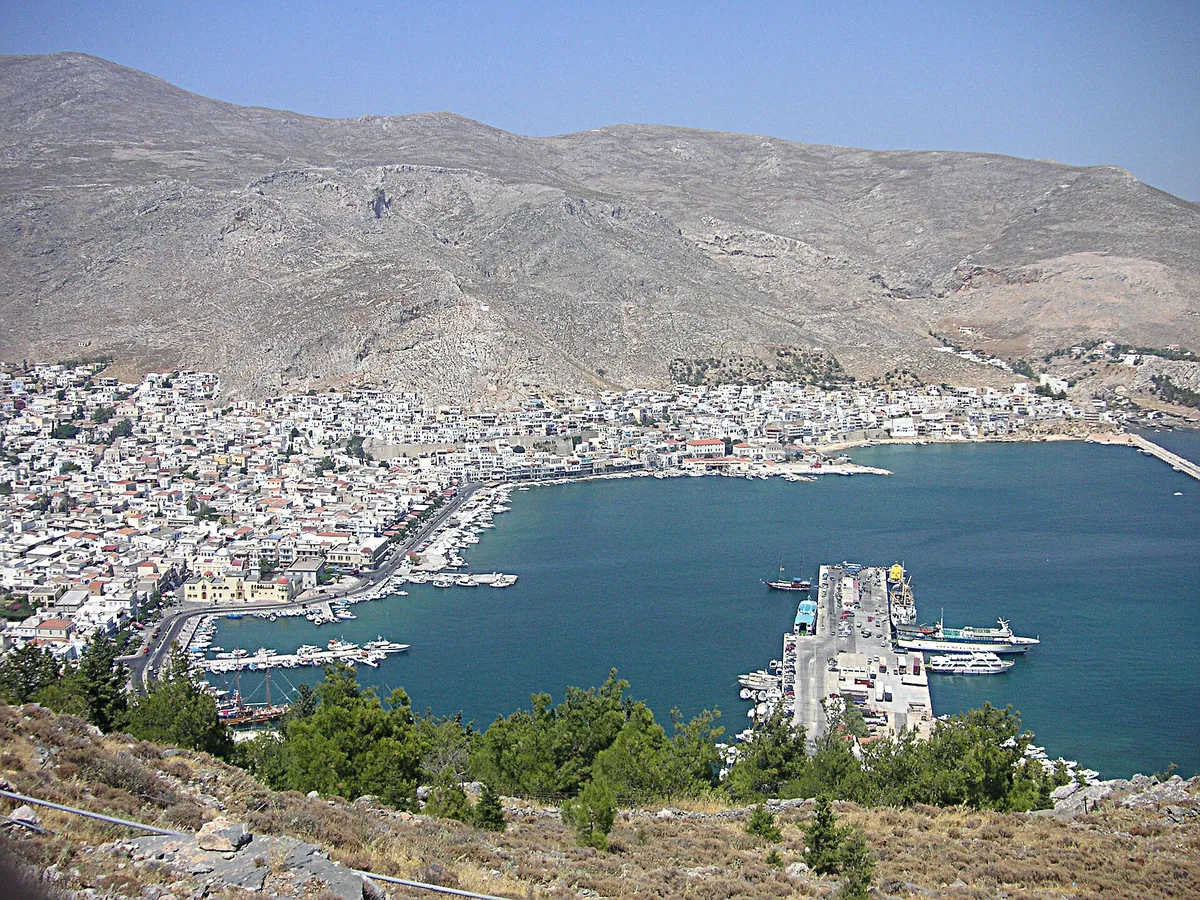
The capital is not a whitewashed postcard. It is a sponge-diving port, still visibly industrial, built up the sides of a bowl in ochre and blue. The sponge trade made the island wealthy and cost it a great many divers, and the town has not been prettified for anyone.
Most visitors stay north in Massouri or Myrties and use Pothia as the ferry gate. That is reasonable, but the town is worth an evening on its own terms.
Getting around
One road runs up the west coast from Pothia through Myrties to Massouri, with a decent local bus and inexpensive taxis. A scooter is the usual choice and covers everything.
A car is only worth it if you are carrying a lot of gear, which on this island is a real consideration — ropes and mats are not hand luggage.
Where it fits in a route
North to Samos, south to Kos and on to Rhodes: Kalymnos sits in the middle of the Dodecanese chain and is easy to include in a line rather than a loop.
Because the Kos crossing is so short and so frequent, it also works as a two-day detour from a Kos holiday — which is what a lot of people do without ever intending to climb anything.
Kalymnos ferry & travel FAQ
What is the quickest way to get to Kalymnos?
From Mastichari on Kos, not from Kos Town. The crossing to Pothia takes roughly 30 to 45 minutes and Mastichari is only about 7 km from Kos airport, against 23.5 km to the main harbour.
How long is the ferry from Kos to Kalymnos?
Our timetable holds nine sailings at about 35 minutes on Blue Star Ferries and Dodekanisos Seaways. The separate Mastichari–Pothia local boats take 30 to 45 minutes.
Does the Kos to Kalymnos ferry run in winter?
Yes. Kalymniots commute daily to work on Kos, so the crossing runs year round with an early first boat and a late last one.
When is the best time to visit Kalymnos?
The opposite of the usual Greek answer. Climbing is the island's main draw and limestone is unusable in August, so the season runs through the cool months — autumn to spring, with April and October busiest.
How do I get to Telendos?
Small boats leave the Myrties jetty roughly every half hour for a five-minute crossing. Telendos has no cars, a few tavernas and well-known climbing.
Where should I stay on Kalymnos?
Most visitors stay at Massouri or Myrties on the west coast, under the crags. Pothia, the capital, is a working sponge-diving port and the ferry gate rather than a resort.
Can I get to Turkey from Kalymnos?
There is a short seasonal crossing to Turgutreis at about 45 minutes.
Do I need a car on Kalymnos?
Usually not — one road runs up the west coast with a decent bus and cheap taxis, and a scooter covers everything. A car is worth it mainly if you are carrying climbing gear.
More Dodecanese destinations
Reviewed by Serhat Özçelik, Founder & Editor of Ferry Schedule Hub · Last updated August 8, 2026.