Dodecanese · Greece
Patmos & Leros
Patmos and Leros are two separate islands about thirty kilometres apart, and they appear together here for one honest reason: the Blue Star ship that serves the northern Dodecanese calls at both on the same run, so travellers routinely treat them as a pair. They are not remotely alike. One is a pilgrimage site with a fortified monastery on its skyline; the other is a naval bay with Italian rationalist architecture around it.
One line, two stops
The northern Dodecanese route runs Piraeus – Patmos – Lipsi – Leros – Kalymnos – Kos, and both islands sit on it. Our timetable holds 5 sailings south to Kos at about 3 hours on Blue Star, and a link from Syros at just under four hours.
Each island also has its own separate Piraeus service: see Patmos at roughly 8 hours and Leros at around 9. Leros additionally has short crossings to Bodrum and Turgutreis in Turkey, at about an hour and forty-five minutes respectively; Patmos's Turkish links exist in the network but hold no current sailings.
Patmos: the monastery is the island
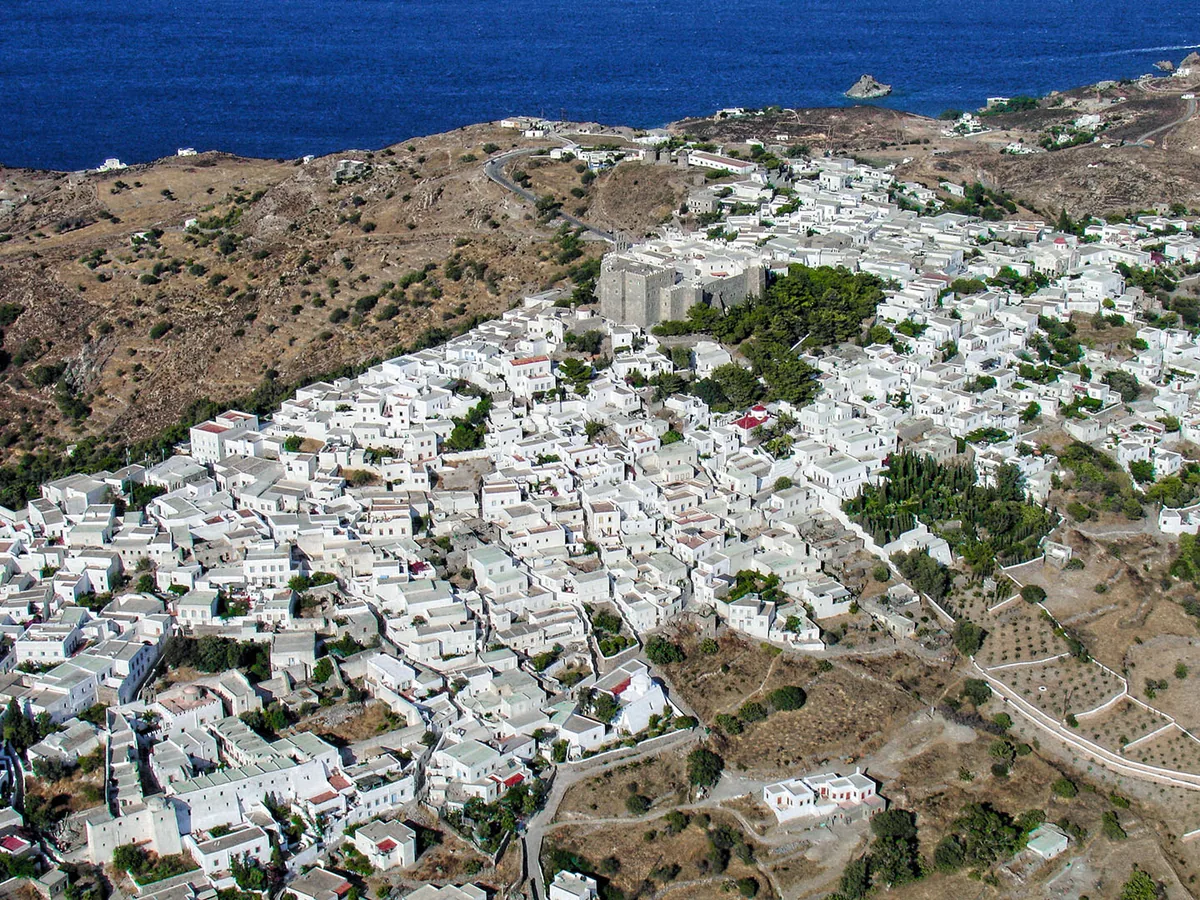
The Cave of the Apocalypse, where the Book of Revelation is held to have been written, and the fortified Monastery of Saint John above it are both UNESCO-listed, and Chora — the whitewashed town wrapped around the monastery walls — is one of the finest in the Aegean.
Skala is the port and where the boats and most of the rooms are. The island is quiet in a slightly formal way: cruise tenders come for the monastery, and there is a dress code that is enforced.
Leros: a different century entirely
Leros was an Italian naval base in the 1920s and 30s, and Lakki, its main harbour, was built as a planned town in the rationalist style — wide boulevards, curved facades, a cinema and a market building that look nothing like anywhere else in Greece.
The island has deep sheltered bays, a Byzantine castle above Platanos, and a strong sailing scene. It sees far fewer visitors than Patmos and has no equivalent single attraction, which is precisely why people who like it come back.
⚠ Do not treat them as one destination
They are separate islands with separate harbours, and getting between them means a boat — there is a local link via Lipsi and the Blue Star ship itself, but it is not a shuttle and it does not run on demand.
If you want both, plan two stays rather than a base and a day trip, and check the connecting sailings before you commit to dates.
Turkey from Leros
Leros has the more useful international position of the two: Bodrum is about an hour away and Turgutreis around forty-five minutes, which makes flying into Bodrum and crossing a genuine alternative to the eight-hour ship from Athens.
Both are full border crossings out of the Schengen area, and both are seasonal.
Where they sit in a Dodecanese route
North to south the chain runs Patmos, Lipsi, Leros, Kalymnos, Kos, then Rhodes. Doing it in one direction and flying out of the far end avoids repeating any leg.
Kos is the natural hinge: three hours from here, with the airport and the frequent Turkish crossing. See the Kos guide for which of its four harbours you actually need.
Season
The Piraeus services run year round on a reduced winter schedule; the fast craft, the Turkish crossings and the small inter-island boats belong to roughly May through September.
Patmos is busiest around Orthodox Easter and in August. Leros barely has a peak, which is part of its appeal.
Patmos & Leros ferry & travel FAQ
Are Patmos and Leros the same island?
No — they are separate islands about thirty kilometres apart. They appear together because the Blue Star ship serving the northern Dodecanese calls at both on the same run.
How long is the ferry to Kos?
About three hours, with five sailings in our timetable on Blue Star Ferries. Kos is the natural hinge of the northern Dodecanese, with an airport and frequent Turkish crossings.
How long is the ferry from Athens?
Roughly eight hours to Patmos and around nine to Leros, on the Piraeus service.
Can I get to Turkey from Leros?
Yes — Bodrum is about an hour away and Turgutreis around forty-five minutes. Both are seasonal and both are full border crossings out of the Schengen area.
What is Patmos known for?
The Cave of the Apocalypse and the fortified Monastery of Saint John above it, both UNESCO-listed, with the whitewashed town of Chora wrapped around the monastery walls. Skala is the port. There is an enforced dress code.
What is Leros known for?
Lakki, a planned Italian rationalist town from the 1920s and 30s built as a naval base — wide boulevards, curved facades, a cinema and market unlike anywhere else in Greece — plus deep sheltered bays and a Byzantine castle above Platanos.
Can I visit both on one trip?
Yes, but plan two stays rather than a base and a day trip. Getting between them means a boat, and it is not a shuttle that runs on demand.
When should I visit?
May to September for the full network. Patmos is busiest around Orthodox Easter and in August; Leros barely has a peak, which is part of its appeal.
More Dodecanese destinations
Reviewed by Serhat Özçelik, Founder & Editor of Ferry Schedule Hub · Last updated August 8, 2026.