Cyclades · Greece
Naxos
Naxos is the largest of the Cyclades and the most central, which makes it unusual among Greek islands: you can reach it up to seven times a day from Piraeus, and once there, Mykonos is 35 minutes away and Santorini a little over an hour. The ferry decision is not really where to go but which kind of boat — the fast craft that saves two hours, or the conventional ship that still sails when the wind gets up.
Getting to Naxos by ferry
Direct crossings serving Naxos — open one for its full timetable.
Speed or sea-keeping: the choice that shapes the trip
Piraeus to Naxos runs up to seven times a day in season, but the sailings are two different products:
- High-speed craft — 3 h 30 m to 5 hours, roughly €45–60. Airline-style seating, limited deck access, and small enough that wind delays and cancellations are routine.
- Conventional ferries — 5 to 7 hours, about €33–45. Far more room, open decks, and they keep sailing when the fast boats stop.
Blue Star runs the conventional ships; SeaJets the catamarans. In July and August the price gap narrows enough that the real question is not cost but whether you mind losing a day to a cancellation.
Which Piraeus gate, and why it matters
Naxos sailings leave from the Cyclades cluster — typically E4, E6, E7, E9 or E10, with E7 the usual high-speed berth. Piraeus runs about four kilometres end to end, so the gate on your ticket decides whether the metro drops you outside the door or forty minutes away.
Gates are reassigned in high season; check the boards at the port entrance on the day. Our Piraeus port guide has the full layout.
You arrive in the middle of town
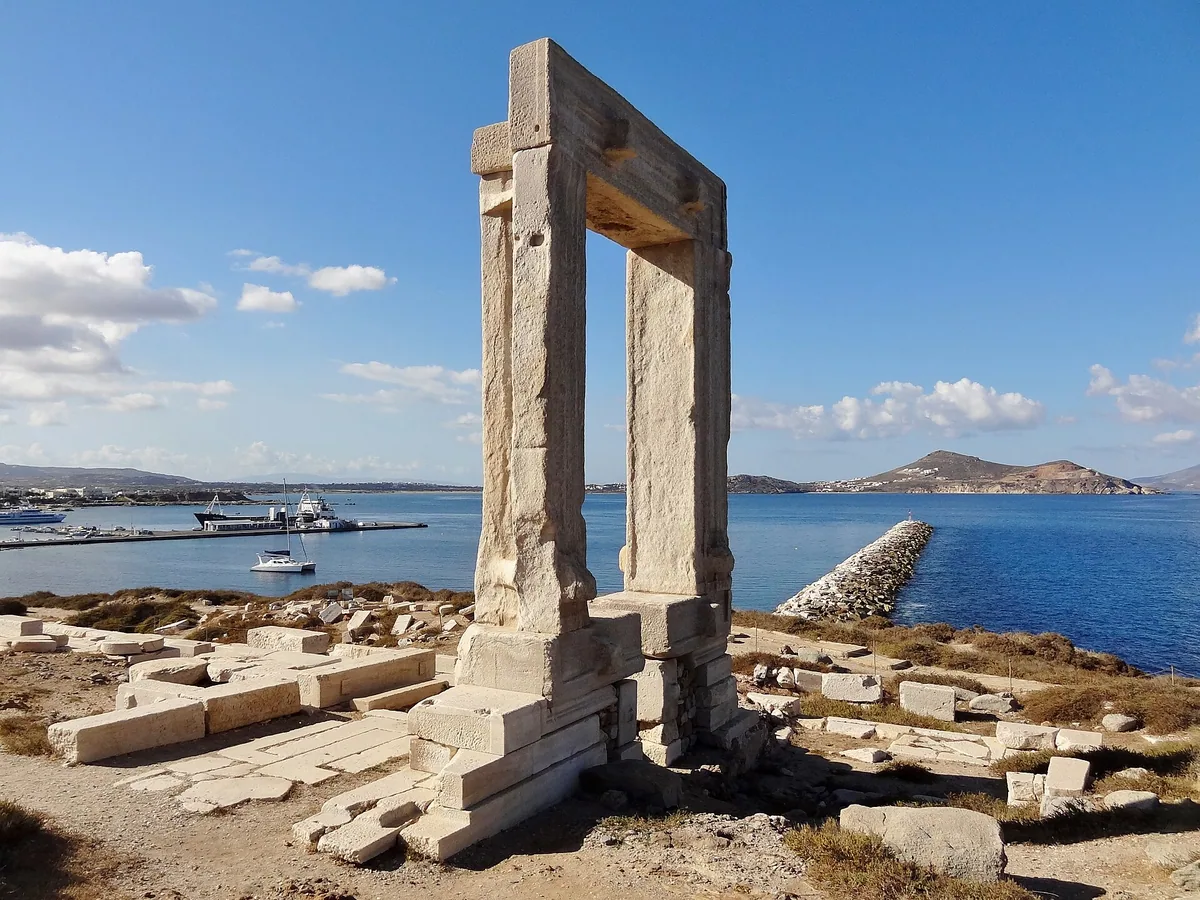
Ferries dock at Chora, the island capital, and the quay is the town — the waterfront cafés start where the ramp ends and the Portara, the marble gate on the islet opposite, is a ten-minute walk. There is no transfer, no second port, no shuttle to arrange.
This is a real difference from Santorini, where the ferry port sits far below the villages and every arrival involves a bus or taxi up the cliff.
Naxos as a hub, not an endpoint
Naxos sits in the middle of the Cyclades and the connections show it. From our timetable:
- Santorini — 8 sailings, about 65 minutes. Blue Star and SeaJets.
- Ios — 6 sailings, roughly 40 minutes.
- Mykonos — 4 sailings, about 35 minutes, with Fast Ferries, Golden Star and SeaJets.
- Irakleia and the Small Cyclades — 4 sailings, around 90 minutes, partly on the local Small Cyclades Lines boat.
Because Mykonos and Santorini are both under 70 minutes away, Naxos works as a base in a way that neither of them does — you can day-trip to the famous islands and sleep somewhere cheaper and quieter.
The Small Cyclades are a separate network
Irakleia, Schinoussa, Koufonisia and Donousa are served partly by the big ferries and partly by a small local vessel that threads between them. Sailings are fewer, seasonal, and sometimes weather-dependent in a way the Piraeus route is not.
If these islands are the point of the trip, build the itinerary around their timetable first and fit Naxos around it — not the reverse.
⚠ The meltemi is a planning factor, not a footnote
From roughly July to early September the meltemi blows hard from the north. It is the high-speed craft that suspend first; Blue Star's conventional ships handle the same conditions and keep running.
Two practical consequences. If you have a flight home from Athens, do not put a fast catamaran on the last day. And if a sailing is cancelled, the conventional ferry the following morning is usually the first thing that moves — book it before the queue forms.
When to come, and when the timetable thins
The full seven-a-day frequency belongs to July and August. From late May to late September you still get several daily options; outside that the fast craft largely stop and Naxos falls back to the year-round Blue Star service, which runs but on a much reduced schedule.
May, June and September give you the timetable without the crowds and without the worst of the wind.
Getting around once you land
Naxos is the largest of the Cyclades and the interior is genuinely mountainous — the villages of the Tragaea, the marble quarries above Apollonas, the long west-coast beaches from Agios Prokopios south. Buses run from Chora to the main beaches and villages, but a car or scooter opens the island up in a way it does not on smaller neighbours.
Arriving without a vehicle is fine if you are staying near Chora; if you are heading inland, arrange transport before you sail rather than at the quay.
Naxos ferry & travel FAQ
How long is the ferry from Athens to Naxos?
High-speed craft take 3 h 30 m to 5 hours; conventional ferries take 5 to 7 hours. There are up to seven sailings a day in peak season from Piraeus.
Should I take the fast ferry or the conventional one?
The fast craft saves roughly two hours for about €10–15 more, but is small enough that wind causes frequent delays and cancellations. Conventional ships are more spacious, have open decks, and keep sailing in conditions that stop the catamarans. If your schedule is tight — a flight home, for instance — the slower boat is the safer ticket.
Which gate at Piraeus do Naxos ferries use?
Usually the Cyclades cluster: E4, E6, E7, E9 or E10, with E7 the typical high-speed berth. Gates are reassigned in high season, so check the electronic boards at the port entrance on the day.
Where does the ferry dock on Naxos?
At Chora, the island capital. The quay is in the town itself — waterfront cafés begin where the ramp ends and the Portara is a ten-minute walk. No transfer is needed.
Can I day-trip to Mykonos or Santorini from Naxos?
Yes. Mykonos is about 35 minutes with four daily sailings, and Santorini about 65 minutes with eight. That proximity is why Naxos works as a base for the central Cyclades.
How do I reach the Small Cyclades?
Irakleia, Schinoussa, Koufonisia and Donousa are served partly by the big ferries and partly by a small local vessel, roughly four sailings on the Irakleia run at about 90 minutes. Frequencies are lower and seasonal — plan the trip around their timetable, not around Naxos.
Do ferries to Naxos run in winter?
Yes, but reduced. The high-speed services largely stop outside the May-to-September window and the island falls back to the year-round Blue Star sailings on a thinner schedule.
Do I need a car on Naxos?
Only if you are leaving Chora. Naxos is the largest of the Cyclades with a mountainous interior; buses reach the main beaches and villages, but a car or scooter is what makes the Tragaea villages and the far beaches practical.
More Cyclades destinations
Reviewed by Serhat Özçelik, Founder & Editor of Ferry Schedule Hub · Last updated August 8, 2026.