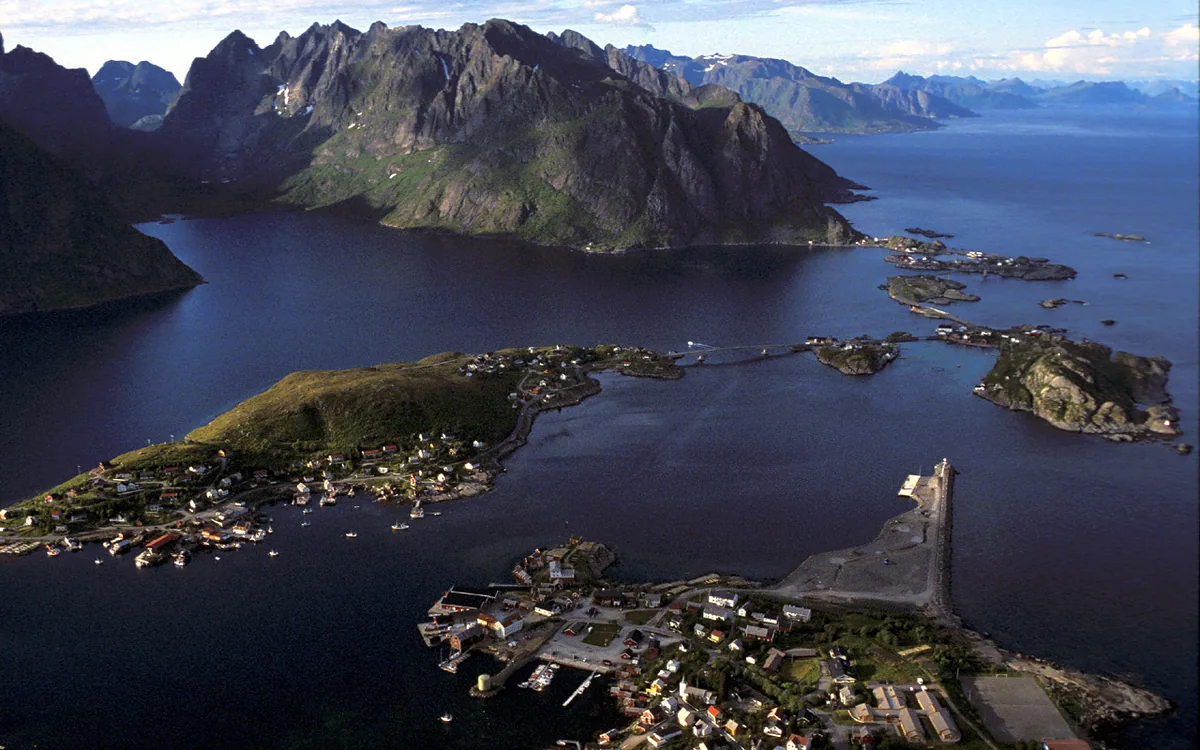
 (c) User:Michael Haferkamp / CC BY-SA 3.0
Lofoten Islands by Ferry: Routes, Times & Tips
Every ferry to and around the Lofoten Islands — Bodø–Moskenes, the Bodø–Svolvær express boat, seasonal shortcuts, and practical tips for cars and foot passengers.
By Serhat Özçelik, Founder & Editor of Ferry Schedule Hub· Published June 18, 2026· updated July 11, 2026
The Lofoten Islands rise straight out of the sea above the Arctic Circle — a chain of jagged peaks, white-sand beaches and red fishing cabins that draws travellers from across the world. While the main islands are now linked to the mainland by the E10 road and a series of bridges and tunnels, ferries remain the most scenic, and often the most practical, way to reach and explore the archipelago. Arriving by sea, with the wall of Lofoten peaks sharpening on the horizon, is one of the great Norwegian travel experiences. This guide breaks down every Lofoten ferry route, when each one runs, and how to plan a smooth crossing. It is part of our wider guide to ferries in Norway.
The Main Gateway: Bodø to Moskenes
The car ferry from Bodø to Moskenes, operated by Torghatten Nord, is the principal sea link between the mainland and western Lofoten. The direct crossing takes roughly three hours and fifteen minutes across the open Vestfjorden, delivering you right into the heart of the most photographed corner of the islands — within easy reach of Reine, Hamnøy and the road's end at Å.
Frequency swings dramatically with the season. In summer (June to August) there can be up to nine departures a day, often running every couple of hours. In winter (roughly September to May) the timetable thins to just one or two sailings daily, so off-season travel demands careful planning around a single departure window. The crossing itself is part of the experience: on a clear day you watch the mainland recede and the serrated Lofoten wall grow ahead of you. You can always check current times for the Bodø–Moskenes route before you set off.
Getting to Bodø, Your Springboard
Because most Lofoten ferries radiate from Bodø, it pays to think of the town as your staging post. It sits at the end of the Nordland railway, has an airport with frequent domestic flights, and is itself a stop on Norway's coastal voyage. Many travellers arrive in Bodø the evening before an early ferry, stay overnight, and join the queue fresh in the morning — a far less stressful approach than racing for a single winter sailing. If you are continuing a longer coastal trip, a leg aboard a coastal ship that calls at Stamsund or Svolvær is another way to step ashore in Lofoten without driving at all.
Reaching the Outer Islands: Værøy and Røst
Beyond Moskenes lie two remote outposts worth the extra effort. Some sailings follow a longer loop calling at Værøy and Røst, tiny bird-cliff islands famous for puffins, sea eagles and traditional stockfish racks. You can sail the Moskenes–Værøy leg or reach the outer islands directly from the mainland on the Bodø–Røst service. These crossings are more exposed to the open sea, so build in buffer days — a cancelled return can leave you stranded a night, which on Røst is no hardship but can wreck a tight schedule.
The Express Boat: Bodø to Svolvær
If you are travelling without a car, the passenger express boat (hurtigbåt) between Bodø and Svolvær is a faster, year-round alternative. It threads through islands and skerries across the Vestfjorden with calls at small communities in Steigen and Hamarøy — including Helnessund, Nordskot, Bogøy and the island of Skrova. The ride is quicker than the car ferry and runs reliably all winter, which makes it the dependable choice when car-ferry frequencies drop to a single daily sailing. Bikes and luggage are usually fine, but vehicles are not carried, so it suits foot travellers, cyclists and anyone basing themselves in Svolvær.
Seasonal Shortcuts: Skutvik and the Senja Connection
Two summer-only routes can save serious driving time. The Skutvik–Svolvær car ferry runs from June to August and is a handy shortcut for drivers coming from the south who want to avoid the long road around the fjord; departing from Skutvik, it has also been free of charge in recent seasons. To the north, the Gryllefjord–Andenes ferry links the island of Senja with Andenes in Vesterålen. It is a spectacular seasonal crossing that lets you combine Senja's mountains, whale-watching at Andenes and Lofoten into a single loop instead of doubling back inland. Note that some seasonal Northern-Norway crossings have started charging foot passengers again after the free-ferry years: on Gryllefjord–Andenes, travellers aged 30–66 pay a passenger fare from the 2026 season, so check the current fare rather than assume it is free.
Island-Hopping Within Lofoten and Vesterålen
Once you are on the islands, shorter ferries fill the gaps the road network leaves. The Fiskebøl–Melbu ferry is the key link between Lofoten and neighbouring Vesterålen, carrying E10 traffic across the strait and opening up the quieter islands of Hadsel and Langøya. Smaller local boats reach pockets of the Reinefjord and other roadless hamlets, delivering you to hiking trailheads and quiet beaches that most visitors never see. Treat these little crossings as part of the sightseeing rather than mere transport — many run through some of the finest scenery in the archipelago.
Practical Tips for Lofoten Ferries
- Reserve your vehicle in summer. On the busy Bodø–Moskenes route a share of the deck can be reserved in advance for a small guarantee fee. With a reservation you must join the marked "reserved" lane about 45 minutes before departure or you risk losing the slot. See our guide to taking a vehicle on a ferry for what to expect at the ramp.
- Arrive early without a booking. Unreserved cars board on a first-come basis, and in peak season a single queue can fill an entire sailing. Turn up well ahead, especially for the last departure of the day, when missing the boat may mean an unplanned overnight.
- Foot passengers have it easier. Walk-on travellers rarely need to book and enjoy far more flexibility, particularly on the express boat — a strong argument for leaving the car on the mainland.
- Watch the weather. The Vestfjorden crossing is open water; strong winds occasionally delay or cancel sailings, so keep a flexible buffer in winter and the shoulder seasons.
- Carry a backup payment method. Most routes take cards and app tickets, but having the local app set up before you travel saves fumbling at the terminal.
- Chain your crossings. Lofoten works beautifully as part of a longer northern route. Our multi-stop planning guide shows how to sequence several ferries without backtracking.
However you arrive, approaching Lofoten from the water is memorable. Browse all Norway ferry routes to slot these crossings into your own itinerary and check the latest departure times before you travel.
Frequently asked questions
How long is the Bodø to Moskenes ferry?
The direct car ferry across the Vestfjorden takes about 3 hours and 15 minutes. Sailings that call at Værøy and Røst on the way take longer.
Do I need to book the Lofoten car ferry in advance?
In summer it is strongly recommended on the Bodø–Moskenes route, where part of the deck can be reserved for a small guarantee fee. Outside peak season most cars board first-come, first-served, but arriving early is always wise.
Is there a passenger ferry to Lofoten without a car?
Yes. The express boat between Bodø and Svolvær runs all year and is a fast, scenic option for foot passengers, with several stops along the Steigen and Hamarøy coast. It does not carry vehicles.
When does the Skutvik to Svolvær ferry run?
It is a summer-only service, typically from June to August, and has been free of charge in recent years. Outside that window, use the Bodø–Moskenes ferry or the year-round express boat.
How can I combine Lofoten with Senja?
Take the seasonal Gryllefjord–Andenes ferry, which links Senja with Andenes in Vesterålen. From Andenes you can drive on toward Lofoten, making a scenic loop through three of Northern Norway's most beautiful regions. Note that foot passengers aged 30–66 pay a fare on this crossing from the 2026 season.
Can I reach the outer islands of Værøy and Røst?
Yes. Some sailings extend from Moskenes to Værøy and Røst, and there are direct services from Bodø. These open-water crossings are more weather-dependent, so allow buffer time in case of cancellations.
Keep reading