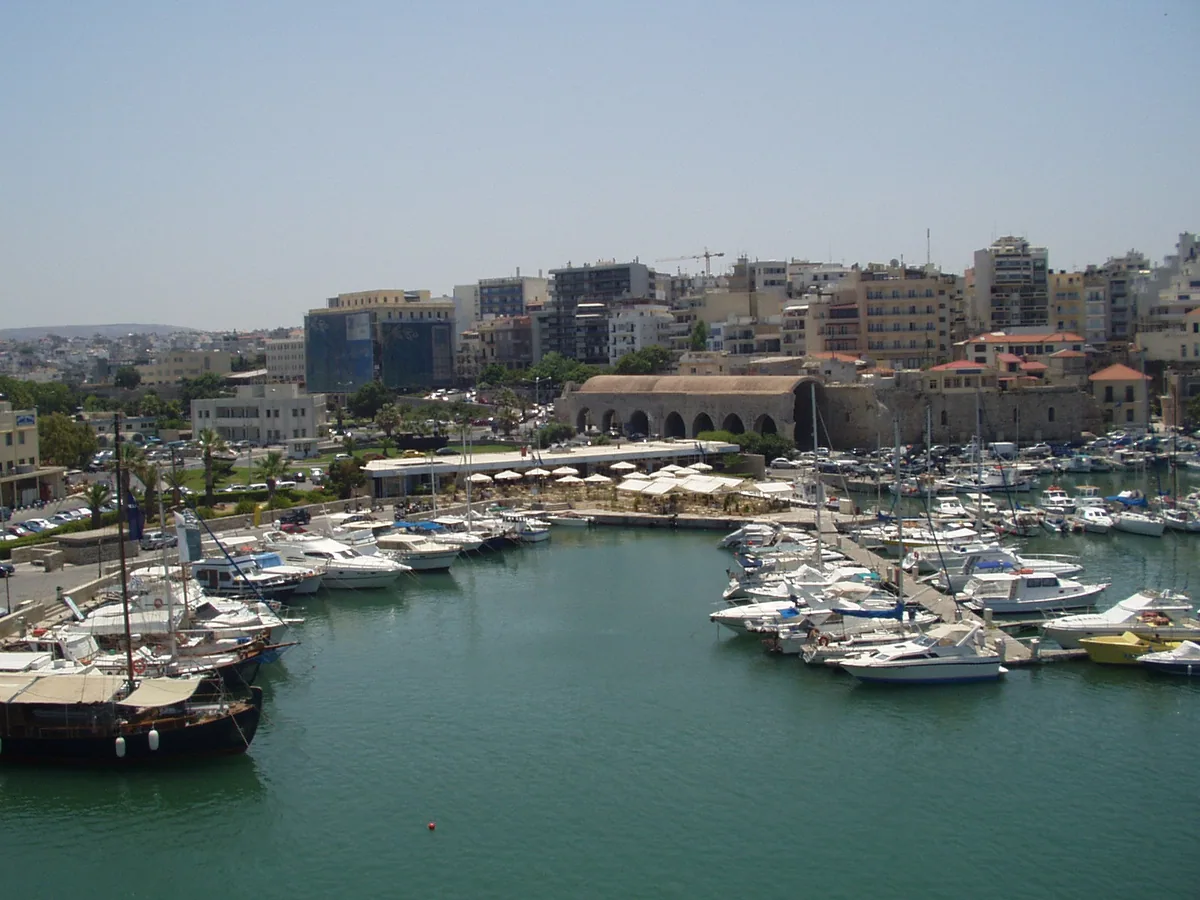
 (c) JohnnyB / CC BY-SA 3.0
Ferry vs Flight: Athens (Piraeus) to Crete (Heraklion)
Miss the morning boats to Crete and a better plan appears: an afternoon in Athens, then a 21:00 night ferry with Minoan, Blue Star or Hellenic Seaways that docks in Heraklion before breakfast. We weigh it against the 50-minute domestic flight.
By Serhat Özçelik, Founder & Editor of Ferry Schedule Hub· Published June 18, 2026· updated July 11, 2026
Your flight touches down at Athens airport at 09:00 on a Tuesday in June. Crete is where you are actually headed, Heraklion the port of entry. And at this precise moment, two Cretan-bound ships — the 09:00 Blue Star and Hellenic Seaways departures — are already easing off the quay at Piraeus, forty minutes away across the city. You were never going to make them. So what now?
This is the situation in which most Piraeus–Heraklion decisions actually get made, so let us play both hands properly.
Hand one: connect straight through by air
Athens–Heraklion ranks among the busiest domestic corridors in Greece. Aegean, Olympic Air and Sky Express between them run rotations throughout the day, with scheduled block time a little under an hour. Stay airside, board the next available departure, and you can be standing in Cretan sunshine by early afternoon; Heraklion airport lies barely five kilometres east of the city centre. The catch is cost volatility — a same-day seat in high summer can be punishing, so check current fares before assuming this is the cheap move.
Hand two: an afternoon in Athens, a bed at sea
The alternative reframes the "missed" morning boats as a gift. The main overnight departures leave Piraeus around 21:00 every evening: Minoan Lines covers the crossing in 9h 30m, while ANEK-Superfast — now part of Attica Group, alongside Blue Star Ferries — is timetabled at roughly 9 hours. Both put you on the quay in Heraklion between about 06:30 and 07:00. Operators and exact departure times on this route shift from season to season, so check the route page for the current line-up before you build your evening around a particular ship.
The day now writes itself. Drop your bags, take the metro up to the Acropolis, eat an unhurried dinner in Plaka, then ride back down to the port for boarding around 19:30. Deck fares start at €42; cabins — from four-berth inside up to deluxe outside grades — cost more (check current fares for your date), yet whatever you spend on a berth quietly deletes one hotel bill from the trip. You fall asleep in the Saronic Gulf and wake as the ship lines up on the Venetian harbour walls of Heraklion, the Koules fortress off the bow, with an entire first day on Crete ahead of you.
Full sailing details, including which operator sails on which day, live on the Piraeus to Heraklion route page.
The middle options nobody mentions
Two daytime sailings round out the timetable. SeaJets sends a high-speed vessel out at 09:30 that reaches Heraklion in 7h 50m — useful if you slept in Athens and want to travel by daylight. Blue Star also runs a 17:00 departure, but at ten hours it arrives around three in the morning, which explains why it is the least loved boat on the route. Treat it as a fallback, not a plan.
What the night crossing is actually like
If you have never done a Greek overnight ship, recalibrate your expectations upwards. These are not commuter boats but small floating hotels: multiple restaurants and bars, shops, lounges, and on some vessels a pool deck. Boarding opens around ninety minutes before departure — walk on with your bags, find your cabin, and claim a rail-side table as the ship clears the breakwater with the lights of Athens spreading behind it. Dinner on board is unhurried; most passengers turn in before midnight because the arrival announcement comes early, typically around 06:00.
A few earned tips. Book a cabin rather than an airline seat if your budget stretches at all — the difference between arriving rested and arriving wrecked is the whole game. Keep a small overnight bag separate from anything left in your car on the vehicle deck, which stays locked during the voyage. And in winter, when the Aegean can turn boisterous, midships lower-deck cabins ride noticeably softer than anything high and forward.
Scoring the two hands
On raw speed there is no contest and never will be: fifty minutes in the air beats any ship. The night ferry claws everything back on different terms.
- Accommodation economics. A cabin is transport and hotel in one line item. Price the flight honestly by adding a night's stay at either end.
- Zero airport friction. Heraklion's ferry quay is walkable to the old town; there is no security queue, no baggage carousel, no transfer bus.
- Luggage freedom. Bicycles, dive kit, a car on the vehicle deck — the ship swallows it all without a surcharge conversation.
- The Athens bonus. The 21:00 departure converts a layover into six good hours in one of Europe's great cities.
Where the ship loses: a rough winter crossing can mean broken sleep, and travellers prone to seasickness should pick a lower-deck cabin midships or simply fly. Families with very small children often find the flight's brevity kinder than a night in a shared cabin.
A word on timing and season
The 21:00 departures run year-round because Crete's supply lines depend on them, which makes this one of the most reliable timetables in the Greek islands — even when meltemi-season cancellations are scything through Cycladic catamaran schedules, the big Cretan ships tend to sail. July and August still demand early booking, especially for cabins and vehicle space; shoulder-season travellers can be far more spontaneous. Flights, by contrast, thin out in winter and their pricing turns spiky around Greek public holidays and Easter week, when half of Athens seems to be heading home to the island.
The verdict, by traveller
Business trip or a 72-hour visit: fly, both ways, and spend the savings in time on Knossos. Backpacker or anyone touring Crete for a week or more: night boat out, and decide the return later. Driving your own car to the island: the ferry decides itself. And if you have never crossed the Aegean after dark — dinner on deck, the lights of the Cyclades sliding past to port — there is a fair argument for doing it once regardless of the arithmetic. Start with our Heraklion guide to plan what happens after the gangway.
Frequently asked questions
Is there an overnight ferry from Piraeus to Heraklion?
Yes. The two main overnight ships leave Piraeus around 21:00 every evening: Minoan Lines, timetabled at about 9 hours 30 minutes, and ANEK-Superfast (part of Attica Group, alongside Blue Star Ferries) at roughly 9 hours. Both arrive in Heraklion between about 06:30 and 07:00 the next morning. Operators and exact times shift by season, so check the current Piraeus to Heraklion route page before booking.
How much does the Heraklion ferry cost?
Deck (economy seat) fares start from about 42 euros one way. Cabin berths cost more depending on grade and season, but replace a hotel night, which changes the maths.
How long is the flight from Athens to Heraklion?
Scheduled block time is just under one hour. Aegean, Olympic Air and Sky Express operate multiple daily rotations, and Heraklion airport sits about five kilometres from the city centre.
Is there a fast daytime ferry to Heraklion?
SeaJets runs a 09:30 high-speed sailing taking about 7 hours 50 minutes, arriving in the early evening — the main daylight alternative to the 21:00 night boats.
Where does the ferry arrive in Heraklion?
At the main port beside the Venetian harbour, within walking distance of the old town — no transfer needed, unlike the airport run.
Keep reading