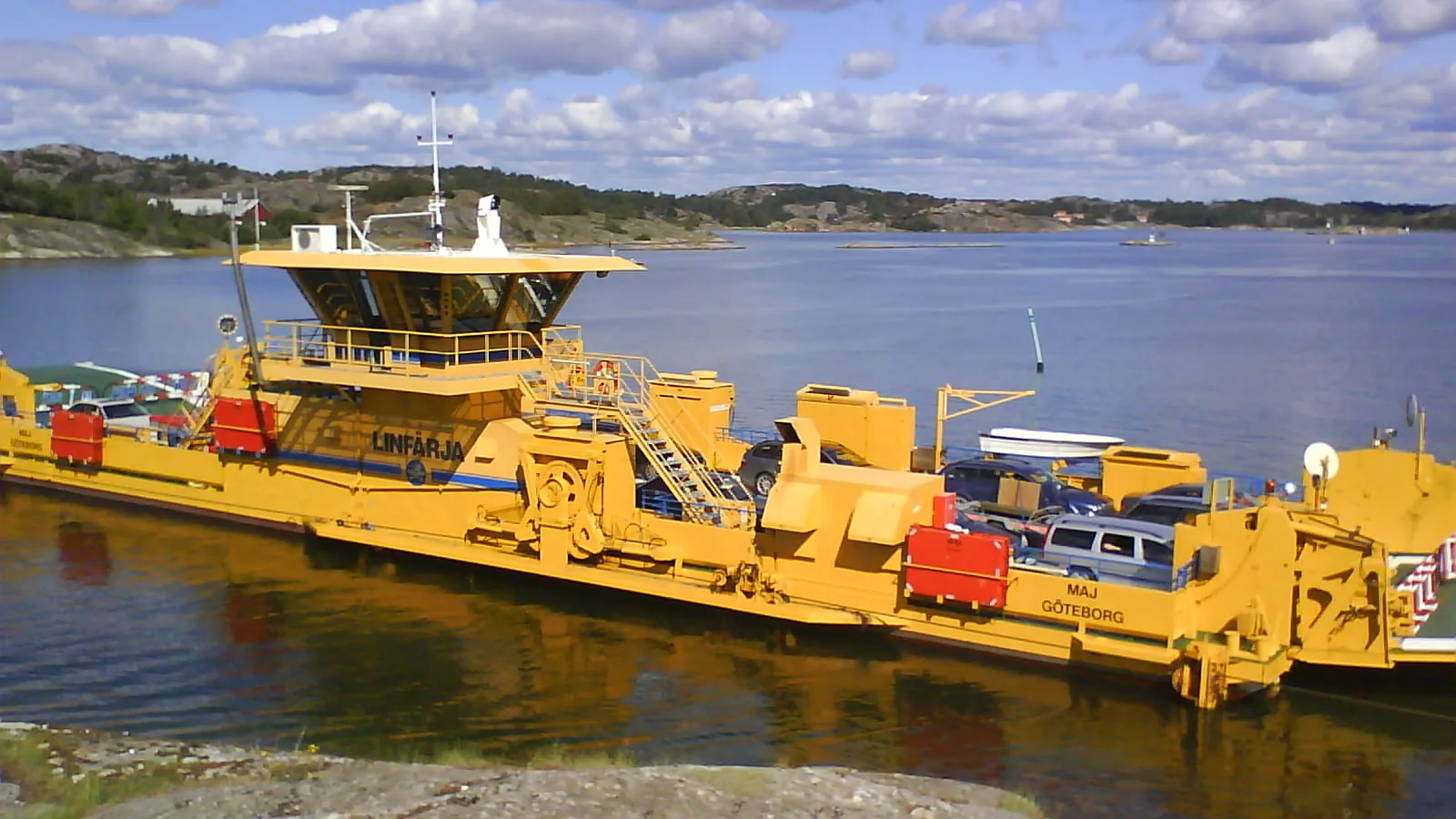
 (c) ChrisPsi / Public domain
Free Road Ferries in Sweden: How the Yellow Ferries Work
Sweden runs around 40 free car ferries — the distinctive yellow boats that carry the public roads across sounds and rivers. Here's how they work, why they're free and where to find them.
By Serhat Özçelik, Founder & Editor of Ferry Schedule Hub· Published July 16, 2026
One of the small delights of driving in Sweden is discovering that some of the ferries are simply free. You round a bend, the road runs onto a yellow boat, you switch off the engine, and a few minutes later you drive off the other side without paying a krona. These are Sweden's road ferries — around 40 of them — and they work quite differently from the ticketed archipelago boats that also ply Swedish waters.
What are Sweden's yellow ferries?
The free ferries are run by Färjerederiet, the ferry division of Trafikverket (the Swedish Transport Administration). They operate roughly 40 crossings — the vägfärjor, or road ferries — where the national road network meets water that no bridge spans. Almost all of them are painted the same cheerful yellow, so once you know the look, you'll spot them everywhere from the west-coast skerries to the great inland lakes.
Crucially, these are treated as part of the road itself. The crossing is a färjeled — a "ferry route" that carries a numbered road across the water — which is why there's no toll and no ticket office.
Why are they free?
The logic is the same as a bridge: if the state builds a road, you don't pay to drive along it, and a road ferry is just a floating section of that road. Färjerederiet's crossings are funded centrally as public infrastructure, so vehicles, drivers and passengers all travel at no charge. (Drivers are asked to switch off the engine during the short crossing, both for the environment and for comfort.)
How they work — you just drive on
There's no booking and no ticket. You join the queue at the quay, drive on in order, and drive off at the far side — turn-up-and-go, exactly like the everyday car ferries in neighbouring Norway. Frequencies are high on the busy routes and lower on the quiet ones; some remote crossings run on demand or can be called out at night.
Many of the smaller routes are cable ferries — linfärjor — which haul themselves across on a fixed cable rather than steering freely. They're slow, steady and use very little fuel, which is part of why Sweden has kept so many of them.
Where you'll find them
The free ferries cluster where Sweden's coast and lakes are most broken up:
- Bohuslän and the west coast — the granite islands north of Gothenburg lean heavily on free crossings, linking the roads around Orust and Tjörn, over the Gullmarn fjord and up toward the Norwegian border. See our Bohuslän ferry guide.
- The Stockholm archipelago — road ferries such as Vaxholm–Rindö and the Ljusterö crossing carry the island roads out into the fjord. They sit alongside the ticketed passenger boats covered in our Stockholm archipelago guide.
- The lakes and rivers — inland, small cable ferries cross Sweden's great lakes and waterways where a bridge was never built.
Free road ferries vs the ticketed archipelago boats
This is the point that catches visitors out. Sweden has two quite different kinds of ferry, and only one of them is free:
- Färjerederiet road ferries — free, carry cars, part of the road network, turn-up-and-go.
- Regional archipelago boats — run by the county transport authorities such as Waxholmsbolaget (Stockholm) and Västtrafik (the west coast), these are ticketed passenger services out to the islands, and you pay a public-transport fare.
So "are ferries free in Sweden?" has the honest answer: the yellow car ferries on the roads, yes; the passenger boats to the archipelago islands, no. Our guide on foot-passenger versus car ferries explains the wider distinction.
Going electric
Färjerederiet has been steadily electrifying its fleet, replacing diesel engines with batteries on more of the busy crossings, while the old cable ferries were always among the greenest boats afloat. It's a quiet green-transport story riding along on Sweden's free roads.
Frequently asked questions
Are all ferries in Sweden free?
No. Sweden's roughly 40 yellow road ferries, run by Trafikverket's Färjerederiet, are free because they carry the public road across the water. The regional archipelago passenger boats — such as Waxholmsbolaget in Stockholm and Västtrafik on the west coast — are ticketed public transport and are not free.
Do I need to book a Swedish road ferry?
No. The free road ferries are turn-up-and-go: you join the queue at the quay, drive on in order and drive off the far side. There is no ticket and no reservation.
Which Swedish ferries are free?
The free ones are the state road ferries operated by Färjerederiet (Trafikverket) — the yellow boats that carry numbered roads across sounds, fjords and lakes, concentrated in Bohuslän, the Stockholm archipelago and the inland lakes.
Are the Stockholm archipelago boats free?
The passenger boats out to the archipelago islands, run by Waxholmsbolaget, are ticketed — not free. But some road ferries in the same area, such as Vaxholm–Rindö, are free Färjerederiet crossings. It depends on whether it's a road ferry or a passenger boat.
What is a linfärja?
A linfärja is a cable ferry — a boat that pulls itself across on a fixed cable rather than steering freely. Sweden runs many of them on its smaller free crossings; they're slow, steady and very fuel-efficient.
Do foot passengers and cyclists pay on the free ferries?
No. On Färjerederiet's free road ferries, everyone travels at no charge — vehicles, drivers, passengers, cyclists and pedestrians alike.
Keep reading