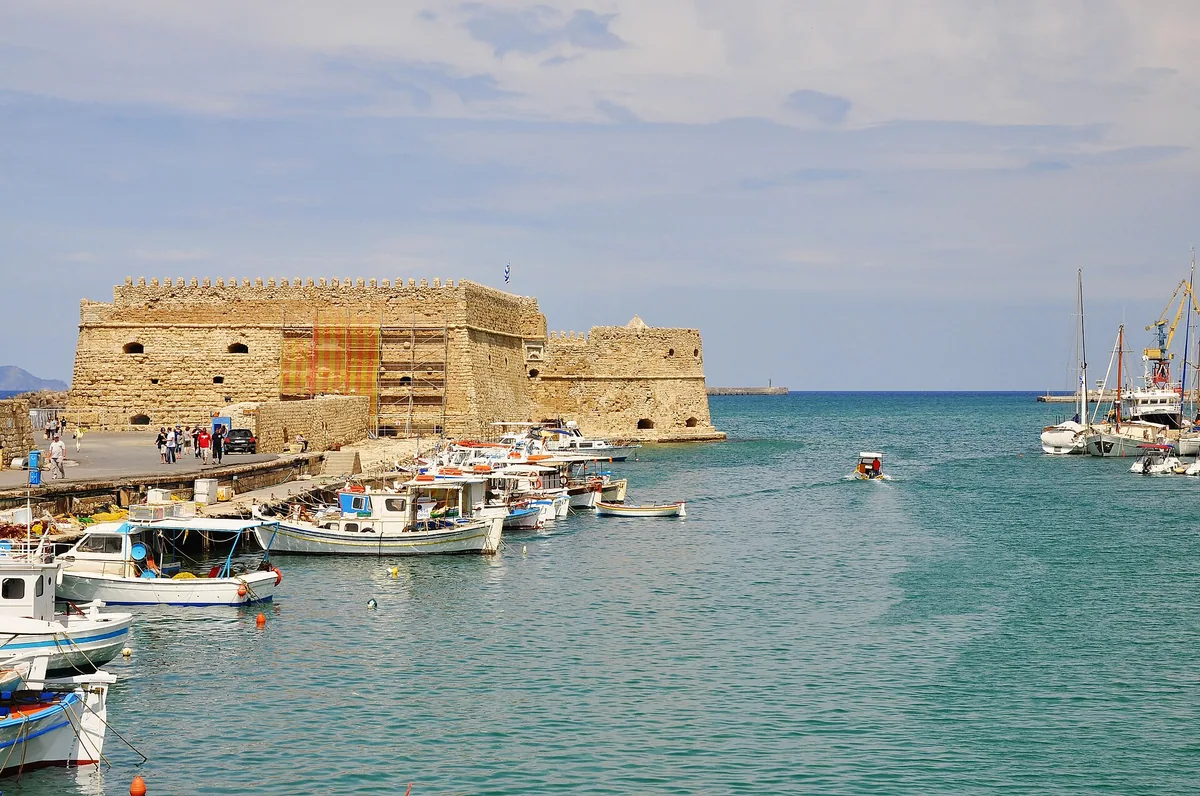
Crete · Greece
Heraklion
Crete has two ferry doors and they are 150 kilometres apart. Choosing the wrong one does not cost you a ferry — it costs you a day of driving at the far end. Heraklion is the busier of the two, and it is the only one from which you can reach the Cyclades by sea, which for a lot of itineraries settles the question before price does.
Getting to Heraklion by ferry
Direct crossings serving Heraklion — open one for its full timetable.
Heraklion to Milos
- Fastest crossing
- 4h 40m
- Operators
- 1 operator
See schedule
Heraklion to Naxos
- Fastest crossing
- 3h
- Operators
- 1 operator
See schedule
Heraklion to Syros
- Fastest crossing
- 5h 15m
- Operators
- 1 operator
See schedule
Heraklion ferry crossings at a glance
| Route | Crossing | Sailings | Operators | Country |
|---|---|---|---|---|
| Heraklion → Naxos | 3h | 1 / wk | 1 | Greece |
| Heraklion → Milos | 4h 40m | 1 / wk | 1 | Greece |
| Heraklion → Syros | 5h 15m | 1 / wk | 1 | Greece |
Heraklion or Chania: the actual difference
Both take overnight ships from Piraeus and both work well. What separates them is what happens next:
- Heraklion — more operators, more frequency, and the island-hopping links. Knossos and central Crete are on the doorstep; the east of the island is reachable.
- Chania — the port is at Souda, 7 km east of town, and it is the door for western Crete: the Samaria Gorge, Elafonisi, Kissamos.
The two ports are about 150 km apart, roughly two and a half hours by road. If your accommodation is west of Rethymno, sail to Chania even if Heraklion had a better fare.
The Cyclades link only exists here
This is the part that decides most trips. From Heraklion you can sail on to the islands:
- Santorini — 4 sailings, about 2 hours, on Blue Star, Minoan Lines and SeaJets.
- Milos — 5 sailings, roughly 4 h 20 m.
- Naxos, Anafi and Syros — single sailings, but they exist.
From Chania, none of these do. Combining Crete with the Cyclades in one trip means arriving or leaving through Heraklion.
The overnight from Athens
Heraklion to Piraeus takes about 9 h 15 m with 5 sailings in our timetable. The ships leave at 21:00 and dock around six or seven in the morning — a night's sleep that also happens to be the journey.
At the Athens end, Crete ferries use gates E2 and E3 at Piraeus. That is worth writing down: Piraeus is enormous, the gates are far apart, and the taxi rank does not know which one you want unless you say.
Book a cabin, not a seat
On a nine-hour overnight the difference between a cabin and an airline-style seat is the difference between arriving rested and arriving wrecked at 06:00 with a full day of Crete ahead of you.
The economics usually work out anyway: a cabin replaces a hotel night at both ends of the trip. Book it early in July and August, when the Cretan routes carry as much resident and freight traffic as tourist traffic.
What Heraklion opens up
Knossos is fifteen minutes from the port, and the Archaeological Museum in the city holds the finds from it — the two belong together and most people see only one. Beyond that, Heraklion is the base for central and eastern Crete: the Lasithi plateau, Malia, Agios Nikolaos, and eventually Sitia at the far end.
The city itself gets skipped by visitors in a hurry to leave it, which is a fair judgement about the outskirts and an unfair one about the old harbour and the Venetian walls.
Arriving with a vehicle
All the Piraeus ships are car ferries and Heraklion is the more straightforward Cretan port for driving off: the road network out of the city is direct in three directions, and the east of the island is only sensibly reachable from here.
If you are shipping a vehicle unaccompanied rather than driving it aboard, Heraklion is also the Cretan port that handles it — Chania does not.
Two doors, one island, one plan
A common and good itinerary: fly into Chania, work east, and sail out of Heraklion to Santorini. It avoids backtracking, uses each port for what it is best at, and turns the 150 km between them into the trip rather than a chore.
The reverse works equally well. What does not work is booking both legs through the same port because it was simpler at the time.
When to sail
The Piraeus overnights run year round — they are Crete's supply line, not a seasonal service. The Cyclades links are the seasonal part, thickening from May and thinning after September, with Santorini holding on longest.
Late September is the best window here: the sea crossings are all still running, the museum and Knossos are bearable, and the island is no longer at capacity.
Heraklion ferry & travel FAQ
Should I sail to Heraklion or Chania?
Heraklion has more operators and frequency, and it is the only Cretan port with ferry links to the Cyclades. Chania's port at Souda is the door for western Crete. They are about 150 km apart, so choose by where you are staying, not by fare.
How long is the ferry from Athens to Heraklion?
About 9 hours 15 minutes, with five sailings in our timetable. The ships leave Piraeus at 21:00 and arrive around 06:00 to 07:00.
Which gate at Piraeus do Crete ferries use?
Gates E2 and E3. Piraeus is a very large port and the gates are far apart, so give the specific gate rather than just asking for the ferry terminal.
Can I get from Heraklion to Santorini by ferry?
Yes — about two hours, with four sailings on Blue Star Ferries, Minoan Lines and SeaJets. This link does not exist from Chania.
Is a cabin worth it on the overnight ferry?
On a nine-hour crossing that docks at 06:00, yes. It also replaces a hotel night, so the cost difference is smaller than it looks. Book early for July and August.
Which Cretan port handles unaccompanied vehicles?
Heraklion. Chania does not handle unaccompanied vehicle shipments.
What can I reach from Heraklion?
Knossos is fifteen minutes away, with the finds displayed at the Archaeological Museum in the city. Heraklion is also the base for central and eastern Crete — the Lasithi plateau, Agios Nikolaos and Sitia.
Do Heraklion ferries run all year?
The Piraeus overnights do; they are Crete's supply line. The Cyclades connections are seasonal, running roughly May to September with Santorini lasting longest.
More Crete destinations
Reviewed by Serhat Özçelik, Founder & Editor of Ferry Schedule Hub · Last updated August 8, 2026.