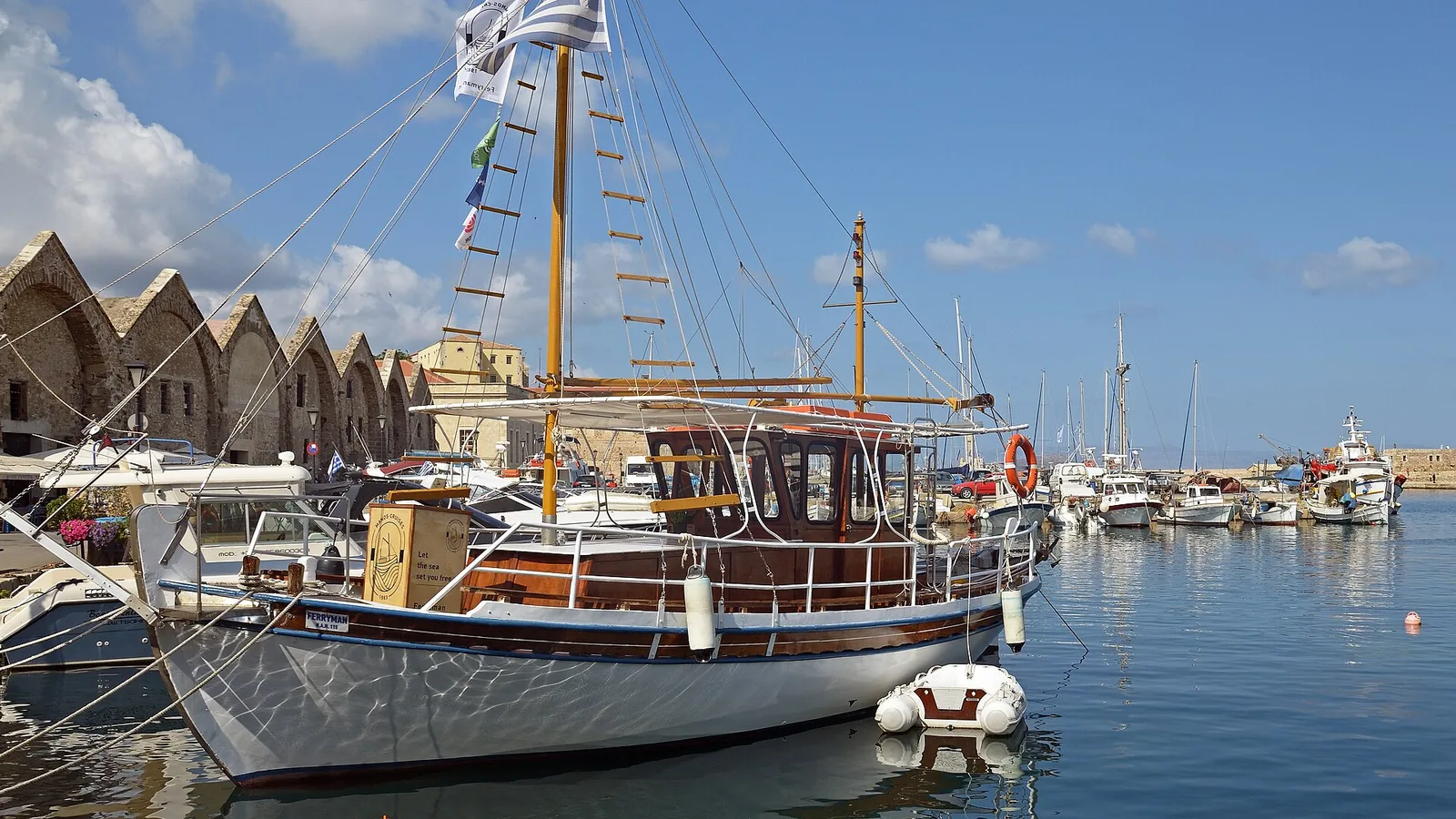
Crete · Greece
Chania
You reach Chania by ferry through Souda, the working port about 7 km east of the Old Town in far-western Crete. The signature link is the overnight boat from Piraeus (Athens): it sails in the evening and lands you at Souda soon after dawn, roughly a 9-hour crossing. From the quay a city bus or taxi drops you at the Venetian harbour in 15-20 minutes. Chania itself is Crete's most photogenic town, a lighthouse-topped harbour and Venetian-Ottoman lanes that make the best base for the wild west of the island.
The signature crossing: Piraeus to Souda, overnight
For most travellers, reaching Chania means one boat: the nightly conventional ferry from Athens's port of Piraeus across the Aegean to Souda Bay. It is a true overnight sailing. Departures leave Piraeus in the evening, typically around 21:00 in the off-season and 22:00 at the height of summer, berthing at Souda in the early morning. ANEK gives the scheduled duration as 9 hours 25 minutes; in practice arrival falls between 05:30 and 07:00 depending on ship and season.
Find Gate E3. Piraeus is enormous and the Crete boats do not leave from the part of the port most visitors walk into. The operator directs Chania passengers to Gate E3 — worth knowing before you arrive with luggage at 20:30 looking for a ship that is a twenty-minute walk away.
These are full-size conventional car-and-passenger ships, not high-speed catamarans, with cabins, reclining seats, lounges, bars and open decks. The whole point is that the journey is the hotel: you board after dinner, sleep at sea, and step off with a complete first day in Crete ahead of you. See our Piraeus to Chania overnight ferry route page for current departure times and live pricing.
One operator note worth understanding: following the merger of ANEK Lines into the Attica Group, the Piraeus-Chania line is now run by Attica, with sailings marketed under the ANEK Lines and Blue Star Ferries brands. The ships you are most likely to board are the Elyros and El. Venizelos, both wearing the familiar ANEK livery. Whichever brand appears on your ticket, it is the same daily service to the same berth at Souda.
Souda is not the Venetian harbour: arriving and reaching town
This trips up first-time visitors, so it is worth saying plainly: ferries dock at Souda, not at Chania's famous Old Venetian Harbour. The postcard harbour with the Egyptian lighthouse is a small, shallow basin used today only by fishing boats, wooden kaikia and yachts. Big ferries stopped using it generations ago.
Souda, about 7 km east around the bay, is a modern commercial and passenger port that doubles as a NATO naval base, so expect an industrial, workmanlike feel with warships alongside the ferry quay rather than tavernas. The terminal address is Leoforos Soudas, Souda 732 00, and Chania International Airport is a further 14–17 km away on the Akrotiri peninsula — relevant if you are pairing a ferry in with a flight out.
You cannot walk from Souda to the Old Town, but connections are easy. City bus route 13 links the port with central Chania roughly every 20 minutes, taking about 20–25 minutes for a couple of euros, and drops you near the Agora (covered market), a short walk from the harbour. A taxi covers the same distance in around 15 minutes; budget €15–20. Taxis queue at the port on ferry arrival, but a full boat can clear the rank quickly, so join it promptly or pre-book if you land at dawn with luggage. Long-distance KTEL buses also call at Souda if you are heading straight on to another part of Crete.
Cabin, airplane seat, or deck? Choosing your overnight passage
On an overnight crossing your ticket type matters more than on a two-hour daytime hop. There are three broad choices:
- Deck / economy (unreserved): the cheapest fare, giving you a seat in a common lounge and access to the decks. Adult deck tickets start around €37–52. Fine for tough sleepers or short-notice budget travel, but you are not guaranteed a proper place to lie down.
- Reserved airplane-style seat: a numbered reclining seat, from roughly €41. A modest upgrade that guarantees you a spot, though sleeping upright for nine hours is a compromise.
- Cabin: the option we recommend for the overnight run. Cabins have proper beds and an en-suite bathroom, and start around €86.
Reading the cabin codes. ANEK labels cabins with a letter and a number, and once you know the pattern the booking screen stops being cryptic: A means an outside cabin with a window or porthole, AB means an inside cabin, and the digit is the number of berths. So AB4 is a four-berth inside cabin and A2 is a two-berth outside cabin. Single-berth cabins are AB1 and A1. Outside costs roughly €7–15 more than the equivalent inside.
Because the overnight ferry effectively replaces a night's hotel, a cabin fare is genuinely competitive with flying once you factor in accommodation saved. The catch is availability: deck seats are usually there right up to departure, but cabins sell out first, especially in July and August, so book them as early as you can.
Bringing a car (or camper) to western Crete
Crete is huge and its best corners, the west especially, reward having your own wheels, so the Piraeus-Chania ferry is a popular way to bring a vehicle. Car decks are standard on these conventional ships. Indicative one-way vehicle fares are roughly €85 and up for a car, from around €28 for a motorcycle, and about €157 for a motorhome, always on top of the per-passenger fare.
Check the packages before you book separately. ANEK sells combined passenger-plus-car fares on this route that undercut adding the two together. Published examples: one passenger in economy with a car €129; with an aircraft-type seat €134.50; with a berth in a four-berth inside cabin (AB4) €174, or an outside A4 €181.50; a single-berth inside cabin (AB1) with car €249.50. Whole-cabin packages exist too — two people in an AB2 with a car €243, four people in an AB4 with a car €281. There are separate discounted packages for Greek university students.
The critical rule is to book vehicle space early: car decks on the Crete routes fill fast in summer, they sell out well before foot-passenger tickets do, and a sold-out deck cannot be squeezed. If you would rather fly yourself and have the car meet you, note that unaccompanied vehicle transport is offered on the Piraeus-Heraklion line rather than to Chania, so that means collecting it at Heraklion.
Chania or Heraklion? Picking your Cretan gateway
Crete has two main ferry gateways from Athens, and choosing the right one saves hours of driving. The rule of thumb is simple: arrive at the port nearest where you actually want to be.
Choose Chania (Souda) for the west: Chania Old Town, the Samaria Gorge, and the show-stopping beaches of Balos, Elafonisi and Falasarna. The Piraeus-Chania service is essentially the overnight conventional boat described above.
Choose Heraklion for central and eastern Crete, the Palace of Knossos, or if you simply want the widest choice of sailings. Heraklion is Crete's primary maritime hub, sits mid-island, and is served by both conventional overnight ferries and, seasonally, faster high-speed vessels, with crossings from Piraeus a touch shorter at around 7.5 hours. If your base is the far east, around Agios Nikolaos or the Lasithi coast, consider that Sitia has its own long-distance ferry link too. The two north-coast ports are about a 2.5-hour drive apart, so landing at the wrong end of the island is a real time cost, not a minor one.
Seasons, prices and when to book
The Piraeus-Chania line runs year-round, typically with 1-2 daily crossings. Frequency and demand swing hard with the calendar:
- July and August (peak): the busiest window. Passenger deck tickets remain easy, but cabins and vehicle spaces sell out well in advance, often two to four months ahead. If your dates are fixed and you want a cabin or car space, book as early as your plans allow.
- Shoulder season (May-June, September-October): the sweet spot. Daily sailings continue, the crossing is calmer and cooler, and you can usually secure a cabin a few weeks out.
- Winter: the route still operates most days but with reduced frequency, and rough Aegean weather can occasionally disrupt schedules. Off-season, booking a month ahead is generally plenty.
Fares are dynamic, so the same cabin can cost noticeably more on a peak Friday than a quiet Tuesday. Base deck fares hover in the mid-30s to low-50s of euros, with cabins layered on top. The earlier you commit, the better the price and the more likely you are to get the berth type you want.
Beyond Piraeus: Kissamos, Gavdos and island-hopping
The Athens overnight boat is not the only ferry serving the Chania region. Two smaller ports widen your options:
- Kissamos (Kastelli), about 40 km and 40 minutes' drive west of Chania, runs seasonal ferries down the western seaboard to the island of Kythira, tiny Antikythira, and Gythio on the Peloponnese, usually a few times a week in summer. It is a useful backdoor if you are combining Crete with the southern Peloponnese rather than Athens.
- Paleochora, on Chania's south coast, is the departure point for the little ferries to remote Gavdos, the southernmost island in Europe, several times a week in season, along with the scenic coastal boats to Sougia, Agia Roumeli (the foot of the Samaria Gorge) and Loutro.
For classic Greek-island hopping, remember that Crete sits at the bottom of the map: direct high-speed links to the Cyclades run mainly from Heraklion, so pairing Chania with Santorini or Mykonos usually means routing via Heraklion or back through Piraeus. Plan those legs around the overnight Chania boat rather than assuming a quick daytime hop straight from Souda.
Before you sail: the practical bits
A few things regular travellers on this route take for granted, and first-timers usually learn the hard way.
- Allow two hours at Piraeus in summer. Gate E3 is a walk from where most people enter the port, and boarding a full car ferry in July takes longer than you think. Outside high season an hour is enough.
- The car deck sells out before the passenger deck. If you are bringing a vehicle, that is the booking that constrains your dates — sort it first and fit the cabin around it.
- Deck class is not a quiet option. The lounges have televisions that often stay on through the night, and the reclining seats are shared space. If you genuinely need to sleep, the cabin is not a luxury on this crossing, it is the difference between arriving rested and arriving wrecked.
- You arrive very early. Berthing between 05:30 and 07:00 means you are in Chania before most hotels will check you in. Either book the previous night so the room is waiting, or plan a slow breakfast in the Old Town — the harbour at dawn, before the tour groups, is one of the better arguments for taking the boat.
- Web check-in and phone cabin keys. ANEK offers online check-in and, on the newer ships, a digital cabin key you use from your phone, alongside onboard wi-fi. Sort the check-in before you leave for the port rather than queueing for a paper boarding card.
Chania ferry & travel FAQ
How long is the ferry from Athens (Piraeus) to Chania?
ANEK gives the scheduled crossing as 9 hours 25 minutes. Ships leave Piraeus in the evening — around 21:00 in the off-season, 22:00 at the height of summer — and berth at Souda between roughly 05:30 and 07:00, so you sleep through most of the journey.
Which gate does the Chania ferry leave from at Piraeus?
Gate E3. Piraeus is a large port and the Crete boats do not depart from the section nearest the metro, so allow time to walk. Consult the port map if you are arriving with luggage or a vehicle.
Does the ferry arrive in Chania town or somewhere else?
Ferries dock at Souda, a working commercial and naval port about 7 km east of Chania, at Leoforos Soudas, Souda 732 00. It is not the picturesque Old Venetian Harbour, which today handles only small boats. City bus route 13 runs into the centre roughly every 20 minutes in about 20–25 minutes for a couple of euros; a taxi takes around 15 minutes and costs about €15–20.
What do the cabin codes AB4 and A2 mean?
The letter is the cabin type and the number is the berth count. A is an outside cabin with a window or porthole; AB is an inside cabin. So AB4 is a four-berth inside cabin and A2 is a two-berth outside one. AB1 and A1 are single-berth cabins. Outside cabins cost roughly €7–15 more than the equivalent inside.
Should I book a cabin or just a deck seat for the overnight ferry?
For an overnight sailing we recommend a cabin — real beds, an en-suite bathroom, from around €86. Deck and reserved-seat tickets are cheaper but mean sleeping upright in a shared lounge where the televisions often stay on all night. Cabins also sell out first, especially in July and August.
Can I take my car on the ferry to Chania?
Yes. These are conventional car-and-passenger ships. Expect roughly €85 and up for a car and from about €28 for a motorcycle, on top of passenger fares — but check ANEK's combined packages first, which bundle a passenger and a car from about €129 in economy or €174 with a berth in a four-berth inside cabin. Car space sells out before foot-passenger tickets, so book it early. Unaccompanied vehicle delivery is offered on the Piraeus–Heraklion line, not to Chania.
How early should I get to the port?
Two hours before departure in July and August, an hour outside high season. If you are travelling with a vehicle, err towards the earlier end — loading a full car deck is the slow part.
Is there a faster way to reach Chania than the overnight boat?
Flying is quicker door to door, but the overnight ferry replaces a night's accommodation, which changes the real comparison. A seasonal daytime high-speed service also runs on some Crete routes, cutting the crossing substantially, though the overnight sailing is the year-round backbone and carries the freight and most vehicles.
Can I get from Chania to the other Greek islands directly?
Rarely in one hop. Crete sits at the bottom of the map and the direct high-speed links to the Cyclades run mainly from Heraklion, so pairing Chania with Santorini or Mykonos usually means routing via Heraklion or back through Piraeus. Kissamos, 40 km west, is the exception: it runs seasonal ferries to Kythira, Antikythira and Gythio on the Peloponnese.
More Crete destinations
Reviewed by Serhat Özçelik, Founder & Editor of Ferry Schedule Hub · Last updated August 8, 2026.