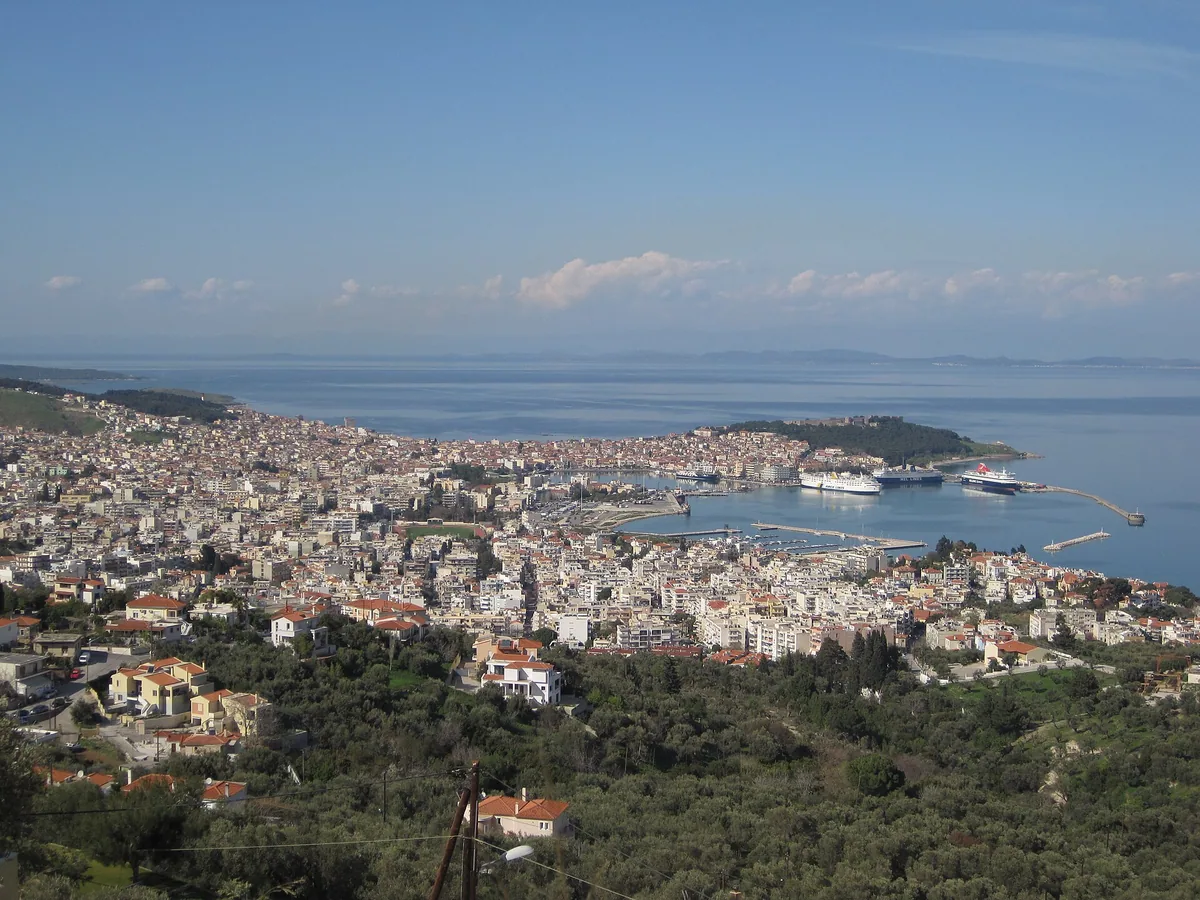
North Aegean · Greece
Lesvos
Lesvos covers 1,632 square kilometres — bigger than several countries with seats at the United Nations — and it is twelve hours from Athens by sea. It is also ninety minutes from Turkey. Those two numbers together explain almost everything about how the island works, including why most visitors arrive with a plan for a week and discover they have booked one for a weekend.
Getting to Lesvos by ferry
Direct crossings serving Lesvos — open one for its full timetable.
Lesvos to Ayvalik
- Fastest crossing
- 1h 30m
- Operators
- 1 operator
See schedule
Lesvos to Piraeus
- Fastest crossing
- 12h 20m
- Operators
- 1 operator
See schedule
Lesvos ferry crossings at a glance
| Route | Crossing | Sailings | Operators | Country |
|---|---|---|---|---|
| Lesvos → Ayvalik | 1h 30m | 2 / wk | 1 | Greece |
| Lesvos → Piraeus | 12h 20m | 2 / wk | 1 | Greece |
The scale problem
This is the third largest of the Greek islands and it does not behave like an island. Mytilene, the port and capital, is in the southeast. The petrified forest at Sigri is at the far western tip. The distance between them is a real drive, not a bus ride, and the road goes around a gulf rather than across it.
Plan Lesvos as you would plan a region: pick a base, accept that you will not see all of it, and hire a car. A day trip here reaches roughly a tenth of the island.
Turkey is the near shore
Ayvalık takes about 90 minutes in our timetable, with three sailings each way; the fastest craft do the crossing in well under an hour, and in high summer the link runs several times a day. There is a second crossing to Aliağa at around 110 minutes.
Compare that with 12 hours to Piraeus. If you are coming from outside Greece, flying to İzmir and crossing from Ayvalık is a serious alternative to routing through Athens, and it is not the option the booking sites put in front of you.
The Thessaloniki ship
Lesvos has something almost no other Aegean island has: a direct sailing to Thessaloniki, around 13 hours with Blue Star.
For anyone based in northern Greece, or coming overland from the Balkans, this removes the entire journey down to Athens. It is a single sailing in our timetable rather than a frequent service, but it exists, and most itineraries never consider it.
The North Aegean chain
Chios is the strongest link — 8 sailings southbound at about 2 h 25 m, on Blue Star and Hellenic Seaways. Together with Samos further south, the three islands form a line rather than a cluster.
See the Chios guide: the two islands run 19 sailings between them across both directions, which is frequent enough that you do not have to decide in advance which one you sleep on.
What the island is actually known for
Two things, and neither is a beach. Lesvos is the home of ouzo — three of the five best-selling Greek brands are distilled here, mostly around Plomari in the south. And the petrified forest at Sigri is the second largest in the world, a UNESCO-protected monument of fossilised trees standing where they grew twenty million years ago, with a natural history museum on site.
Add Molyvos in the north, a castle village on a headland, and Mytilene's own neoclassical waterfront, and the island rewards depth rather than a checklist.
⚠ Twelve hours means an overnight, and a cabin
The Piraeus crossing is a night at sea. Deck tickets exist and are cheap; on a twelve-hour sailing they are a poor trade, particularly if you are picking up a hire car on arrival.
Book the cabin, and if you are travelling in high summer book it early — the North Aegean routes carry residents and freight as much as visitors, and they do not have the seasonal surge capacity the Cyclades routes do.
Where to base yourself
Mytilene if you want the city, the ferry and the museums. Molyvos and Petra in the north if you want the postcard. Plomari and the southern coast for the ouzo country and the quieter beaches. Skala Eressou in the west if you are heading for the far end anyway.
What does not work is trying to combine two of those in a short stay. The island is too big and the roads are too slow for that to be anything but driving.
Season
Piraeus and Chios sailings run all year because the island has a resident economy. The Turkish crossings are concentrated from spring to autumn and peak between June and September, when Ayvalık runs at its fullest.
May and September are the best of it — the crossings are all running, the driving is comfortable, and the island is at a scale where the absence of crowds actually shows.
Lesvos ferry & travel FAQ
How big is Lesvos?
About 1,632 square kilometres, the third largest Greek island. Mytilene is in the southeast and the petrified forest at Sigri is at the western tip — the distance between them is a real drive, so hire a car.
How long is the ferry from Athens to Lesvos?
Roughly 12 hours from Piraeus in our timetable, overnight. A cabin is worth booking, especially in summer when the route carries residents and freight as well as visitors.
How long is the ferry from Lesvos to Turkey?
About 90 minutes to Ayvalık in our timetable, with three sailings each way; the fastest craft do it in well under an hour. There is a second crossing to Aliağa at around 110 minutes.
Can I get to Lesvos from Thessaloniki?
Yes — a direct sailing of around 13 hours with Blue Star Ferries. It is a single sailing in our timetable rather than a frequent service, but almost no other Aegean island has one at all.
What is Lesvos famous for?
Ouzo — three of the five best-selling Greek brands are distilled here, mostly around Plomari — and the petrified forest at Sigri, the second largest in the world and a UNESCO-protected monument.
How do I get from Lesvos to Chios?
Eight sailings southbound at about 2 hours 25 minutes on Blue Star Ferries and Hellenic Seaways. The two islands run 19 sailings between them across both directions.
Where should I stay on Lesvos?
Mytilene for the city and the ferry, Molyvos and Petra in the north for the scenery, Plomari in the south for the ouzo country, Skala Eressou in the west. Do not try to combine two — the island is too big.
When is the best time to visit Lesvos?
May and September. All the crossings are running, driving is comfortable, and on an island this size the absence of crowds is actually noticeable.
More North Aegean destinations
Reviewed by Serhat Özçelik, Founder & Editor of Ferry Schedule Hub · Last updated August 8, 2026.