Ionian Islands · Greece
Cephalonia
Almost everyone planning a ferry to Cephalonia starts by looking at Patras, because Patras is the port they have heard of. Our timetable holds two sailings from there. It holds sixteen from Kyllini, a small harbour eighty kilometres further south that most people have never heard of at all. Getting this one decision right saves half a day.
Getting to Cephalonia by ferry
Direct crossings serving Cephalonia — open one for its full timetable.
Cephalonia to Ithaca
- Fastest crossing
- 30m
- Operators
- 3 operators
See schedule
Cephalonia to Kyllini
- Fastest crossing
- 1h 30m
- Operators
- 2 operators
See schedule
Cephalonia ferry crossings at a glance
| Route | Crossing | Sailings | Operators | Country |
|---|---|---|---|---|
| Cephalonia → Ithaca | 30m | 4 / wk | 3 | Greece |
| Cephalonia → Kyllini | 1h 30m | 3 / wk | 2 | Greece |
Kyllini is the answer
Kyllini to Poros on Cephalonia runs about 90 minutes and carries 16 sailings in our timetable, with Levante Ferries and Kefalonian Lines. It runs year round and it is the fastest way onto the island by sea.
By comparison, Patras holds two sailings. Patras is the bigger, more famous port — it is also facing the wrong way for this particular island.
Five ports, and they face different directions
Cephalonia is large and its harbours point at different neighbours:
- Poros — the Kyllini gate on the southeast coast. Year round.
- Sami — east coast, for Patras and Astakos on the mainland. Year round.
- Fiskardo — the far north, seasonal, for Nydri on Lefkada.
- Pessada — the south, seasonal, for Zakynthos.
- Argostoli — the capital, seasonal traffic.
The mistake is choosing by crossing time and then discovering that your port is an hour's drive from your village on an island where the roads go around mountains.
Ithaca is twenty minutes away
Cephalonia to Ithaca runs at 20 to 30 minutes with 12 sailings across both directions, on Levante, Kefalonian Lines and Ionian Sea Ferries.
That is frequent enough to make Ithaca a genuine afternoon rather than an expedition, and it is the reason to base on Cephalonia rather than on the smaller island: you get the Homeric one as a day trip and a real supermarket to come home to.
The Italian sailing nobody expects
There is a link between Cephalonia and Bari, one sailing each way in our timetable, with Ventouris Ferries.
For most travellers this is a curiosity. For anyone driving between Italy and the Ionian, it removes the mainland entirely — no Patras, no Igoumenitsa, no drive across the Peloponnese. It is thin and seasonal, so confirm before planning around it.
Zakynthos, and the gap in the map
Pessada to Zakynthos is the only direct island-to-island link south, at about 80 minutes with two sailings.
It is seasonal, it is small, and both its harbours are inconveniently placed for the towns they serve. Island-hopping the Ionian is not the smooth chain that the Cyclades offer — more often you go back to the mainland and come out again.
Getting around once you land
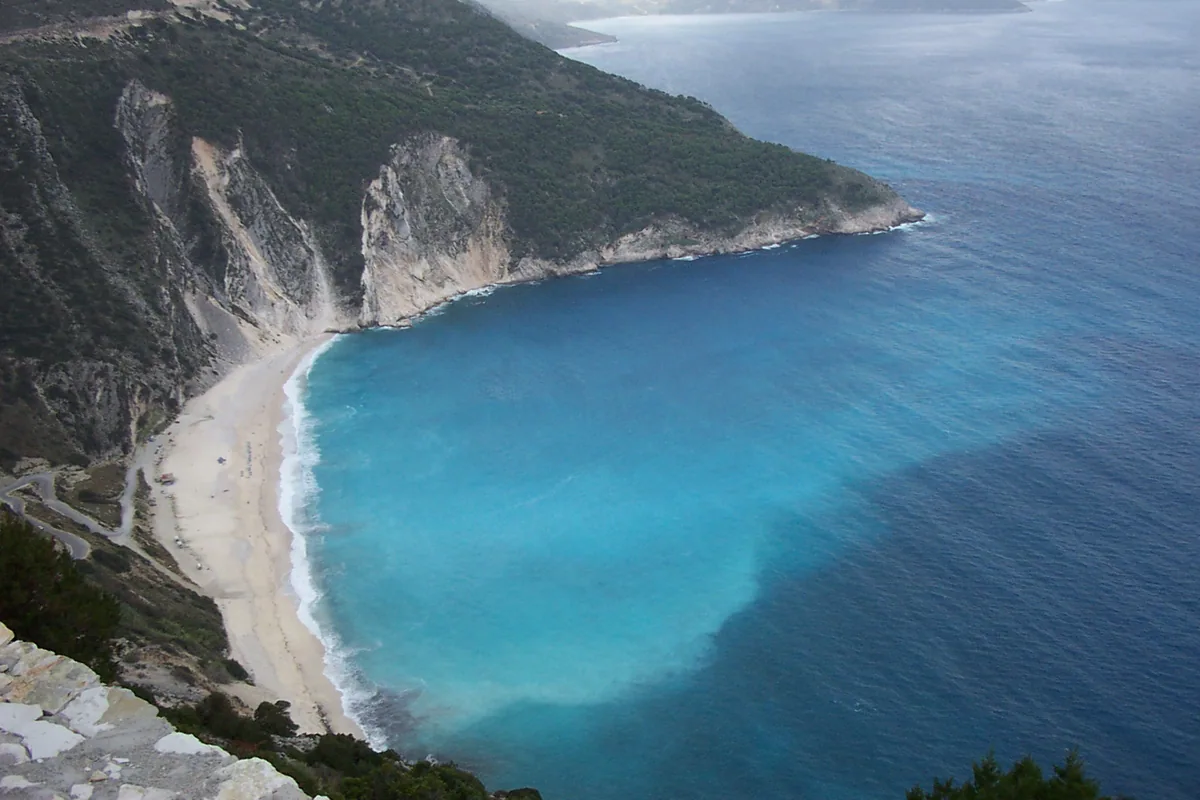
Hire a car. Cephalonia is mountainous, the villages are spread thin, and the bus network exists for residents rather than for a beach itinerary. Myrtos, the beach in every photograph of the island, is reached by a road that descends a cliff in switchbacks; there is no bus that makes it a casual outing.
Distances look small and take twice as long as they should. Budget accordingly, particularly if you are catching a ferry from a port at the other end.
What the island is for
Melissani cave, where the roof collapsed and left a lake lit from above. Assos, a village on an isthmus below a Venetian fort. Myrtos, which really does look like that. And a great deal of quiet interior that the coach tours never reach.
It is also the island of the 1953 earthquake, which flattened almost everything except Fiskardo — which is why the north looks old and the rest of the island looks like the 1950s.
Season
Poros and Sami run year round. Fiskardo, Pessada and Argostoli are summer services and disappear entirely in winter, which narrows a five-port island down to two.
June and September carry the full network with room on the boats. If you are travelling outside those months, check which of the five ports is actually open before booking accommodation near it.
Cephalonia ferry & travel FAQ
Which mainland port should I use for Cephalonia?
Kyllini, not Patras. Kyllini to Poros takes about 90 minutes and carries 16 sailings in our timetable, year round; Patras holds two. Kyllini is 80 km further south and far less well known.
How many ports does Cephalonia have?
Five. Poros and Sami run year round; Fiskardo, Pessada and Argostoli are seasonal. They face different directions, so choose by where you are staying rather than by crossing time.
How long is the ferry from Cephalonia to Ithaca?
Twenty to thirty minutes, with twelve sailings across both directions. That makes Ithaca an afternoon trip rather than an expedition.
Can I sail from Italy to Cephalonia directly?
There is a Ventouris Ferries link to Bari, one sailing each way in our timetable. It is thin and seasonal, so confirm before planning around it — but it removes the mainland Greek leg entirely.
How do I get from Cephalonia to Zakynthos?
Pessada to Zakynthos, about 80 minutes with two sailings. It is seasonal and both harbours are awkwardly placed for their towns — Ionian island-hopping is less smooth than the Cyclades.
Do I need a car on Cephalonia?
Yes. The island is mountainous, villages are spread out, and the bus network serves residents rather than beaches. Myrtos is reached by a switchback cliff road with no casual bus option.
What is there to see on Cephalonia?
Melissani cave, where the collapsed roof leaves a lake lit from above; Assos on its isthmus below a Venetian fort; and Myrtos beach. Fiskardo in the north survived the 1953 earthquake that flattened the rest of the island.
Do Cephalonia ferries run in winter?
Poros and Sami do. Fiskardo, Pessada and Argostoli close, which reduces a five-port island to two — check which port is open before booking accommodation near it.
Reviewed by Serhat Özçelik, Founder & Editor of Ferry Schedule Hub · Last updated August 8, 2026.