 (c) Andy Li / CC0
Wheelchair and Accessible Ferry Travel: Your Rights and How to Book Assistance
Disabled and reduced-mobility passengers have a legal right to free ferry assistance. Here's what to expect on board and the 48-hour rule to know.
By Serhat Özçelik, Founder & Editor of Ferry Schedule Hub· Published July 13, 2026
If you use a wheelchair, travel with a mobility aid, or have any condition that makes moving around harder, a ferry can be one of the easiest ways to cross water with your own vehicle and belongings. It can also feel like a leap into the unknown: every ship is different, ports are busy, and operator websites bury the details. The good news is that in Europe and the UK you have clear, enforceable rights to free assistance, and most of the friction disappears once you understand one simple rule and make one phone call. This guide explains what you are legally entitled to, what is realistically available on board, and exactly how to arrange help before you travel.
You have a legal right to free assistance
Ferry travel across the EU is governed by Regulation (EU) No 1177/2010, which sets out the rights of passengers travelling by sea and inland waterway. It gives disabled passengers and passengers with reduced mobility the right to the same opportunity to travel as everyone else. The core protections are:
- You cannot be refused a booking or boarding because of your disability or reduced mobility. Operators may only decline in two narrow cases: a genuine safety requirement, or where the design of the ship or the port makes it physically impossible to carry you safely.
- Assistance is free of charge. Carriers and terminal (port) operators must help you board, disembark, change ships and move around during the voyage, at no cost.
- Your equipment travels free. You will not be charged for bringing medical or mobility equipment that you reasonably need for the crossing, provided it is permitted on board.
- An accompanying person travels free. If the operator decides a companion is necessary in order to meet safety requirements, that person is carried free of charge.
The UK kept this regulation in domestic law after Brexit (via the European Union (Withdrawal) Act 2018), so the same rights apply to UK sailings. The Maritime and Coastguard Agency (MCA) is the national enforcement body in the UK; other EU countries have their own designated bodies, and the European Consumer Centres Network can give free advice if a dispute arises.
The one rule that matters most: notify 48 hours ahead
Here is the single most important practical point. The operator's duty to guarantee assistance is conditional on you telling them you need it at least 48 hours before departure — and turning up at the port in good time. You can notify by any reasonable means: at the time of booking, by phone, by email, and often through an online form.
If you give less than 48 hours' notice, you are not turned away, but the guarantee weakens: the carrier and port must make all reasonable efforts to help, but they cannot promise that assistance or an accessible cabin will be available at short notice. Because staff, lifts and adapted cabins are limited, treat 48 hours as a bare minimum and book the help as early as you can. Turning up on the day and hoping for the best is the one scenario the rules do not protect you from.
How to request assistance when you book
Requesting help is straightforward, but the exact channel varies by operator. In general:
- Flag your needs while booking. Most operators have an accessibility or "reduced mobility" section during checkout, or a dedicated phone line and email address (DFDS, for example, uses a dedicated accessible-travel inbox). Booking by phone is often easier than online because you can describe your exact requirements.
- Be specific about the level of help. Say whether you can walk short distances, whether you use a manual or powered wheelchair, whether you need a lift rather than stairs, and whether you need an accessible cabin. Vague requests lead to the wrong help on the day.
- Ask for it to be recorded on the booking and repeat your requirements at check-in when you reach the port, so the boarding crew are expecting you.
- Declare medical equipment in advance. Items like a CPAP machine travel free, but things such as medical oxygen usually need written authorisation from your doctor and advance notice, because of how it is stored and handled on board.
Because check-in and boarding can involve extra steps, it is worth reading our guide on how early you should arrive for a ferry and adding a buffer — priority boarding for assisted passengers sometimes happens before, and sometimes after, the main queue.
What's available on board
Facilities vary enormously between a large overnight cruise-ferry and a small local boat, but on most mainstream vessels you can expect some combination of the following:
- Step-free access between decks. Most ferries have lifts from the vehicle decks, or passenger ramps suitable for wheelchair users, so you can reach the passenger areas without stairs. On some ships a few spaces (an upper-deck bar, for instance) may still be reachable only by staircase, and certain lifts are switched off between particular decks while at sea.
- Accessible cabins. Ships with cabins usually have a number of adapted cabins with wider doors and step-free en-suite facilities, sometimes with grab rails and roll-in showers. Numbers are limited and vary by route, so these need booking early.
- Accessible toilets in the public areas on most member vessels, though this varies ship to ship.
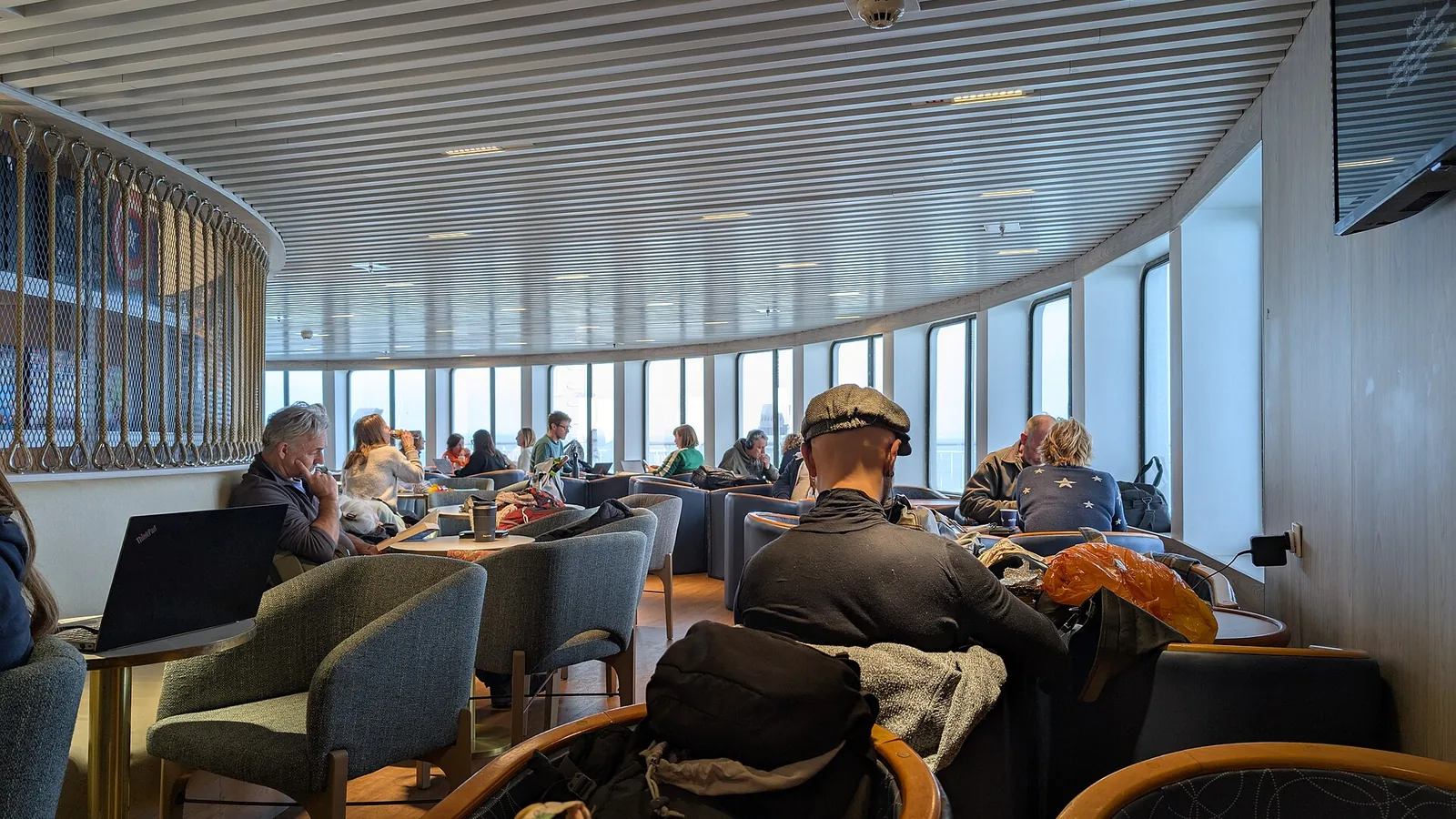
- Priority seating and wheelchair spaces in the lounges, often near the accessible facilities, plus anchored seating with belts if you stay in your own wheelchair.
- Loan wheelchairs. Powered wheelchairs and mobility scooters often cannot be used in passenger areas; they may be carried as freight or left on the vehicle deck, with a standard wheelchair provided for use during the crossing.
- Sensory support. Some ships carry Braille signage and induction loops, and crew can relay important announcements to passengers who are deaf or hard of hearing, or help with orientation if you are blind or partially sighted. Ask at the information desk on board.
One realistic limit worth knowing: crew provide travel assistance, not personal care. They will help you move around, but they cannot help with feeding, medication, toileting or lifting. If you need that kind of support, plan to travel with a companion. For a fuller picture of the general comforts you can expect once aboard, see our rundown of Wi-Fi, food and power on board.
Staying in your vehicle or travelling as a foot passenger
On most vehicle ferries, all passengers are asked to leave their car and go up to the passenger decks for the crossing — vehicle decks are dark, sealed and off-limits at sea for safety reasons. For disabled passengers there are two common accommodations:
- Lift-lane loading. If you need a lift to reach the passenger decks, tell the operator when you book and your vehicle will be parked in the designated lift lane, close to the lift, so you have the shortest possible route.
- Remaining in an adapted vehicle. Some operators allow a passenger who cannot easily leave their adapted vehicle to stay with it on the vehicle deck for the crossing, or to be seated in an accessible area nearby. This is not universal and depends on the route and the vessel, so confirm it in advance rather than assuming.
As a foot passenger, you board via a passenger walkway or ramp and staff meet you to help with boarding and finding your seat or cabin. Either way, boarding for assisted passengers is sometimes handled separately from the main flow to give you more space and time, which can mean a short additional wait.
Guide and assistance dogs
Recognised assistance dogs and guide dogs are carried free of charge and are allowed in all passenger areas, kept on a harness or lead. This is a firm right, not a favour. Two things to plan for: operators may ask for proof of accreditation (such as ADI or IGDF certification), and for cross-border sailings — into the EU or Northern Ireland, for example — your dog will need the usual pet-travel paperwork and health documentation. Emotional-support animals without assistance-dog accreditation are normally treated as ordinary pets and follow the standard pet rules.
What to check with each operator before you book
Rights are consistent; facilities are not. Before committing to a specific sailing, confirm the following for your exact route and ship:
- Whether an accessible cabin is available on that vessel, and how many wheelchair passengers the ship can carry per crossing — some operators cap this for safety (a handful of wheelchair users per sailing is typical), which is another reason to book early.
- Whether there is a lift to every deck you need, or only some.
- Whether you can stay in your vehicle, or must transfer to the passenger deck.
- The accessibility of the ports at both ends, not just the ship — terminal operators share the assistance duty, and a fully accessible ship can still be reached through an awkward terminal.
- Any requirement to travel with a companion.
Larger operators publish per-ship and per-port accessibility guides on their websites — use them. If accessibility is key to your trip, it is worth building in flexibility, because a cancelled sailing may push you onto a different, less-accessible ship; our guide to ferry delays, cancellations and your refund rights explains what you are owed if that happens.
Realistic caveats: small islands and older ferries
Accessible ferry travel has improved dramatically, but it is not uniform. On major routes and modern ships — think large operators on busy international and mainland-to-island crossings — lifts, ramps, adapted cabins and trained assistance are now the norm. The picture changes on small inter-island and local routes. Older or smaller vessels may have no lift, limited deck space, and no accessible toilet; small island quays can have steep or improvised boarding ramps; and these routes are also more prone to weather cancellations. In some regions, seasonal factors matter too — certain sea-access equipment may not be available in winter.
None of this removes your rights, but it does mean the practical experience varies. The safe approach is always the same: choose the most modern ship on your route where you can, contact the operator well beyond the 48-hour minimum, get your assistance recorded on the booking, and confirm the specifics for that exact vessel and both ports. Do that, and ferry travel becomes one of the more accessible and dignified ways to cross the water.
On this page
- You have a legal right to free assistance
- The one rule that matters most: notify 48 hours ahead
- How to request assistance when you book
- What's available on board
- Staying in your vehicle or travelling as a foot passenger
- Guide and assistance dogs
- What to check with each operator before you book
- Realistic caveats: small islands and older ferries
Frequently asked questions
Keep reading