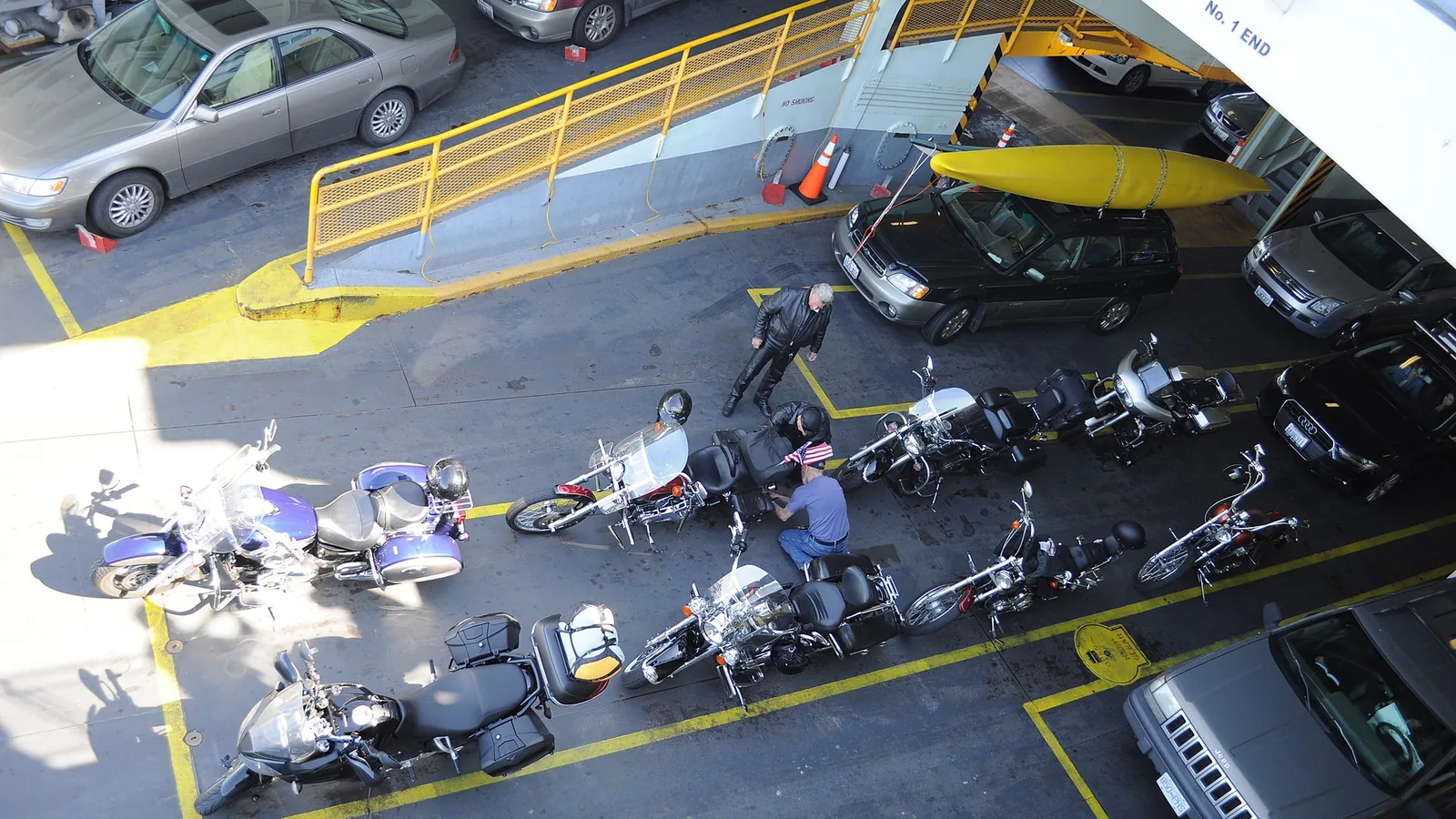
 (c) Joe Mabel / CC BY-SA 3.0
Taking a Motorcycle on a Ferry: Loading, Tie-Downs and Everything Riders Need to Know
How to book, board, strap down and protect your bike on a ferry — tie-down points, side-stand vs centre-stand, gear, alarms and wet-deck safety.
By Serhat Özçelik, Founder & Editor of Ferry Schedule Hub· Published July 13, 2026
Rolling a bike onto a ferry is one of the great small pleasures of motorcycle touring — but it is also the moment most likely to leave a scratch, a dropped bike or a triggered alarm you cannot reach for the next six hours. The forums are full of it: UKGSer, ADVrider and the marque boards all rehash the same questions crossing after crossing. This guide pulls the good advice into one place, from booking through to unloading on the far side, so you can board relaxed and step off with your paint and your dignity intact.
Booking: a bike is (usually) its own cheap vehicle category
You book a motorcycle almost exactly as you would a car — through the same reservation flow, selecting a vehicle rather than travelling as a foot passenger. You will normally be asked for the make, model and registration, and on some routes the length, so the loading crew know what they are fitting in. The good news is that a bike is a smaller vehicle category and is priced accordingly: on the Dover–Calais crossings run by DFDS, P&O and Irish Ferries a motorcycle and rider typically comes in cheaper than a car, with bike returns advertised around the £85 mark against roughly £90–£155 for a car and two people. On short cross-Channel hops the Eurotunnel shuttle is often competitive with the ferry too, so it is worth pricing both. Book early on popular summer routes — bike deck space is finite, and operators such as Caledonian MacBrayne on Scotland's west coast can sell out.
If you are weighing whether to bring the bike at all, or travel light and hire at the far end, our companion piece on choosing between a foot-passenger ticket and taking a vehicle lays out the trade-offs.
Check-in and the bike lane
Arrive in good time. Most operators want vehicles checked in at least 60 minutes before departure — Brittany Ferries states 60 minutes as a minimum — and experienced riders routinely turn up earlier still, around two hours out on busy routes, to avoid a stressful last-minute scramble into a moving queue. At the terminal you will usually be filtered into a dedicated motorcycle lane separate from the car lanes. Keep your ticket, passport and any vehicle documents somewhere you can reach without dismounting and unpacking, because you will be checking in with a helmet on your head and gloves on your hands.
Boarding: first on, last off (usually)
Ferries load by vehicle size and type, and bikes are generally waved on first and parked in a reserved strip — often just inside the garage entrance or along one side of the car deck. Being first on means you are frequently last off, so plan for a short wait at the destination while the cars ahead clear. It is not a hard rule: sometimes bikes are held to load last after the deck has filled, so be patient and take direction from the deck crew, who will point you to your spot. On Greek island services run by the Attica group (Blue Star, Hellenic Seaways) the pattern is the same — motorbike bays sit at the mouth of the garage.
Riding on: mind the ramp
The linkspan ramp and the steel deck are the most dangerous few metres of the whole trip. They are frequently slick — wet from rain and spray, and often greasy with oil, diesel, de-greasing agents or run-off from the refrigeration units on lorries. Ride on slowly, keep the bike upright, cover the clutch, and brake gently and progressively; a grabbed front brake on a wet steel plate is how bikes go down. Watch for raised lips, drainage channels and painted lines, all of which are slipperier than they look. If the ramp is steep or the deck crowded, there is no shame in paddling the bike in with both feet down or walking alongside it, engine off.
Securing the bike: the core technique
Once you are in your bay, the settling-down sequence most touring riders swear by is simple and worth doing every time:
- Select first gear. Roll the bike gently forward until the transmission takes up the slack in the drivetrain and stops it. This stops the bike creeping fore-and-aft as the ship moves.
- Drop the side stand and let the bike lean onto it. The side stand is what the overwhelming majority of riders and crews use. A minority prefer the centre stand, but be aware a bike can rock forward off a centre stand as the deck pitches, leaving your straps slack — which is worse than no straps at all. If you use the side stand, note that pulling straps hard against it loads the stand hinge in a direction it was not designed for, so tension the bike towards the stand, not away from it.
- Apply the steering lock and switch the ignition off.
- Kill the alarm. More on that below.
Now to the straps. Attach the front tie-downs to the fork legs — the sweet spot is a soft loop around each lower fork leg, just above the fork brace or mudguard, taking care to route clear of brake lines, hoses and wiring. At the rear, the passenger footrest hanger or a solid section of subframe is a far better anchor than a rear crash bar or an indicator. Aim to compress the front suspension only slightly — a quarter of an inch or so is plenty. You want the forks preloaded so the straps stay tight if the bike bounces, but heavy, permanent compression stresses the fork seals and can cause leaks. Give the bike a firm shake once it is tied: it should barely move and the straps should not go slack.
Who supplies the straps — and why to bring your own anyway
Every major operator provides tie-down straps or ropes at the deck and expects you, the rider, to attach them; DFDS is explicit that "the attachment is made by the motorcyclists themselves," with crew on hand on request to check or help. Brittany Ferries and the cross-Channel lines follow the same model — crew will verify every bike is secure before sailing. The important exception is high-speed craft: on fast catamarans such as Irish Ferries' HSC Dublin Swift the deck crew secure the bikes themselves, because there is no deck access at speed.
Even so, carry your own straps. The reasons are consistent across the forums: the ferry's supplied straps are often filthy, sometimes worn, and — being simple ropes or cam straps — may not tighten as firmly as you would like. A pair of your own ratchet straps plus a couple of soft-loop extenders gives you a proper, snug tie-down and a backup if the deck runs short. A short Velcro strap cinching the front brake lever acts like a parking brake and is a neat extra against creep. And note the liability position: operators such as DFDS state plainly that "a liability for possible damages cannot be accepted," and marine cargo cover is generic and low — so your bike's security is genuinely your responsibility, not the ship's.
Protecting your paint and chrome
The metal hooks on ferry straps are bare steel and will happily gouge chrome bars, polished cases or a painted tank the moment the deck moves. Two cheap habits prevent it. First, use soft nylon loops between the ferry's hook and your bike, so metal never touches metal. Second, slip a microfibre cloth, a rag or a bar towel under any strap that crosses the seat, tank or bodywork, and under the knots — rope marks and strap chafe on a saddle are a common and avoidable annoyance.
Disable the alarm — really
This one bites riders every crossing. A ship's deck flexes, vibrates and gets jostled by neighbouring vehicles, and a motion-sensitive alarm will go off — often repeatedly — in a sealed car deck you are locked out of for the entire voyage. Switch the alarm fully off before you leave the bike. A wailing, unreachable alarm annoys the crew, drains your battery, and there is nothing you can do about it until arrival.
Luggage and panniers on board
The car deck is locked and off-limits once the ship sails, so your panniers and top box are as secure as the vessel — most riders simply leave hard luggage locked and attached rather than lugging it upstairs. The corollary matters more: you cannot get back to the bike mid-crossing. Before you walk away, take everything you will want for the trip and for arrival — passport and tickets, phone and charger, any medication, and a change of clothes if you have ridden in wet gear or expect to land into rain. On overnight sailings that is the difference between a comfortable cabin evening and a soggy one.
Cross-Channel versus the Mediterranean
The core procedure is universal, but the flavour differs. On the short, high-volume cross-Channel routes (DFDS, P&O, Brittany Ferries, Irish Ferries), turnarounds are quick, lanes are well marshalled and English-speaking crew are used to bikers — it is a slick, well-drilled operation. Longer Bay of Biscay and Mediterranean crossings, and the Greek island network, mean many hours strapped down and a deck that pitches more in open water, so tie down with extra care and expect to bring and rely on your own ratchet straps; provided ropes on some Greek services are basic. Wet, oily decks are, if anything, more of a hazard on the bigger ships. For a route-by-route look at the English Channel operators, see our comparison of the cross-Channel ferry crossings.
The bottom line
None of this is difficult, and after one crossing it becomes routine: book the bike as a vehicle, arrive early, ride the ramp gently, first gear and side stand, soft loops and a cloth to protect the finish, alarm off, valuables in your pocket. The riders who have trouble are almost always the ones who trusted a single dirty ferry strap and a live alarm. Bring your own kit, take five extra minutes over the tie-down, and the crossing becomes the relaxing part of the tour it should be. If you are new to ferry vehicle travel in general, our guide to taking a car on a ferry covers the shared basics of booking, check-in and boarding.
On this page
- Booking: a bike is (usually) its own cheap vehicle category
- Check-in and the bike lane
- Boarding: first on, last off (usually)
- Riding on: mind the ramp
- Securing the bike: the core technique
- Who supplies the straps — and why to bring your own anyway
- Protecting your paint and chrome
- Disable the alarm — really
- Luggage and panniers on board
- Cross-Channel versus the Mediterranean
- The bottom line
Frequently asked questions
Keep reading