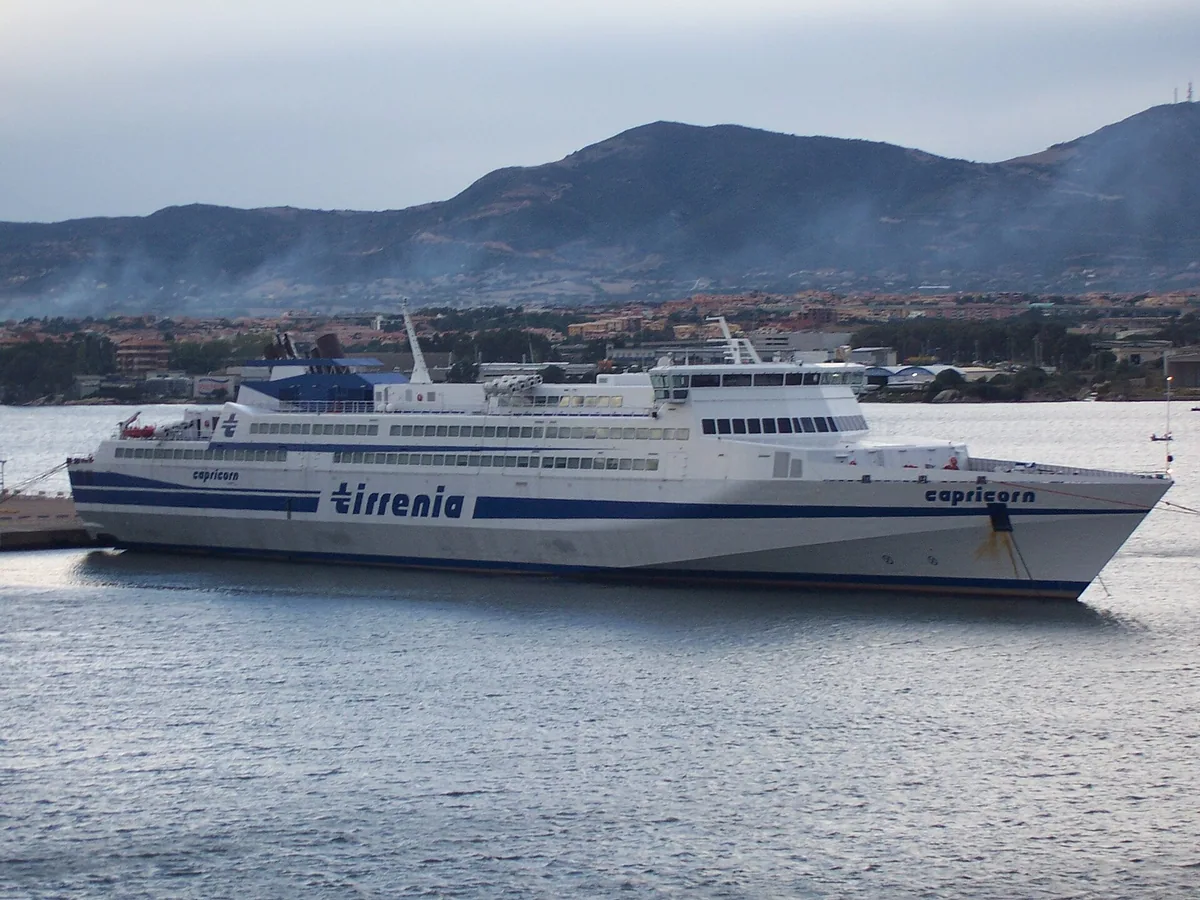
 (c) Cap. Eustachio Patalano / Public domain
Ferry vs Flight: Rome (Civitavecchia) to Sardinia (Olbia)
Ask in February and the answer is a plane; ask in July and it is almost certainly a ship. A month-by-month look at Moby, Tirrenia and Grimaldi sailings from Civitavecchia to Olbia — and when the Rome flight quietly takes over.
By Serhat Özçelik, Founder & Editor of Ferry Schedule Hub· Published June 18, 2026· updated July 11, 2026
Sardinia runs on a seasonal clock, and the best way over from the mainland changes with it. Put the Rome-to-Olbia question to a local in February and you will be pointed towards a departure gate; ask again in July, with a car full of beach kit, and the only sensible answer floats. Rather than a single verdict, this route deserves a calendar.
June to September: the ferry at full stretch
High summer is when the crossing earns its keep. Several sailings link Civitavecchia with Olbia each day. In the morning, Moby Lines departs at 08:30 and, on its fastest sailings, makes the run in about seven hours — the quickest option on the water here — with Tirrenia leaving at the same moment and taking around 7h 30m, which is closer to the route's typical crossing time. After dark come the night boats: Grimaldi Lines at 22:45 and Tirrenia at 23:00, both timetabled at about 7h 30m and berthing in the Gulf of Olbia around dawn. Across the summer season Grandi Navi Veloci (GNV) joins the roster too, running its own Civitavecchia–Olbia sailings on selected days from June to September and typically crossing in around eight hours — welcome extra capacity when the August scramble for space is at its worst.
Fares open at €38, but treat that floor as a spring number; August pricing rises steeply and, more importantly, garage space evaporates. Sardinia-bound Italians book their car slots in April and May. If a summer road trip is the plan, the moment to act is months out — live availability sits on the Civitavecchia to Olbia route page.
The night boat, a small Italian institution
There is a rhythm to the 23:00 Tirrenia that generations of Roman families know by heart: finish the working week, drive the coastal motorway north, roll onto the car deck before midnight, take a cabin or a poltrona, and be woken by the tannoy as granite hills rise on either side of the gulf. Disembark at first light and the entire opening day of the holiday is intact — espresso on the Olbia waterfront included. Grimaldi's 22:45 departure works to exactly the same logic.
April–May and October: the shoulder sweet spot
These are the connoisseur's months for going by sea. Ticket prices sit near their annual low, the Tyrrhenian is usually gentle, the vehicle decks have room for a decision made last Tuesday, and Sardinia itself is green, warm and uncrowded. If the ship has ever tempted you in principle, book it for late May and it will show you its best self.
November to March: when the aircraft takes over
Winter thins the timetable and roughens the sea; the mistral can make an off-season crossing memorable in the wrong way. This is the half of the year when flying becomes the default. Rome Fiumicino connects with Olbia's Costa Smeralda airport in about an hour, with ITA Airways joined by low-cost operators; frequencies drop compared with summer, and prices vary by date, so check current fares rather than assuming winter means cheap. Car-free travellers visiting Olbia town or Cagliari-bound connections simply have no reason to sail in January.
What to book, and when: a seasonal checklist
- Booking for August? Reserve the crossing as soon as dates firm up — ideally by late spring. Garage slots go first, then cabins, then everything else. Consider the 08:30 Moby if you would rather trade a night aboard for the quickest daylight run.
- Booking for May, June or October? A few weeks' notice is plenty. This is when the €38 fares actually exist, and when a last-minute change of plan costs least.
- Booking for deep winter? Compare the reduced sailing list against that hour-long flight before defaulting to either; without a vehicle, the aircraft nearly always deserves the booking.
- Travelling with pets or a camper? The ships handle both routinely — declare them at purchase, since deck space for oversized vehicles is finite in ways the airlines never have to think about.
The geography nobody puts on the ticket
Neither mode starts where you think it does. Civitavecchia lies some 80 kilometres up the coast from central Rome — a regional train from Roma Termini or San Pietro takes 45–80 minutes, followed by a shuttle or a longish walk along the harbour front to the embarkation area (mapped on our Civitavecchia port guide). Fiumicino airport is likewise well outside the city. At the Sardinian end the ferry has the clear edge: the Isola Bianca pier is essentially part of Olbia, while the airport requires a short bus or taxi ride in. Whichever way you travel, budget the approach legs honestly.
Day sailing or night sailing, if the ship wins
Summer travellers who settle on the ferry face one last fork. The 08:30 departures suit anyone starting from Rome itself: an early train up the coast, seven hours of Tyrrhenian blue, and Olbia by mid-afternoon with dinner plans intact. The late-evening boats suit drivers arriving from further afield, converting motorway fatigue into a night's rest. Neither is objectively better — but mixing them, day boat out and night boat home, is a quietly excellent pattern that gives you a sea day at the start and a saved hotel night at the end.
Wheels decide it
Strip away the seasonality and one structural fact remains: north-east Sardinia rewards driving. The Costa Smeralda coves, Golfo Aranci, the granite interior around Tempio — none of it is practical by public transport, and hire cars in Olbia grow scarce and expensive exactly when demand peaks. Bringing your own vehicle over on the ship removes that entire problem, luggage limits included. That is why the honest summary of this route reads so simply: flying wins the calendar's cold half and any trip without a car; from the first warm weekend of the season onwards, the ferry is not merely competitive — for most Sardinian holidays it is the point. Plan the far side with our Olbia guide.
On this page
- June to September: the ferry at full stretch
- The night boat, a small Italian institution
- April–May and October: the shoulder sweet spot
- November to March: when the aircraft takes over
- What to book, and when: a seasonal checklist
- The geography nobody puts on the ticket
- Day sailing or night sailing, if the ship wins
- Wheels decide it
Frequently asked questions
How long is the ferry from Civitavecchia to Olbia?
Moby Lines' 08:30 day sailing is quickest, at around 7 hours on its fastest crossings; Tirrenia's morning ship and the overnight departures (Grimaldi 22:45, Tirrenia 23:00) take about 7 hours 30 minutes, which is the more typical duration. Across summer, GNV also runs the route, crossing in roughly 8 hours.
Are there overnight ferries to Olbia?
Yes — Grimaldi Lines leaves Civitavecchia at 22:45 and Tirrenia at 23:00, both arriving in the Gulf of Olbia around dawn, so your first holiday day stays intact.
When are Civitavecchia–Olbia ferries cheapest?
April, May and October. Fares start from 38 euros in these shoulder months, while August brings the year's highest prices and the earliest sell-outs of vehicle space.
How do I get from Rome to Civitavecchia port?
Regional trains run from Roma Termini and San Pietro to Civitavecchia in roughly 45 to 80 minutes; a port shuttle or a longish walk covers the final stretch to the ferry terminal.
Is it worth taking a car on the ferry to Sardinia?
Usually, yes. North-east Sardinia is difficult without a car, Olbia hire cars are scarce and pricey in peak season, and the garage-deck charge lets you arrive with your own fully packed vehicle.
Keep reading