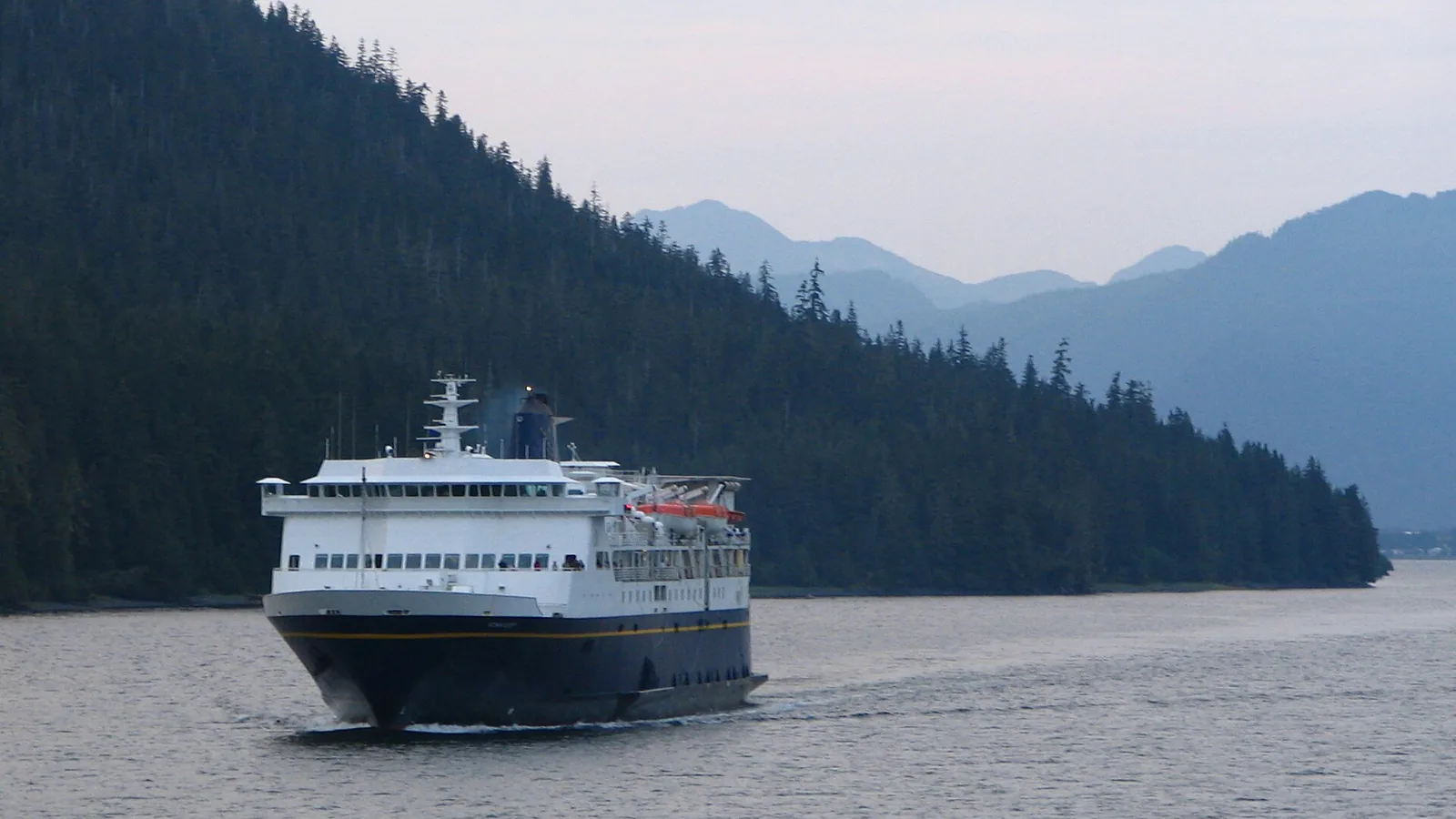
 (c) Photo (c)2006 Derek Ramsey (Ram-Man) / CC BY-SA 2.5
The Alaska Marine Highway: How Alaska's Ferry System Works
The Alaska Marine Highway is a 3,500-mile ferry network and a scenic, affordable alternative to a cruise. Here's how the state ferry works — routes, cabins, vehicles and planning.
By Serhat Özçelik, Founder & Editor of Ferry Schedule Hub· Published July 16, 2026· updated August 2, 2026
Stretching some 3,500 miles from the Pacific Northwest up through the fjords of Southeast Alaska and out along the Aleutian chain, the Alaska Marine Highway is one of the world's great ferry journeys. It's also, famously, one of the more confusing systems to plan — a state-run lifeline first and a tourist route second. Here's how it actually works.
What is the Alaska Marine Highway?
The Alaska Marine Highway System (AMHS) is the state ferry service, and it's exactly what the name says: a marine highway that connects coastal communities with no road access. It links more than 30 ports, from Bellingham in Washington State and Prince Rupert in British Columbia in the south, up through the Inside Passage to Southeast Alaska, and on to the remote Southwest and the Aleutian Islands. It's designated a National Scenic Byway — the only all-water one in the United States.
The network is organised around four regional hubs — Ketchikan, Juneau, Whittier and Homer — and split into three service regions. Southeast covers Bellingham through the Inside Passage as far north as Skagway, and most of its communities get year-round service. Southcentral takes in Prince William Sound and the Kenai Peninsula, with road connections at Valdez, Whittier and Homer. Southwest runs from the Kodiak archipelago along the Alaska Peninsula and out the Aleutians to Dutch Harbor, where winter weather stops service to all but Kodiak, Ouzinkie and Port Lions.
The main routes
AMHS divides its sailings into three types, and the distinction matters more than it sounds: mainline ferries cover thousands of miles with multiple stops and carry cabins, scheduled service routes link a hub to smaller communities, and shuttle routes are short daily hops.
- Mainline (Southeast) — Bellingham → Ketchikan → Wrangell → Petersburg → Juneau, branching to Haines, Skagway and Sitka. Boarding at Bellingham makes it a genuine road-free journey north.
- Scheduled service from Juneau — Angoon, Gustavus, Hoonah, Haines, Kake, Pelican, Tenakee and Skagway.
- Shuttle — Ketchikan → Metlakatla, the shortest hop in the system at 45 minutes.
- Cross-Gulf — the exposed crossing linking Southeast with Southcentral, via Yakutat to Whittier, then Chenega Bay, Kodiak and Homer. Run seasonally by the MV Kennicott.
- Southwest and the Aleutians — Homer → Kodiak → Chignik → Sand Point → King Cove → Cold Bay → False Pass → Akutan → Dutch Harbor, worked by the MV Tustumena. Infrequent, weather-bound and the most remote scheduled ferry service in the United States.
How long each leg takes
AMHS publishes running times per leg, and they are longer than most first-time planners expect — this is a working ferry that calls at small ports, not a fast craft. These are the operator's own sample times:
| Leg | Region | Running time |
|---|---|---|
| Bellingham → Ketchikan | Southeast | 38 hours |
| Ketchikan → Wrangell | Southeast | 6 hours |
| Wrangell → Petersburg | Southeast | 3 h 30 m |
| Petersburg → Juneau | Southeast | 8 hours |
| Ketchikan → Juneau | Southeast | 20 hours |
| Juneau → Sitka | Southeast | 9 h 30 m |
| Juneau → Haines | Southeast | 4 h 30 m |
| Juneau → Hoonah | Southeast | 3 h 30 m |
| Haines → Skagway | Southeast | 1 hour |
| Ketchikan → Metlakatla | Southeast | 45 minutes |
| Whittier → Valdez | Southcentral | 5 h 45 m |
| Whittier → Cordova | Southcentral | 6 h 45 m |
| Whittier → Chenega Bay | Southcentral | 4 h 30 m |
| Homer → Seldovia | Southcentral | 1 h 30 m |
| Homer → Kodiak | Southwest | 9 hours |
| Chenega Bay → Kodiak | Southwest | 14 hours |
| Kodiak → Chignik | Southwest | 18 h 45 m |
| Chignik → Sand Point | Southwest | 9 h 25 m |
| Sand Point → King Cove | Southwest | 6 h 45 m |
| King Cove → Cold Bay | Southwest | 2 hours |
| Cold Bay → False Pass | Southwest | 4 h 25 m |
| False Pass → Akutan | Southwest | 10 h 30 m |
| Akutan → Dutch Harbor | Southwest | 3 h 30 m |
Read down the Southwest column and the scale becomes obvious: Homer to Dutch Harbor is not a day trip but the better part of a week, and the ferry only makes the run a handful of times a year.
Which ship you get — and why it matters
The fleet splits cleanly in two, and the split decides whether you can sleep aboard. The four mainline ferries have cabins; the five day boats and shuttles have none at all, so an overnight leg on one means a reclining chair or the solarium floor.
| Vessel | Type | Built | Passengers | Vehicles* | Cabins | Speed |
|---|---|---|---|---|---|---|
| MV Columbia | Mainline | 1974 | 499 | 133 | 104 (298 berths) | 17.3 kn |
| MV Kennicott | Mainline | 1998 | 450 | 78 / 67 | 109 (320 berths) | 16.75 kn |
| MV Matanuska | Mainline | 1963 | 450 | 83 | 106 (243 berths) | 16.5 kn |
| MV Tustumena | Mainline | 1964 | 160 | 34 | 24 (60 berths) | 13.3 kn |
| MV Hubbard | Day boat | 2019 | 280 | 40 | — | 16.5 kn |
| MV Tazlina | Day boat | 2019 | 280 | 40 | — | 16.5 kn |
| MV Aurora | Day boat | 1977 | 250 | 33 | — | 14.5 kn |
| MV LeConte | Day boat | 1974 | 225 | 33 | — | 14.5 kn |
| MV Lituya | Shuttle | 2004 | 125 | 15 | — | 11.5 kn |
*Approximate number of 20-foot vehicles. AMHS actually sells vehicle space by lane feet — the Columbia carries 2,660 of them — so an RV or a car with a trailer eats several car-equivalents.
Two details worth knowing before you pick a sailing. The Columbia is the largest and fastest ship in the fleet and one of only two with a proper dining room. The Kennicott lists 58 two-berth cabins, but 24 of those are roomettes without private facilities — check which you are booking. And the Tustumena, the Aleutian workhorse, is over sixty years old and carries just 160 passengers, which is why that run sells out so far ahead.
Cabins, or camping on deck
On the longer overnight sailings you have a choice. You can book a cabin — comfortable and worth reserving early — or travel the classic Alaskan budget way: claim a reclining chair, or pitch a tent on the top deck in the heated, glass-walled solarium, where hardy travellers sleep out under the Inside Passage sky. Our guide to overnight ferries, cabins and sleeping aboard explains the options.
Cabin supply is genuinely tight: across the whole fleet there are 343 staterooms, and only four ships have any. If a cabin matters to you, choose the sailing around the ship rather than the other way round.
Bringing a vehicle
You can take a car, camper or RV on the AMHS, which is what makes it such a draw for road-trippers heading north — but vehicle space is limited and books up early, so reserve well ahead. See our guide on taking a car on a ferry.
The practical constraint is the deck, not the ticket: the Lituya has room for roughly fifteen cars, and the day boats for thirty to forty. Book vehicle space the moment the schedule opens, and measure your rig honestly — you pay by length, and an under-declared trailer can be refused at the ramp.
What it costs, and how the fare moves
There is no printed fare table any more. AMHS prices through its Sailing Search tool, and the fare is assembled from separate components — passenger, cabin and vehicle are each priced on their own, by distance. That is why a walk-on fare looks cheap and a car-plus-cabin booking suddenly does not.
Three mechanics catch people out:
- Dynamic pricing. Published fares rise as availability falls, so the same sailing costs more the longer you wait.
- Event pricing. Around certain local events, fares in that port carry a 10% surcharge for four days before and after.
- Change fees escalate. $20 up to two weeks before departure, $50 from two weeks to three days out, and $100 within three days.
Children between 6 and 11 travel at half fare and under-6s go free, which makes the ferry unusually good value for families compared with flying into Southeast Alaska.
How to plan and book
The single most important thing to know is to book early: cabins and vehicle space on the popular summer sailings sell out months in advance. The schedule is seasonal, fullest in summer and pared back in winter, and it's released in blocks, so plan around the sailing dates rather than assuming a daily service.
Know the cut-offs, because they are earlier than most ferry systems. Online booking closes 4 hours before departure at ports with a staffed terminal, and 15 minutes before at unmanned ports. Inside that window you have to call the departing terminal directly. AMHS offers three ways to read the timetable — a month-view Sailing Calendar, a colour-coded grid that shows a whole route at once, and the Sailing Search that doubles as the pricing and booking tool. The grid is the one to learn if you are stringing several legs together.
Seasons and service changes
Summer is the full network; winter is a different system wearing the same name. For the proposed winter 2026/27 schedule, AMHS will not sail to Prince Rupert, will not serve Yakutat, and will not schedule cross-gulf routes at all. Prince Rupert in particular has been off and on for several years over international service requirements and crewing — if a guide tells you to drive up through British Columbia and catch the ferry at Prince Rupert, check the current schedule before committing, because for that winter the connection does not exist.
Crew shortages have also cut mainline Bellingham–Whittier sailings in recent seasons. The lesson is the same either way: verify the specific sailing date rather than trusting the route map.
Four trips people actually take
The system rewards planning backwards from the sailing calendar, so it helps to start from a shape of trip rather than a map. These four cover most of what visitors book — sea time is the sum of AMHS's own published leg times, and excludes port calls, which on a mainline run can add hours.
1. The classic: Bellingham to Skagway
The full Inside Passage under your own steam, no driving through Canada. Bellingham → Ketchikan (38 h) → Wrangell (6 h) → Petersburg (3 h 30 m) → Juneau (8 h) → Haines (4 h 30 m) → Skagway (1 h): roughly 61 hours at sea, before port time. This is mainline territory — Columbia, Kennicott or Matanuska — so cabins exist, and on a leg this long you want one. Done as a single through-booking it is about three days; broken into stopovers it becomes a two-week trip, which is how most people do it.
2. A week around Juneau
Base yourself in the capital and use the day boats: Juneau → Sitka (9 h 30 m), Juneau → Hoonah (3 h 30 m), Juneau → Haines (4 h 30 m), Haines → Skagway (1 h). The catch is the fleet — these runs are worked by day boats with no cabins at all, so plan them as daylight hops with hotel nights ashore, not as sleeper legs. Sitka is the one that justifies itself twice over: nine and a half hours each way, but it is the only Southeast town facing the open Pacific.
3. Cross-Gulf: Southeast into Southcentral
The route that turns a ferry trip into a loop — Ketchikan → Juneau (20 h), on across the Gulf of Alaska to Whittier, then Whittier → Valdez (5 h 45 m) or Whittier → Cordova (6 h 45 m), with Whittier an hour and a half by road from Anchorage. It is worked seasonally by the MV Kennicott, the only ship rated for the open-water crossing. Check the schedule first: cross-gulf sailings are not scheduled at all under the proposed winter 2026/27 timetable, and crew shortages have cut them in recent summers too.
4. The long one: Homer to Dutch Harbor
The Aleutian run is the most remote scheduled ferry service in the United States and it is a genuine expedition: Homer → Kodiak (9 h) → Chignik (18 h 45 m) → Sand Point (9 h 25 m) → King Cove (6 h 45 m) → Cold Bay (2 h) → False Pass (4 h 25 m) → Akutan (10 h 30 m) → Dutch Harbor (3 h 30 m). That is about 64 hours of sea time one way — the better part of three days — aboard the MV Tustumena, built in 1964 and carrying just 160 passengers with 24 cabins. It sails a handful of times a year, weather turns it back regularly, and it sells out further ahead than anything else in the fleet.
If you only want a taste, the two shortest legs in the system make honest half-day trips: Ketchikan → Metlakatla in 45 minutes, and Homer → Seldovia in 1 hour 30 minutes.
One planning note that applies to all four: fares are not fixed. Passenger, cabin and vehicle are priced separately by distance, and the published fare rises as the sailing fills, so the cost of an identical itinerary depends heavily on when you book it. Price your exact dates in the operator's Sailing Search rather than budgeting from any published sample.
Ferry vs cruise
Travellers often weigh the Marine Highway against a cruise. The ferry is cheaper, more flexible and far more local: you share the deck with Alaskans and their pickups, you can stop off and stay in towns along the way, and you build your own itinerary rather than following a fixed loop. What you trade away is the cruise-ship comfort and entertainment. For an independent traveller who wants the real coast, it's hard to beat.
The other difference is arrival. Cruise ships tie up at purpose-built docks; the ferry lands you at the town's working terminal, sometimes several miles out, occasionally at an hour of the night nobody would choose. Budget for that last mile — in the smaller Southeast communities there is no taxi rank waiting.
Frequently asked questions
What is the Alaska Marine Highway?
The Alaska Marine Highway System (AMHS) is Alaska's state-run ferry network, covering about 3,500 miles of coastline and serving more than 30 communities from Bellingham, Washington to Dutch Harbor in the Aleutian Islands. It is a public transport lifeline for towns with no road access, and the only all-water route designated a US National Scenic Byway.
How long does the ferry take from Bellingham to Ketchikan?
About 38 hours. It is the longest single leg in the system and the standard way to reach Southeast Alaska without driving through Canada. Onward from Ketchikan, allow 6 hours to Wrangell, 20 hours to Juneau, and 9 hours 30 minutes from Juneau to Sitka.
Which Alaska ferries have cabins?
Only the four mainline ships: the Columbia (104 staterooms), Kennicott (109), Matanuska (106) and Tustumena (24). The day boats and shuttles — Hubbard, Tazlina, Aurora, LeConte and Lituya — have no cabins at all, so an overnight leg on one means a reclining chair or the solarium.
Do I need a cabin, or can I sleep on deck?
You can sleep in a reclining lounge chair or pitch a tent in the heated glass solarium on the top deck, which is a long-standing Alaskan travel tradition and costs nothing extra. Cabins are limited — 343 across the whole fleet — so book one early if you want it.
Can I bring a car or RV on the Alaska ferry?
Yes, and it is one of the main reasons people use the system. Vehicle space is sold by lane feet rather than per car, so RVs and trailers take several car-equivalents. Capacity is tight — the Lituya holds roughly fifteen cars — and vehicle space sells out well before passenger space.
Does the Alaska ferry still go to Prince Rupert, BC?
Not under the proposed winter 2026/27 schedule — AMHS will not be sailing to Prince Rupert. The connection has been suspended repeatedly in recent years over international service requirements and crewing shortages, so check the current schedule before planning a route through British Columbia.
When should I book the Alaska Marine Highway?
As early as the schedule opens for your dates. Cabins and vehicle space on summer sailings sell out months ahead, fares rise dynamically as availability drops, and change fees escalate from $20 to $100 as departure approaches. Online booking closes 4 hours before departure at staffed terminals and 15 minutes before at unmanned ports.
Is the Alaska ferry cheaper than a cruise?
Substantially, especially for walk-on passengers — and children 6 to 11 travel at half fare with under-6s free. The trade-off is that fares are built from separate passenger, cabin and vehicle components, so a car-plus-cabin booking closes the gap. You also get no cruise entertainment, but you can stop off in towns and build your own route.
Keep reading