Central Visayas · Philippines
Siquijor
There is no bridge and no jet airport on Siquijor, so every visitor arrives by sea. The overwhelming majority route through Dumaguete on Negros, a short fast-ferry hop of roughly 40 to 60 minutes with several daily sailings from operators like OceanJet, Aleson Shipping and Montenegro Lines. Longer fastcraft runs also connect from Cebu (about 4+ hours) and Tagbilaran on Bohol. The reward is the Philippines' mystic island: turquoise waterfalls, cliff-jump beaches, folk-healing lore and a stillness the busier islands lost long ago.
Getting to Siquijor by ferry
Direct crossings serving Siquijor — open one for its full timetable.
Siquijor to Cebu
- Fastest crossing
- 4h 20m
- Operators
- 1 operator
See schedule
Siquijor to Dumaguete
- Fastest crossing
- 45m
- Operators
- 1 operator
See schedule
Siquijor to Tagbilaran
- Fastest crossing
- 2h
- Operators
- 1 operator
See schedule
Siquijor ferry crossings at a glance
| Route | Crossing | Sailings | Operators | Country |
|---|---|---|---|---|
| Siquijor → Dumaguete | 45m | 6 / wk | 1 | Philippines |
| Siquijor → Tagbilaran | 2h | 2 / wk | 1 | Philippines |
| Siquijor → Cebu | 4h 20m | 2 / wk | 1 | Philippines |
Why almost everyone routes through Dumaguete
Siquijor is a compact island province with no commercial airport, so the practical question is never which flight but which port you cross from. For the vast majority of travellers the answer is Dumaguete, the capital of Negros Oriental and the closest mainland gateway.
Dumaguete is reached first by air into Sibulan (Dumaguete) Airport, which takes domestic flights from Manila and Cebu, or overland and by ferry from elsewhere on Negros, Cebu and Bohol. From the airport the seaport is only a 7 to 10 minute ride away; a tricycle runs roughly ₱50 if you flag one on the national highway, more if you book one inside the terminal. That short airport-to-pier hop is what makes Dumaguete so convenient: you can land, transfer and be on a boat within the hour. From there, the Dumaguete to Siquijor fast ferry is the workhorse crossing that carries most visitors onto the island.
The Dumaguete crossing: your workhorse route
This is the shortest and busiest way onto the island, covering roughly 35 to 46 km of open water. On a fast craft the trip takes about 40 to 60 minutes; on a slower RORO ferry it can stretch closer to 1.5 to 2 hours.
Several operators share the route, which is good news for frequency:
- OceanJet — the quickest option, a fastcraft carrying foot passengers only. As of 2026 its Dumaguete departures typically run around 7:20 AM, 11:00 AM, 1:00 PM and 7:10 PM, with fares in the region of ₱450 to ₱750 depending on tourist or business class.
- Aleson Shipping — a RORO vessel taking both vehicles and foot passengers, cheaper (from around ₱260) but slower.
- Montenegro Lines, HS Star Marine (“Anika Star”) and Super Shuttle Ferry also serve the route, spreading sailings across the day.
Between the operators there are well over a dozen crossings daily, with first departures from around 5:00 to 6:30 AM and the last in the early evening. The return leg, the Siquijor to Dumaguete ferry, follows a mirrored timetable — OceanJet return sailings typically leave Siquijor around 6:00 AM, 10:00 AM, 12:00 PM and 6:00 PM. Always treat published times as a guide and reconfirm the day before, because schedules shift without notice.
Coming from Cebu or Bohol instead
If you are already island-hopping the Visayas, you do not have to backtrack to Dumaguete. Two longer fastcraft routes reach Siquijor directly.
From Cebu City, OceanJet runs a daily fastcraft that calls at Tagbilaran (Bohol) en route, so the full Cebu to Siquijor ferry takes about 4 hours 20 minutes including the roughly 20-minute Tagbilaran stop. First departure from Cebu is around 5:10 AM and the last near 1:00 PM, with fares roughly ₱1,600 to ₱2,400. It carries foot passengers only.
From Bohol, the Tagbilaran leg on its own is far shorter — around 2 hours by OceanJet. The Siquijor to Tagbilaran ferry and its reverse run only a couple of times a day (a Siquijor departure near 8:20 AM and a Tagbilaran departure near 3:20 PM are typical), with 2026 fares around ₱880 tourist and ₱1,320 business. Because frequency is thin, these routes reward planning: pair Siquijor with a few days on Bohol rather than trying to thread a tight same-day connection.
Two ports, one island: Siquijor Town vs Larena
Here is a detail that trips up first-timers: Siquijor has two working seaports, and which one your ferry uses affects your onward transfer.
- Siquijor Town Port sits on the island's central-west coast and is the closest port to San Juan, where most beach resorts and guesthouses cluster. Most fast ferries — including the main Dumaguete OceanJet sailings — dock here, which saves you both time and tricycle money.
- Larena Port, a little north, is the island's busier commercial harbour, handling many of the longer routes to Cebu, Mindanao and Bohol as well as some Anika Star trips. It is farther from the San Juan strip, so a tricycle transfer costs more — fares between towns are informally set around ₱250.
Before you book, check which port your specific sailing uses so you are not surprised on arrival. If you have a choice and you're staying in San Juan, a boat into Siquijor Town Port is the more convenient landing.
The last-sailing rule: why day trips bite back
Siquijor is close enough to Dumaguete that day-tripping looks tempting on paper. In practice it is the single most common way to get stranded. Two things conspire against you: the last return sailing is early (the final OceanJet Siquijor-to-Dumaguete boat typically leaves around 6:00 PM), and the island is bigger than it looks — the marquee sights are scattered along a coastal loop that takes real time to drive.
Land on the mid-morning boat and you will spend more of your day travelling than swimming, and if an afternoon squall cancels the last crossing, a “day trip” becomes an unplanned overnight. The honest advice from nearly every island guide is the same: give Siquijor at least one or two nights. If your schedule truly only allows a day, take the earliest outbound ferry and build your return around the second-to-last sailing, never the last one.
Booking, fares and terminal fees without surprises
You can buy tickets three ways: at the pier ticket windows, through the operators' own channels, or via online aggregators such as 12Go, Klook, Bookaway and Ferryscanner. Counter tickets are usually a few pesos cheaper, but online booking locks in your seat on popular sailings and spares you a queue.
A few practical rules that catch people out:
- Buy early. OceanJet tickets should be purchased at least an hour before departure, and check-in closes 30 minutes before the boat leaves. During peak season (roughly December to February, plus Holy Week) reserve one or two days ahead.
- Budget for a separate terminal fee. On top of the fare, a small pier/terminal fee — generally in the ₱15 to ₱30 range — is collected at the port and must be paid before boarding. Keep a little cash handy.
- Carry ID and confirm the class. Tourist/open-air seating is cheapest; air-conditioned business class costs more but is worth it on the longer Cebu and Bohol runs.
Print or screenshot your booking, and note the exact port name on the ticket so you head to the right harbour.
When the sea says no: weather and cancellations
These crossings are open-water and small-craft, so sea conditions rule the timetable. During the southwest monsoon (roughly June to September) the channel between Dumaguete and Siquijor can turn rough, and the coast guard may suspend fastcraft sailings at short notice when swells build. Cancellations tend to cascade through the day rather than affect a single trip.
Two habits keep this from wrecking a trip. First, never plan a zero-slack connection — if you have an onward flight out of Dumaguete or Cebu, cross the day before rather than counting on the morning boat. Second, favour the dry season: roughly November to April brings calmer seas, more reliable sailings and Siquijor's best weather for waterfalls and beaches. If a sailing is scrubbed, operators usually rebook you onto the next available boat; keep your ticket and stay near the terminal for updates.
What you came for: the mystic island
Siquijor's reputation as the Philippines' mystic (or “healing”) island is half its charm — it is still known for traditional folk healers, potion-makers and the folklore that once made mainland Filipinos wary of visiting. Today that mystique sits alongside some of the cleanest, quietest coastline in the Visayas. Once you land, the highlights form an easy coastal loop, best explored by rented scooter or hired tricycle:
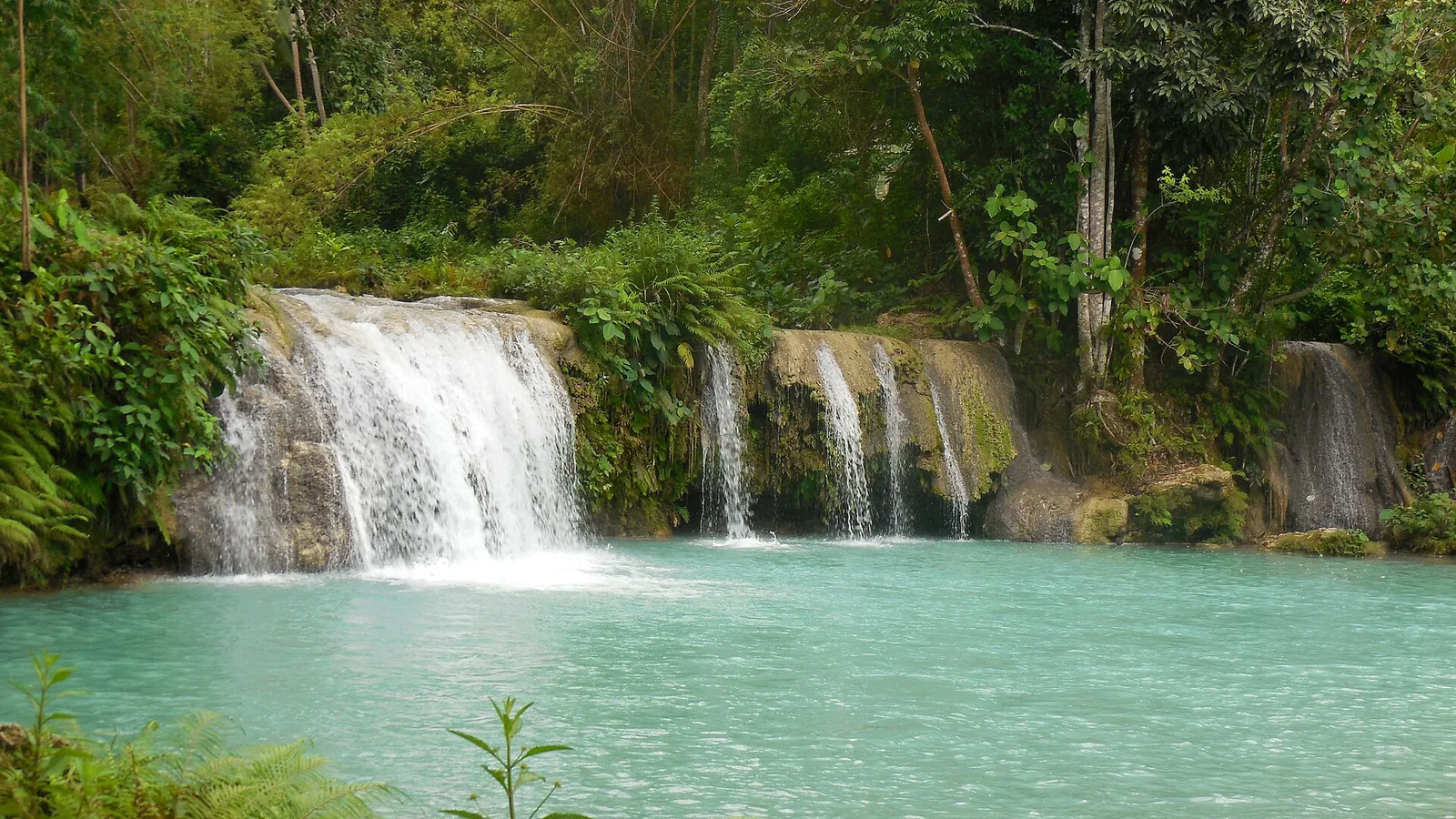
- Cambugahay Falls near Lazi — a three-tier, turquoise spring-fed cascade with a famous rope swing over natural pools. Entry is a token ₱20 with a small extra fee for the swing or bamboo raft; arrive at the 7 AM opening to beat the crowds.
- Salagdoong Beach in Maria — a clean public cove on the eastern tip with concrete diving platforms for cliff jumping into clear water.
- The old balete tree and its enchanted spring, plus the quiet white-sand beaches strung along San Juan, the island's low-key accommodation hub.
The best window for all of it is the November-to-April dry season — conveniently the same months when the ferry crossings are at their calmest.
Siquijor ferry & travel FAQ
What is the main ferry gateway to Siquijor?
Dumaguete, on Negros Oriental. It has the closest port and the most frequent sailings — a fast ferry of roughly 40 to 60 minutes. Dumaguete is reached by air into Sibulan Airport (flights from Manila and Cebu) or overland, and the airport is only about 7 to 10 minutes from the seaport.
How long is the ferry from Dumaguete to Siquijor?
About 40 to 60 minutes on an OceanJet fast craft, or closer to 1.5 to 2 hours on a slower RORO ferry such as Aleson Shipping or Montenegro Lines. The crossing covers roughly 35 to 46 km of open water.
Which operators run the Dumaguete to Siquijor route?
As of 2026, OceanJet (the fastest, foot passengers only), Aleson Shipping (RORO, carries vehicles), Montenegro Lines, HS Star Marine's “Anika Star” and Super Shuttle Ferry all serve the route, giving well over a dozen crossings a day.
Can I reach Siquijor directly from Cebu or Bohol?
Yes. OceanJet runs a daily fastcraft from Cebu City that calls at Tagbilaran (Bohol) en route, taking about 4 hours 20 minutes in total. The Tagbilaran-to-Siquijor leg on its own is about 2 hours but runs only a couple of times a day, so plan connections carefully.
Which port should I arrive at in Siquijor?
Siquijor has two ports. Siquijor Town Port is central and closest to the San Juan resort area, and most fast ferries dock there. Larena Port, a little north, handles many longer routes but is farther from the beaches, meaning a longer, pricier tricycle transfer. Check which port your specific sailing uses.
Is a day trip to Siquijor from Dumaguete a good idea?
It is risky. The last return ferry leaves early (around 6:00 PM), the sights are spread around a coastal loop, and an afternoon cancellation can strand you overnight. Most guides suggest staying at least one or two nights; if you must day-trip, take the earliest boat out and aim for the second-to-last sailing back.
Are there terminal fees on top of the ferry ticket?
Yes. A separate pier/terminal fee, generally around ₱15 to ₱30, is collected at the port before boarding and is not included in your ticket. Keep a little cash on hand for it at both Dumaguete and Siquijor.
When is the best time to take the ferry to Siquijor?
The dry season, roughly November to April, brings the calmest seas and most reliable sailings. During the southwest monsoon (about June to September) the channel can turn rough and fastcraft trips may be suspended at short notice.
More Central Visayas destinations
Reviewed by Serhat Özçelik, Founder & Editor of Ferry Schedule Hub · Last updated July 13, 2026.