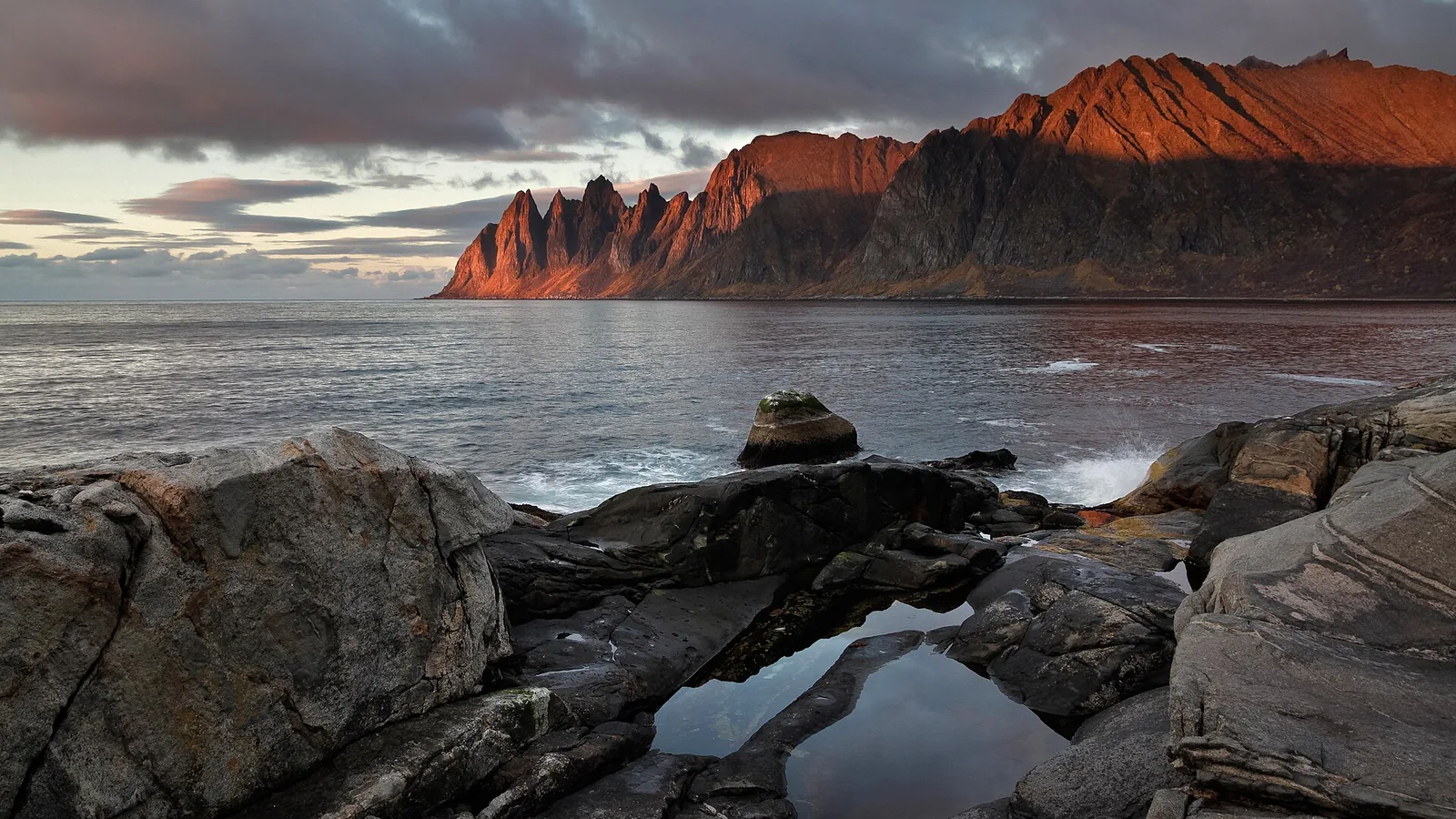
Troms · Norway
Senja
Norway's second-largest island has one road worth driving, two ways in by sea, and a booking system for neither of them that works the way you expect. The famous crossing from Andenes cannot be reserved — you queue for it. The express boat from Tromsø can be reserved, and from February 2026 it effectively must be. Getting to Senja is a scheduling exercise before it is a scenic one.
Two ways in by water, and they behave differently
- Car ferry from Andenes to Gryllefjord — about 100 minutes, three departures a day in peak season, roughly mid-May to late September. No booking possible. You pay driving on.
- Express boat from Tromsø — foot passengers only, either to Finnsnes on the mainland side in about 1 h 20 m, or on the Mondays-Wednesdays-Fridays route to Lysnes on Senja itself in around 40 minutes.
The first is for drivers and rewards early arrival. The second is for travellers without a car and rewards a ticket bought in advance.
⚠ The queue is the ticket
On the Gryllefjord crossing there is no reservation, no priority and no standby list — only the order in which vehicles arrive. In July the practical advice is two to three hours early, and drivers do sleep in the line.
With three sailings a day and a last departure at 17:00, this single fact should shape your route. Plan the Senja–Vesterålen leg as a half-day with slack in it, not as a two-hour transfer between two evenings' accommodation.
The 2026 rule change on the express boats
From 1 February 2026 a seat guarantee applies across the Troms express boat network: to be sure of a place on a specific departure, you buy the ticket in advance rather than turning up.
That is new, and older guides do not mention it. If you are reaching Senja by hurtigbåt from Tromsø, book the specific sailing.
Segla, and what the hike actually involves
The vertical fin above Fjordgård is the image Senja sells itself on. The walk is roughly two hours up on a steep but marked path, and the exposed final section is not for anyone uncertain about heights.
Go early. Parking at the trailhead is limited and fills, and the ridge is a poor place to be in wind or wet rock. This is a hike rather than a viewpoint you drive to.
The road that is the point
The Nasjonal turistveg along the outer coast strings together Tungeneset, Bergsbotn and Husøy, with engineered viewing platforms at each. It is slow — single lane in places, with passing bays — and it is the reason to be here.
Husøy in particular is a fishing village on its own islet in the middle of a fjord, connected by a causeway, with more boats than houses. It is a detour and it is worth it.
Lofoten without the crowds, honestly assessed
The comparison is fair on scenery and misleading on infrastructure. Senja has fewer hotels, fewer restaurants, thinner mobile coverage in the fjords and one main road that takes far longer than the distance suggests.
If you want dramatic coast without queues at every viewpoint, it delivers. If you want to arrive without a plan and improvise, Lofoten is the more forgiving island.
Motorhomes and the ferry
Senja is popular with camper vans and the Gryllefjord ferry takes them, but they occupy the space of two cars and there is still no way to reserve. In peak weeks that combination is the single most common reason people miss the boat.
If you are driving something long, treat the first departure of the day as the target and everything after it as a fallback.
Season
The Andenes crossing runs roughly 13 May to 27 September and nothing replaces it outside those dates. The Tromsø express boats run year round, which makes them the winter route in.
June to mid-September is the window for the full island. Outside it Senja is still reachable — by road from the mainland at Finnsnes, or by hurtigbåt — but the loop through Vesterålen is closed.
Senja ferry & travel FAQ
How do I get to Senja?
By car ferry from Andenes to Gryllefjord, about 100 minutes with three departures a day in peak season; by express boat from Tromsø to Finnsnes in about 1 hour 20 minutes; or by road from the mainland at Finnsnes.
Can I book the Andenes–Gryllefjord ferry?
No. There is no reservation system — places go in queue order and you pay as you drive on. In July arrive two to three hours before departure.
Do I need to book the Tromsø express boat?
From 1 February 2026 a seat guarantee applies across the Troms express boat network, so buy a ticket for the specific departure rather than turning up. Older guides do not mention this.
How long does the Andenes ferry take?
About 100 minutes. It runs roughly 13 May to 27 September, with the first departure at 08:45 and the last at 17:00 in peak season.
How hard is the Segla hike?
Roughly two hours up on a steep but marked path from Fjordgård, with an exposed final section that is not for anyone uncertain about heights. Trailhead parking is limited and fills early.
Is Senja really Lofoten without the crowds?
On scenery, broadly yes. On infrastructure, no — fewer hotels and restaurants, thinner mobile coverage in the fjords, and one slow main road. Lofoten is the more forgiving island if you want to improvise.
Can I take a motorhome on the Senja ferry?
Yes, but a camper takes the space of two cars and there is still no way to reserve. Target the first departure of the day and treat later ones as fallbacks.
Can I visit Senja in winter?
Yes, by road from Finnsnes or by express boat from Tromsø, both of which run year round. The Andenes ferry does not, so the loop through Vesterålen is closed outside the season.
More Troms destinations
Reviewed by Serhat Özçelik, Founder & Editor of Ferry Schedule Hub · Last updated August 8, 2026.