Møre og Romsdal · Norway
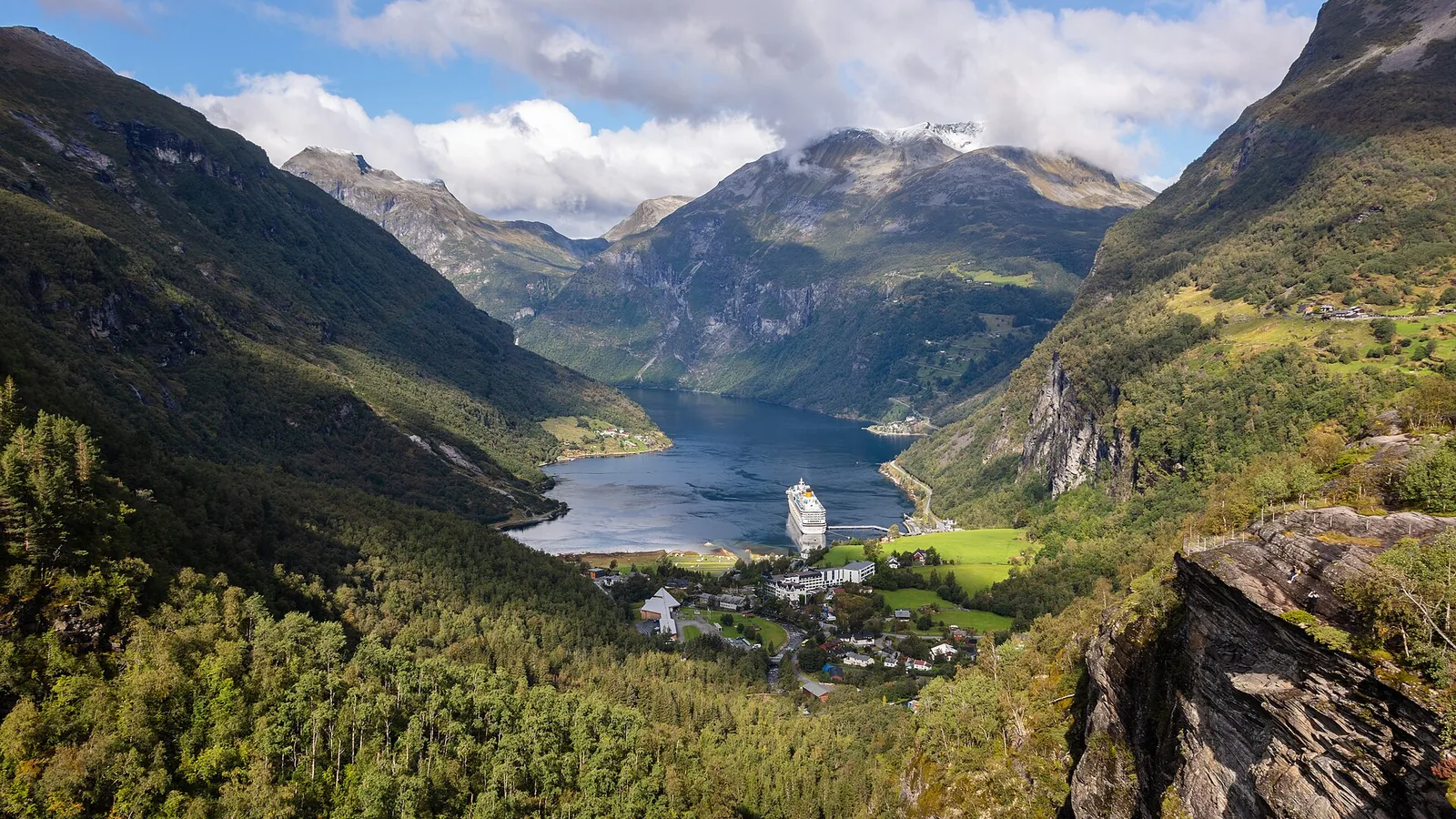
Geirangerfjord
Most ferries in this guide are a way of getting somewhere. The one between Geiranger and Hellesylt is the thing you came for. It runs sixty-five minutes down a UNESCO-listed fjord past the Seven Sisters waterfall and the abandoned cliff farms, it goes more than thirty times in our timetable, and it is priced as public transport because that is what it is.
The crossing is the sightseeing
Hellesylt to Geiranger and the return leg carry 33 and 34 sailings respectively in our timetable, at about 65 minutes. The route runs the length of the Geirangerfjord — the waterfalls, the sheer walls, the farms perched where no farm should be.
It is served both as a county car ferry and by sightseeing operators, which means you can do the same water on a scheduled crossing with your car on board, or on a tourist sailing with commentary. The view does not change.
⚠ You do not need a cruise ship for this
Geiranger is a major cruise call and most published accounts of the fjord are written from a ship's rail. That obscures a simple fact: the public ferry covers the same fjord, several times a day, for a fraction of the price and with no need to book a fortnight of holiday around it.
The practical version is a one-way crossing built into a driving route — arrive at one end, sail, drive out the other. You are not doubling back and you are not paying for a berth.
It is one leg of a road, not a destination in itself
Hellesylt and Geiranger are both tiny. The ferry exists because the road between them is impossible — the fjord is in the way — so the boat is the road.
Above Geiranger the Ørnevegen eagle road climbs in eleven hairpins to a viewpoint over the fjord; above Hellesylt the road runs on toward Stryn and the glaciers. Plan the ferry as the middle of a day's drive rather than as an outing from a base.
The other way in: the coastal ships
Hurtigruten appears in our timetable on longer runs — Geiranger to Ålesund at roughly 4 h 15 m, and a shorter link to Urke at about an hour.
These are seasonal coastal sailings rather than the fjord shuttle, and they are the option if you are arriving from the coast without a car. Ålesund is the nearest town of any size and the nearest airport.
Cars, and whether to bring one
Bring one. This is the opposite of the Greek and Croatian islands elsewhere in this guide: the fjord country is only navigable by road, distances are long, public transport between villages is sparse, and the ferry is designed around vehicles.
Book the crossing in advance in July and August. The sailings are frequent but the deck space is finite and the queue at Hellesylt in high summer is real.
Weather decides what you see
The fjord is spectacular in sun and merely grey in low cloud, and the difference is total. Waterfall volume also swings enormously — the Seven Sisters are at their fullest with the snowmelt in late spring and can thin markedly by late summer.
If your schedule allows a choice of day, take the clear one. Nothing else about this trip matters as much.
Where the fjord sits in a longer route
Geiranger is usually done as part of a loop through western Norway: Ålesund on the coast, the Trollstigen road to the north, Stryn and the Jostedalsbreen glacier to the south. The ferry stitches the middle of that together.
Two nights in the area is enough to see the fjord properly without turning the drive into a marathon. One night works if you accept that you will spend most of it driving.
Season
This is a summer route in practice. The Hellesylt–Geiranger service runs from spring into autumn, thickening through the peak, and the mountain roads that make the drive worthwhile — Ørnevegen, Trollstigen, the passes toward Stryn — are themselves closed by snow for much of the year.
Late May through September is the window. Outside it, the fjord is still there but the way in is not.
Geirangerfjord ferry & travel FAQ
How long is the Geiranger to Hellesylt ferry?
About 65 minutes each way, with more than thirty sailings in our timetable in each direction. The crossing runs the length of the Geirangerfjord.
Do I need a cruise ship to see Geirangerfjord?
No. The public car ferry between Hellesylt and Geiranger covers the same fjord several times a day, at public-transport prices, and can be built into a driving route as a one-way leg.
Should I bring a car to Geiranger?
Yes. Unlike the island destinations in this guide, fjord country is only navigable by road — distances are long and village-to-village transport is sparse. Book the crossing ahead in July and August.
What else can I reach by boat from Geiranger?
Hurtigruten runs seasonal coastal sailings — about 4 hours 15 minutes to Ålesund, and roughly an hour to Urke. Ålesund is the nearest town of any size and the nearest airport.
What is there to see on the crossing?
The Seven Sisters waterfall, the sheer fjord walls, and the abandoned farms built on ledges high above the water. Waterfall volume peaks with the late-spring snowmelt.
Is Geiranger worth staying overnight?
Two nights in the area lets you see the fjord and drive the mountain roads — Ørnevegen above Geiranger, Trollstigen to the north, Stryn to the south — without rushing.
When does the Geiranger ferry run?
In practice it is a summer route, running from spring into autumn. The mountain roads that make the drive worthwhile are closed by snow for much of the year, so late May to September is the window.
Does the weather matter?
More than anywhere else in this guide. The fjord is spectacular in sun and grey in low cloud. If you can choose your day, take the clear one.
Reviewed by Serhat Özçelik, Founder & Editor of Ferry Schedule Hub · Last updated August 8, 2026.